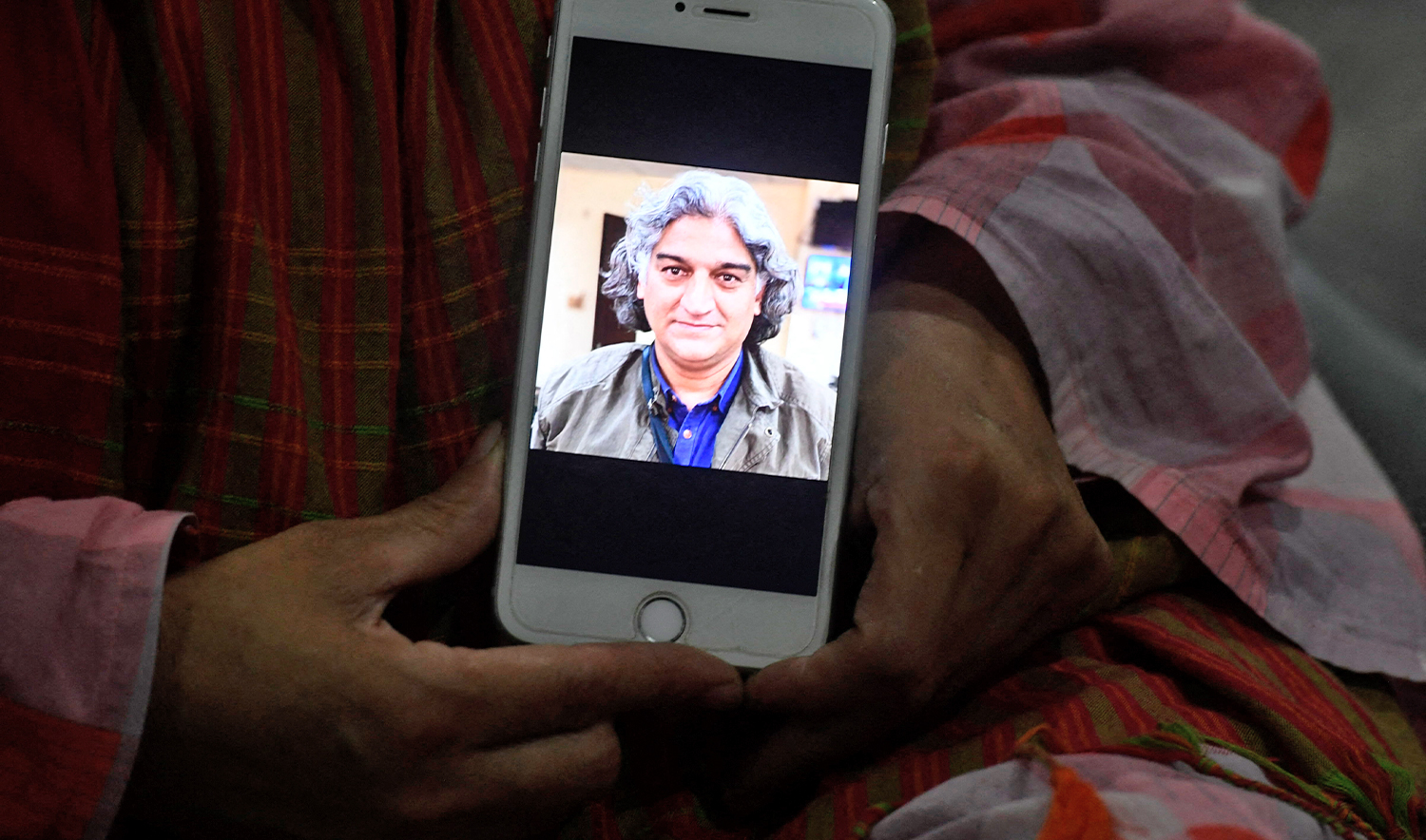
- Matiullah Jan, remanded in Islamabad Police custody for two days, describes charges as “fabricated”
- Complaint says Jan, under influence of narcotics, attacked police constable at Islamabad checkpoint
ISLAMABAD: Pakistani journalist Matiullah Jan, critical of authorities’ handling of recent anti-government protests, was booked in a terrorism and narcotics case and remanded to Islamabad Police’s custody for two days on Thursday after his son said he was “picked up” from outside a hospital in the federal capital a day earlier.
Police booked Jan in a case on charges that he was found in possession of 246 grams of narcotic methamphetamine (crystal meth) when his vehicle was stopped at the capital’s E-9 area. The police registered a complaint against him under multiple sections of the law, including Section 9 (2) 4 of the Control of Narcotic Substances Act (CNSA) 1997, which specifies the punishment for possessing or trafficking “more than 100g and up to 500g” of psychotropic substance.
The disappearance of Jan, known for his outspoken reporting and criticism of the all-powerful military, comes after he published reports on his YouTube channel that a paramilitary officer killed during recent opposition protests had been run over by the force’s own vehicle.
Police produced the journalist in an Anti-Terrorism Court in Islamabad, seeking his physical remand for the investigation. During the hearing, public prosecutor Raja Naveed sought a 30-day physical remand of the journalist for investigation, which was limited to two days by the judge, Tahir Abbas Sipra.
“This is all fake, funny and fabricated. I don’t even smoke cigarettes,” Jan told a journalist as he was brought to the court by police officers.
“And we are not afraid of you [state]. We will keep our work going. This is highly irresponsible and the integrity of all institutions is being destroyed.”
The police complaint against Jan said a shopping bag containing crystal meth was recovered under his car’s driving seat after a search. It further said Jan was found under the influence of narcotics.
“The substance was weighed on an electronic scale and a sample of one gram was taken from the 246 grams for chemical examination,” the complaint read.
Section 7 of the Anti-Terrorism Act 1997, 279 (rash driving or riding on a public way), 411 (dishonestly receiving stolen property), 382 (theft after preparation made for causing death, hurt or restraint), 506 ii (threat to cause death or grievous hurt), 427 (mischief causing damage to the amount of Rs50), 353 (assault or criminal force to deter public servant from discharge of his duty) and 186 (obstructing public servant) of the Pakistan Penal Code were also included in the complaint.
According to the complaint, police signaled to the driver to stop a rapidly moving vehicle at a checkpoint at E-9 when the driver “stepped out of the car and attacked a police constable, then snatched his rifle and pointed it back at the cop.”
The complaint said that upon inquiry, the driver identified himself as Matiullah Jan.
In recent years, journalists in Pakistan have complained of increasing government and military censorship, intimidation and harassment as well as digital abuse. Authorities deny they persecute journalists. This has been an especially dangerous year for the press in Pakistan, with at least six journalists killed in direct or suspected relation to their work, the Committee to Protect Journalists said last month.
Abdul Razzaq, Jan’s son, termed the charges against his father as “frivolous and baseless,” vowing to fight them legally in a court of law.
“My father is a professional journalist and he is duty-bound to report facts, and this is what he was doing,” Razzaq told Arab News. “He just loves his job and keeps doing his professional work without any fear or favor.”
He also described Jan’s arrest as a “direct attack” on the freedom of the press and freedom of speech in the country.
“We have faced such challenges before and are ready to fight this bogus case too,” he added.
The Committee to Protect Journalists, an international non-governmental organization dedicated to protect journalists and their right to freedom of expression, expressed alarm over Jan’s predicament.
“CPJ expresses grave alarm over reports of the abduction of journalist Matiullah Jan in the capital Islamabad following his coverage of protests by supporters of imprisoned former Prime Minister Imran Khan. Authorities must ensure Jan’s safety and immediate release,” CPJ said on X.
“We call for a swift and impartial investigation into the incident and accountability for all perpetrators.”
The Human Rights Commission of Pakistan also demanded Jan’s “immediate and unconditional release,” saying he had “reportedly been arrested following his coverage of the recent protests in Islamabad.”
Jan was picked up once before in June 2020 but released after about 20 hours. The CPJ said at the time, demanding Jan’s release, that he may have been picked up for sharing anti-state remarks on social media.
Jan has been at the forefront of reporting on protests that began last week by the Pakistan Tehreek-e-Insaf party of jailed former premier Imran Khan. The government says three paramilitary troops and one policeman were killed in violence by protesters, with Jan questioning the circumstances of the deaths in his reporting.