

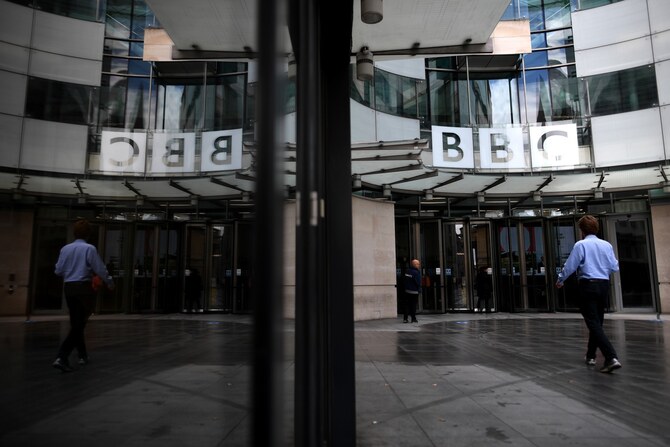
Union chiefs urge BBC staff to wear Palestinian flag colors or keffiyeh during ‘day of action’

Short Url
Updated 27 November 2024
Follow

Union chiefs urge BBC staff to wear Palestinian flag colors or keffiyeh during ‘day of action’

  • Protest on Thursday is a gesture of solidarity in support of demands for a permanent ceasefire in Gaza and the release of all hostages, organizers say
  • Some workers voice concerns that the action violates the broadcaster’s strict guidelines on impartiality and risks upsetting colleagues

LONDON: Britain’s Trades Union Congress has urged BBC staff and workers in other sectors to participate in a “workplace day of action” on Thursday by wearing the colors of the Palestinian flag or a keffiyeh.

Organizers said their call for action is intended as a gesture of solidarity and to support demands for a permanent ceasefire and end to the violence in Gaza, and the release of all hostages.

The TUC, an umbrella organization that represents 5.5 million members of 48 trade unions, suggested that employees “wear something red, green, black, or a Palestinian keffiyeh to visibly show solidarity” in their workplaces.

The National Union of Journalists informed its members of the protest last week and condemned the actions of the Israeli government, which it said have resulted in the deaths of at least 135 Palestinian journalists since the Oct. 7 attacks by Hamas last year.

“The NUJ is urging branches and chapels to show support on the day and amplify the union’s calls,” it said.

However, The Times newspaper reported on Wednesday that the campaign has drawn criticism, particularly from Jewish staff at the BBC who raised concerns that it violates the broadcaster’s strict guidelines on impartiality and risks upsetting colleagues.

A spokesperson for the TUC emphasized the need for sensitivity while participating in the protest.

“The day of action is focused on the TUC’s call for an immediate and permanent ceasefire and the release of all hostages and political prisoners,” the organization said.

“We are advising trade union members to undertake the action respectfully and to discuss with colleagues what action is best suited to their workplace.”


Meta to charge Arab advertisers extra fee for reaching European audiences

Updated 11 March 2026
Follow

Meta to charge Arab advertisers extra fee for reaching European audiences

  • US tech giant told advertisers it will add fees ranging from 2 to 5 percent on image and video ads delivered on its platforms to offset digital service taxes
  • Charges are determined by where the audience is located, not where the advertiser is based

LONDON: Meta will from July 1 impose location-based surcharges on advertisers targeting audiences in six European countries, a move that will directly affect Arab businesses that run campaigns across the continent.

The US tech giant announced it will add fees ranging from 2 to 5 percent on image and video ads delivered on its platforms, including Facebook, Instagram and WhatsApp, to offset digital service taxes imposed by individual governments.

Crucially, the charges are determined by where the audience is located, not where the advertiser is based.

That means Saudi, Emirati, Egyptian or other Arab companies paying to reach consumers in the UK, France or Italy will face the additional costs regardless of their own country’s tax arrangements with Meta.

Fees will apply at 2 percent for ads reaching UK audiences, 3 percent for France, Italy and Spain, and 5 percent for Austria and Turkiye.

“If you deliver $100 in ads to Italy, where there is a 3% location fee, you will be charged $100 (ad delivery), plus $3 (location fee), for $103 total,” the company wrote in an email to an advertiser initially reported by Bloomberg. “Note that any applicable VAT will be calculated on top of the total amount.”

The taxes have been introduced at different points, starting with France in 2019, though not the EU as a bloc.

Many tech companies report substantial sales in Europe and millions of users but pay minimal tax on profits. The goal is to claw back locally derived economic value, Bloomberg reported.

The move follows similar decisions by Google and Amazon, which have also begun passing European digital tax costs on to advertisers.

For Arab brands with growing European footprints, particularly in fashion, travel, hospitality and media, the new fees add another layer of cost to campaigns already subject to currency and targeting complexities.

Digital services taxes, levied as a percentage of revenues earned by major tech platforms in individual countries, have drawn criticism from Washington, which argues they unfairly target US companies.

Meta has been reached for comments.