



ISLAMABAD: Pakistan’s Deputy Prime Minister and Foreign Minister Ishaq Dar said on Thursday that the US and Iran were engaged in indirect talks through Islamabad, reaffirming his country’s commitment to promoting peace and stability in the region.
Dar’s announcement followed amid Pakistan’s intensified diplomatic engagements in the region following joint US and Israeli strikes on Iranian targets last month, which triggered retaliatory attacks and heightened fears of a broader conflict.
Islamabad has been positioning itself as a potential intermediary, with international media reports suggesting that it has been conveying messages between Washington and Tehran since the start of the crisis. Trump envoy Steve Witkoff confirmed in a cabinet meeting on Thursday that Washington had presented a 15-point action list to Iran “that forms the framework for a peace deal” through the Pakistani government.
The statement came as recent media reports claimed that US-Iran talks can take place in Islamabad. So far, there has been no confirmation of such negotiations from the countries involved. Dar referred to media speculation about the peace talks as “unnecessary.”
“In reality, US-Iran indirect talks are taking place through messages being relayed by Pakistan,” the foreign minister wrote.
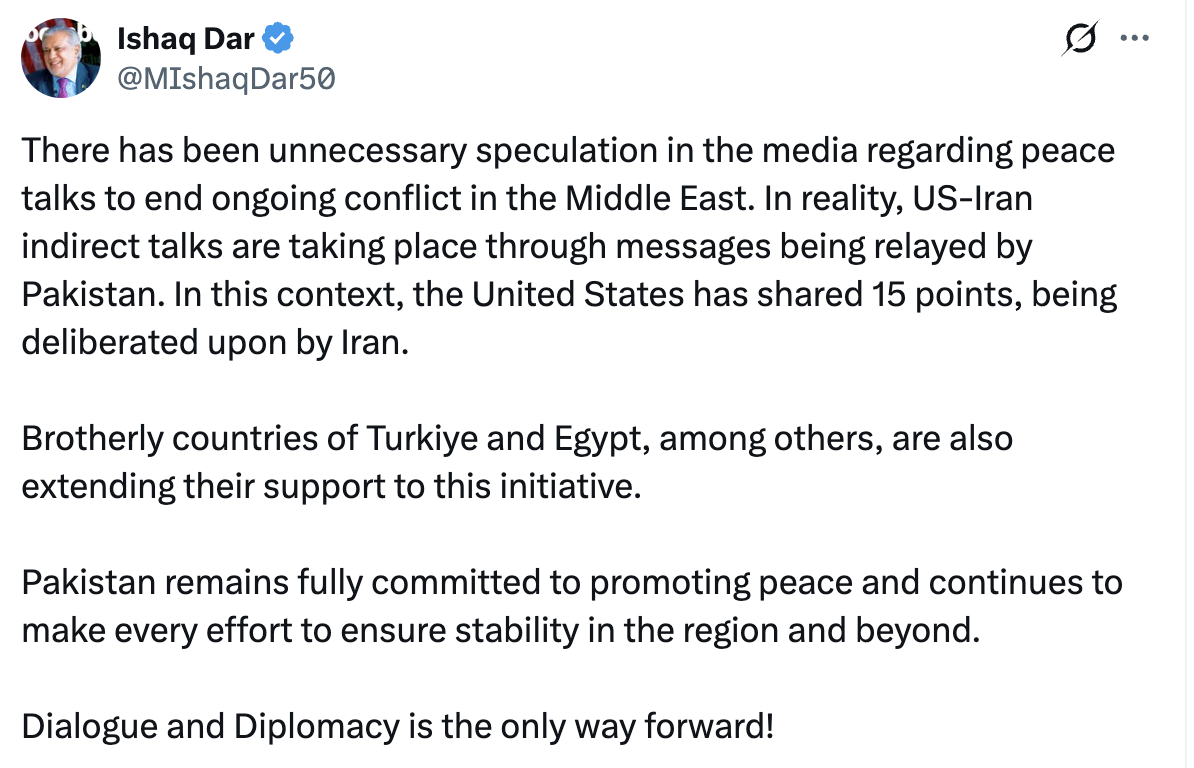
He confirmed that the US has shared 15 points with Iran, which he said were being deliberated by Tehran.
Dar said Türkiye and Egypt, among other countries, are also extending their support for this initiative.
“Pakistan remains fully committed to promoting peace and continues to make every effort to ensure stability in the region and beyond,” he said.
‘DIPLOMACY A PROCESS, NOT EVENT’
Separately, Pakistan’s Foreign Office spokesperson Tahir Andrabi told reporters during a weekly press briefing on Thursday that Islamabad was offering its “good offices” to support a dialogue, including the possibility of hosting and facilitating negotiations between Washington and Tehran. He clarified that this was subject to both parties agreeing to the initiative.
“We have remained actively and constructively engaged with relevant regional stakeholders and beyond our region, consistently advocating for immediate peace, cessation of hostilities and an irreversible path toward a peaceful resolution,” Andrabi said.
He stressed that Pakistan’s role remains focused on promoting a peaceful settlement to the Middle East war and cessation of hostilities. He said Prime Minister Shehbaz Sharif was personally leading diplomatic outreach efforts and maintaining close coordination with regional and international stakeholders.
Addressing reports claiming that senior Iranian Foreign Minister Abbas Araqhchi and Parliamentary Speaker Mohammad-Bagher Ghalibaf were removed from an Israeli target list at Pakistan’s request, Andrabi said he could not confirm the information.
“These remain unconfirmed, unverified and I cannot offer a comment on issues which I don’t have any knowledge [about],” he said.
The spokesperson urged media outlets to exercise restraint, emphasizing that diplomacy— especially during sensitive times— requires discretion and confidentiality.
“Diplomacy is a process, not an event,” he said, adding that no specific timelines or details about potential talks could be shared at this stage. Any concrete developments, he noted, would be communicated in due course of time.
Reaffirming Pakistan’s stance on the Middle East war, Andrabi said the country would continue to play a “principled and proactive” role at building bridges and advancing peace in the region.
‘PRINCIPLE INTERLOCUTOR’
Andrabi also highlighted Pakistan’s close coordination with Saudi Arabia, describing it as a “principal interlocutor” that has been kept informed of ongoing diplomatic efforts.
“You see, Saudi Arabia is a principal interlocutor and a major party in this,” Andrabi said. “Saudi Arabia has been attacked. So, of course, the conversation with Saudi Arabia has gone on.”
He said recent engagements between Pakistan and Saudi Arabia, including contacts between Sharif and Crown Prince Mohammed bin Salman, reflect continued alignment on promoting dialogue and regional stability.
“Saudi Arabia is, of course, a close brotherly country and whatever we do in terms of our advocacy for peace, dialogue and peaceful settlement of dispute, this is in very close coordination with Saudi Arabia,” the foreign office spokesperson said.
He said the same is applicable “to a certain degree” about other Gulf countries.
“You know, we condemned when attacks were launched on these Gulf countries, including Saudi Arabia, UAE, Qatar, Kuwait and Bahrain,” Andrabi said.
The US and Israel struck Iran on Feb. 28, citing insufficient progress on nuclear talks, though mediator Oman said significant headway had been made. Since then, Iran has hit countries hosting US bases, targeted Gulf energy infrastructure, and effectively closed the Strait of Hormuz, a key conduit for a fifth of the world’s oil and liquefied natural gas.
The US said it was intensely bombing Iran before President Donald Trump gave it a deadline to reopen the waterway until Mar. 27.
Meanwhile, the Pentagon has ordered thousands of additional troops to the region, in addition to the 2,500 Marines already en route.


