


RIYADH: Saudi Arabia has signed nine major agreements valued at SR35 billion ($9.31 billion) during the Global Supply Chain Resilience Initiative forum in Riyadh. The deals aim to enhance global trade connectivity and diversify the Kingdom’s economy.
The agreements span key sectors, including copper smelting, aluminum production, and rare earth processing. These projects align with GSCRI’s goal of attracting SR150 billion in export-focused investments by 2030. Saudi Arabia’s significant progress in logistics is reflected in its 17-place jump to 38th position in the World Bank’s 2023 Logistics Performance Index.
Key agreements
Notable agreements include ventures in copper smelting, refining, and rod production with Vedanta; titanium projects with Advanced Metals Industries Cluster and Tasnee; and rare earth processing facilities with Hastings. Other key deals involve semi-finished aluminum plants with Red Sea Aluminum and an aluminum foil rolling plant with Tahweel.
Further investments include zinc smelting opportunities with Moxico, a platinum group metals smelter and base metals refinery with Ajlan & Bros and Platinum Group, and lithium carbonate extraction along with a copper refinery project with Zijin Group.
One of the highlights of the forum is the signing of a deal to establish a state-of-the-art manufacturing facility with GlassPoint, marking the first step toward building the world’s largest industrial solar thermal project.
Strategic vision
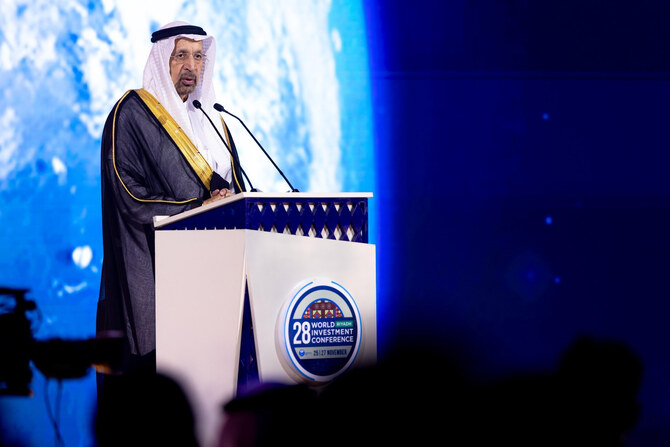
Saudi Investment Minister Khalid Al-Falih emphasized that while globalization is ongoing, it is evolving into a new phase characterized by regionalization and the clustering of supply chains. “In the future, supply chains will be centered around where raw materials, energy, human resources, and capital coexist in an enabling business environment,” he said.
Al-Falih also highlighted the important roles of companies backed by the Public Investment Fund (PIF), such as Manara and Alat, in advancing sectors like mining and digital manufacturing.
Industrial and mining growth
Minister of Industry and Mineral Resources Bandar Alkhorayef reaffirmed Saudi Arabia’s ambition to become a leading industrial player on the global stage. “The country is focused on expanding its industrial base, entering new sectors, and playing a key role in global challenges, particularly in mining,” he stated.
As part of this vision, the Ministry of Industry and Mineral Resources has announced the qualification of both local and international firms to compete for exploration licenses in key mineralized areas, including Jabal Sayyad and Al-Hajar, which cover a combined 4,788 square kilometers. Eligible companies include Zijin Mining Group, Hancock Prospecting, and First Quantum Minerals.
Enhancing supply chain resilience
Minister of State Hamad Al-Sheikh underscored Saudi Arabia’s commitment to strengthening its logistical infrastructure and enhancing global supply chain resilience. He outlined several national strategies aimed at attracting both local and international investment, including the National Industrialization Strategy, the National Investment Strategy, the National Transportation and Logistics Strategy, and the National Agricultural Strategy.
However, Al-Sheikh also cautioned about the challenges posed by shifting market dynamics, geopolitical influences, and environmental considerations. “We must remain aware of the challenges arising from rapid changes in the global supply chain landscape,” he warned.
Aviation industry and logistical stance
President and board chairman of Boeing Saudi Arabia Asaad Al-Jomoai also took part in the event. His speech mainly focused on the Kingdom’s advancements in the aviation industry as well as its logistical positioning.
With regards to air mobility and environmental concerns, Al-Jomoai highlighted that Boeing has pledged that by the end of the decade, all its commercial jetliners will be compatible with sustainable aviation fuel.
“We think that the PSAF, which is producing sustainable aviation fuel using renewable energy, since the Kingdom has second-to-none infrastructure when it comes to the cost of renewable, I think that is a super attractive value proposition for companies like the Boeing Co. to look into sourcing PSAF down the road from the Kingdom of Saudi Arabia,” he said.
When it comes to Saudi Arabia’s logistical positioning, the chairman added: “We are at the crossroads of three continents, also at the crossroads of leading trade routes and energy flows and we also have very strategic and competitive energy landscape, both hydrocarbon and renewable energy in addition to world-class physical and digital infrastructure.”
Al-Jomoai further highlighted that the nation is leading the way in digitizing its government processes.
“The fiscal and monetary stability that the Kingdom offers investors is very rare around the world. I’d like to also highlight that the currency exchange has been fixed for the US dollar for a very long time, which gives certainty for many, many investors that we meet and that we engage with,” he said.
Launched in October 2022, the GSCRI initiative aims to position Saudi Arabia as a global supply chain hub by capitalizing on its strategic advantages and mitigating the impact of global disruptions. This initiative is an integral part of the ongoing 28th World Investment Conference in Riyadh, which continues until Nov. 27.


