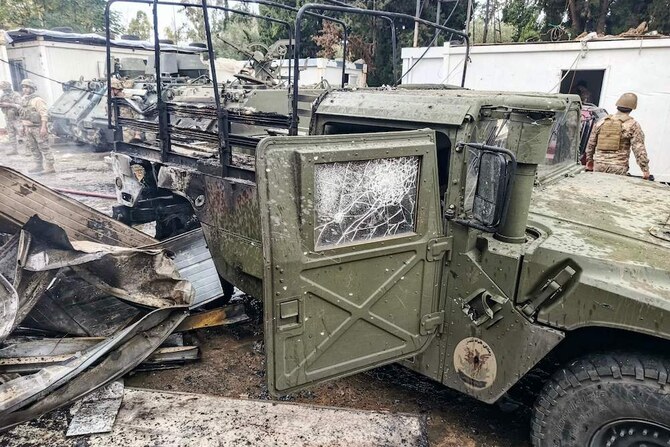

BEIRUT: An Israeli strike on a Lebanese army center on Sunday killed a soldier and wounded 18 others, the Lebanese military said, with the caretaker prime minister, Najib Mikati, calling the attack “a direct bloody message rejecting all efforts to reach a ceasefire.”
The attack came as top EU diplomat Josep Borrell called for an immediate ceasefire in the Israel-Hezbollah war while on a visit to Lebanon.
According to the Lebanese Army Command, the first adjutant, Diab Mohammed Jaafar, was killed when Israel targeted Al-Amariyeh checkpoint on the road between Tyre and the town of Naqoura.
In a statement, Mikati said: “Israel’s messages rejecting a solution are ongoing, and just as it turned against the US-French call for a ceasefire in September, here it is once again responding with Lebanese blood, blatantly rejecting the solution that is being discussed.”
FASTFACT
Israeli airstrikes on Saturday pounded central Beirut, killing at least 20 people and wounding 66, according to Lebanon’s Health Ministry.
He called on “the countries of the world and the relevant international institutions to assume their responsibilities on the issue.”
Mikati’s condemnation came amid growing concerns that the Israeli military is trying to solidify its westward incursion in the coastal town of Al-Bayada, located between Tyre and Naqoura, while facing strong resistance from the eastern side of the border area in its positions in Khiyam.
Israeli forces are trying to encircle the South Litani area from both sides.
Hezbollah said it “targeted a gathering of the enemy army s forces east of the city of Khiyam with a salvo of rockets,” and “a gathering of Israeli forces at the Metula site (Israel’s outlet toward Khiyam) was targeted with a volley of rockets followed by an aerial attack with a squadron of assault drones … hitting its targets accurately.”
The Israeli military said Hezbollah launched 160 projectiles toward Israel on Sunday.
Sirens sounded across northern and central Israel, reaching Tel Aviv at successive intervals, forcing thousands of Israelis to head toward shelters.
Footage from central Israel showed extensive material damage and fires.
The Israeli military issued further warnings to residents of Beirut’s southern suburbs to evacuate, targeting Bourj Al-Barajneh and Hadath.
Former Israeli minister Benny Gantz claimed that the Lebanese government “is leaving Hezbollah unchecked,” adding: “It is time to act against its assets forcefully.”
These developments came during a round of discussions conducted by Borrell, high representative of the EU for foreign affairs and security policy, in Beirut with Mikati and Speaker Nabih Berry.
In a statement, Borrell stressed the need for exerting pressure on Israel and Hezbollah to accept the US proposal for a ceasefire.
Borrell emphasized that “the situation in the Middle East, particularly here in Beirut, presents a significant challenge to the international community. The international community cannot remain inactive in the face of these events. The absence of peace in the Middle East has reached an intolerable level, and people are dying under bombardment.”
He added that two months on from his last visit to Beirut, he now views Lebanon as on the verge of collapse due to the conflict, which has led to the devastation of numerous villages, as well as airstrikes aimed at Beirut and Baalbek. He also reiterated that “the human cost is exceedingly high.”
Borrell said Israeli airstrikes had claimed the lives of over 3,500 people in Lebanon, a figure three times greater than the casualties recorded in 2006.
The only viable path forward, Borrell said, is an immediate ceasefire and the full implementation of Security Council Resolution 1701.
Borrell praised the UNIFIL forces and confirmed the EU’s readiness to allocate €200 million ($208.3 million) to the Lebanese Armed Forces.
He emphasized the Lebanese need to “assume their political responsibilities by electing a president and putting an end to this prolonged power vacuum that has exceeded two years.”
Borrell said a ceasefire proposal for Gaza is pending Israeli government approval, and “we, as the international community, need to work to ensure the respect of international law, as we see famine being used as a weapon of war through international law violations, the complete siege imposed on Gaza and the number of people that are dying in Lebanon.”
He added that in his view the decisions of the International Criminal Court to issue arrest warrants for Israeli Prime Minister Benjamin Netanyahu and his former defense minister, Yoav Gallant, for Israel’s activities in Gaza were not politically motivated and had been made under international law, which applied to everyone. “We strongly support the court,” he said.