Ukraine needs better air defenses, Zelensky says after Russian drone attack

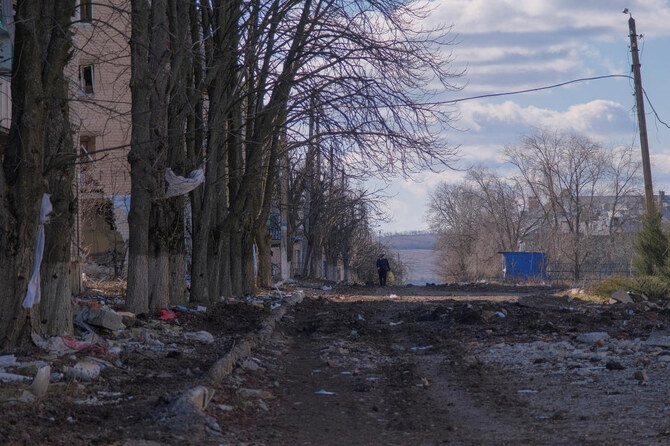
FILE PHOTO: A local resident walks along a damaged street, amid Russia's attack on Ukraine, in the town of Siversk, Donetsk region, Ukraine March 5, 2023. REUTERS/Alex Babenko/File Photo
Short Url
Updated 24 November 2024
Follow

Ukraine needs better air defenses, Zelensky says after Russian drone attack

  • Over the past week Russia used more than 800 guided aerial bombs, about 460 attack drones, and more than 20 missiles of various types

KYIV: President Volodymyr Zelensky said on Sunday Ukraine needs to strengthen its air defenses to protect people after its air defense units shot down 50 of 73 Russian drones launched overnight over many regions.
“An air alert has been sounded almost daily across Ukraine this week,” Zelensky said on Telegram messenger.
Over the past week Russia used more than 800 guided aerial bombs, about 460 attack drones, and more than 20 missiles of various types, Zelensky said.
“Ukraine is not a testing ground for weapons. Ukraine is a sovereign and independent state. But Russia still continues its efforts to kill our people, spread fear and panic, and weaken us,” he said.
The Ukrainian military said earlier on Sunday that air defense units had destroyed more than 10 Russian drones that were targeting Kyiv in an overnight attack.
There were no immediate reports of damage or injuries as a result of the attack, Kyiv’s military administration posted on Telegram.
Reuters witnesses heard explosions in Kyiv in what sounded like air defense units in operation.
“The UAVs (unmanned aerial vehicles) were flying in different directions toward Kyiv,” said Serhiy Popko, head of Kyiv’s military administration. “The air raid alert in the city lasted for more than three hours.”
There was no immediate comment from Russia about the attack.


France bans 10 British far-right, anti-migration activists from entering

Updated 3 sec ago
Follow

France bans 10 British far-right, anti-migration activists from entering

PARIS: France’s interior ministry said on Wednesday it has banned 10 British far-right activists from entering or staying in the country, after they carried out actions deemed to ​incite violence and seriously disturb public order on French territory.
The activists, identified as members of a group called “Raise the Colors” that was involved in a national flag-raising campaign, seek to find and destroy boats used to carry migrants and spread propaganda on France’s northern coast calling on the British public to join the movement to stop ‌migration, according to ‌the French interior ministry.
“Our rule ‌of ⁠law ​is non-negotiable, ‌violent or hate-inciting actions have no place on our territory,” French Interior Minister Laurent Nunez wrote on social media platform X on Wednesday.
The ministry said in a statement it had been informed of the group’s activities in December last year and that it had referred the matter to the relevant authorities, ⁠as the actions were likely to cause “serious disturbances” to public order.
“Raise the ‌Colors” describes itself as a grassroots movement ‍that began in the central ‍English city of Birmingham, when a small group started ‍tying national flags to lampposts in a show of national pride. It says the effort has since spread across the UK.
The widespread display of the red-and-white St. George’s Cross for England and the ​Union Jack for Britain has prompted concern among some migrant communities as a reflection of rising anti-immigration ⁠sentiment in the country, coinciding with a wave of protests outside hotels housing asylum seekers last year.
Neither the group nor the British Foreign Office immediately responded to Reuters requests for comment.
Immigration and the crossings of small boats carrying migrants from France have become a focal point for British voters and has helped propel Nigel Farage’s right-wing, anti-immigration Reform UK party, into a commanding opinion poll lead.
Farage last year in London met the leader of French far-right National Rally (RN) party, Jordan Bardella, ‌who has accused France of being too soft on immigration.