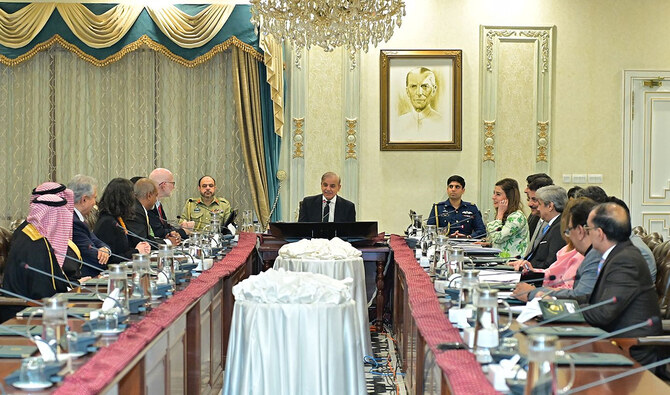
KARACHI: Officials from Saudi aid agency KSrelief, as part of a Global Polio Eradication Initiative delegation, met Prime Minister Shehbaz Sharif to discuss strengthening Pakistan’s vaccination campaigns, tackling polio challenges and securing support for a polio-free future, according to an official statement released on Saturday.
Pakistan, along with neighboring Afghanistan, remains the last polio-endemic country in the world. The South Asian nation’s polio eradication campaign has faced serious challenges, with a significant spike in reported cases this year amid militant attacks on polio teams, prompting officials to reassess their approach to combating the crippling disease.
Pakistan reported two new polio cases from Dera Ismail Khan in the northwestern Khyber Pakhtunkhwa (KP) province a day earlier, bringing the total number of cases to 52 since the beginning of the year.
“Pakistan hosted a high-level delegation from the GPEI for a second time this year from Nov. 20-22,” the Pakistan Polio Eradication Program (PPEP) said in a statement, adding that the meeting reflected the highest level of political commitment to eradicating polio in the country.
The delegation included two senior KSrelief officials along with World Health Organization, Bill & Melinda Gates Foundation and UNICEF representatives.
The prime minister expressed gratitude to the delegation for supporting Pakistan, emphasizing that the country considers the eradication of polio a top priority.
“A strategic National Emergency Action Plan is being implemented to reverse the virus surge, and all chief ministers and secretaries are providing direct oversight and working in coordination to fight the current polio outbreak,” Sharif was quoted as saying.
“The Government of Pakistan will not rest until we have ended the scourge of polio from our borders,” he added.
The delegation also visited metropolitan Karachi during their stay in the country, where its members met with female frontline health workers to discuss the challenges they face and explore ways to address them, the statement said.
Of the 52 polio cases reported in 2024, 24 were from Balochistan province, 13 from Sindh, 13 from KP, and one each from Punjab and Islamabad, the federal capital.
Poliovirus, which can cause crippling paralysis, particularly in young children, remains incurable and continues to threaten human health as long as it is not eradicated. Immunization campaigns have succeeded in most countries and have made significant progress in Pakistan, but persistent challenges remain.
In the early 1990s, Pakistan reported approximately 20,000 cases annually, but by 2018 the number had dropped to eight. Six cases were reported in 2023, and only one in 2021.


![]()

KSrelief officials join global delegation meeting PM Sharif to boost Pakistan’s polio fight
Short Url
https://arab.news/pfqdx
KSrelief officials join global delegation meeting PM Sharif to boost Pakistan’s polio fight
- Shehbaz Sharif says his government will not rest until the ‘scourge of polio’ is completely eradicated
- Pakistan has reported 52 polio cases since the beginning of the year, mostly from KP and Balochistan


Latest updates


© 2026 SAUDI RESEARCH & PUBLISHING COMPANY, All Rights Reserved And subject to Terms of Use Agreement.