Ukraine, Middle East conflicts eating into US air defense stocks, US admiral says

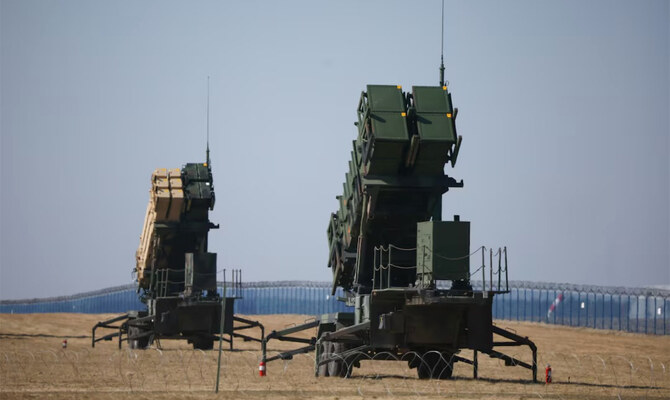
US Army MIM-104 Patriots, surface-to-air missile (SAM) system launchers, are pictured at Rzeszow-Jasionka Airport, amid Russia's invasion of Ukraine, Poland March 24, 2022. (Reuters)
Short Url
Updated 20 November 2024
Follow

Ukraine, Middle East conflicts eating into US air defense stocks, US admiral says

  • Paparo said the expenditure of US air defenses “imposes costs on the readiness” of the United States to respond in the Asia-Pacific, particularly given that China is the most capable adversary in the world

WASHINGTON: Conflicts in Ukraine and the Middle East are eating into US stockpiles of air defenses, the top US admiral overseeing American forces in the Asia-Pacific region said on Tuesday.
The admission by Admiral Sam Paparo could draw the attention of members of President-elect Donald Trump’s incoming administration, who are more skeptical of the war in Ukraine and who argue that President Joe Biden has failed to prepare for a potential conflict with China.
“With some of the Patriots that have been employed, some of the air-to-air missiles that have been employed, it’s now eating into stocks and to say otherwise would be dishonest,” Paparo, head of the US Indo-Pacific Command, said during an event.
Paparo said the expenditure of US air defenses “imposes costs on the readiness” of the United States to respond in the Asia-Pacific, particularly given that China is the most capable adversary in the world.
Biden’s administration has been steadily arming Ukraine and Israel with its most sophisticated air defenses. The US Navy has been directly defending shipping in the Red Sea in the face of missile and drone attacks from Houthi rebels in Yemen.
In the case of Ukraine, Biden has given Kyiv a full array of defenses, including Patriot missiles and National Advanced Surface-to-Air Missile systems.
The United States last month deployed to Israel a THAAD, or the Terminal High Altitude Area Defense system, and about 100 US troops to operate it. The THAAD is a critical part of the US military’s layered air defense systems.


Thai and Cambodian top diplomats meet in China to solidify ceasefire

Updated 58 min 22 sec ago
Follow

Thai and Cambodian top diplomats meet in China to solidify ceasefire

  • The ceasefire agreement comes with a 72-hour observation period, at the end of which Thailand agreed to repatriate 18 Cambodian soldiers it has held as prisoners since earlier fighting in July

BEIJING: Top diplomats from Thailand and Cambodia kicked off two days of talks in China on Sunday as Beijing seeks to strengthen its role in mediating the two countries’ border dispute, a day after they signed a new ceasefire.
The ceasefire agreement signed on Saturday calls for a halt to weeks of fighting along their contested border that has killed more than 100 people and displaced over half a million in both countries.
Thai Foreign Minister Sihasak Phuangketkeow and Cambodian Foreign Minister Prak Sokhonn were set to meet in China’s southwestern Yunnan province for talks mediated by their Chinese counterpart, Wang Yi.
The talks aim to ensure a sustained ceasefire and promote lasting peace between the countries, according to a statement by Sihasak’s office.
Wang was scheduled to join both bilateral meetings with each of the diplomats and a trilateral talk on Monday.
China has welcomed the ceasefire announcement, which freezes the front lines and allows for displaced civilians to return to their homes near the border.
“China stands ready to continue to provide (the) platform and create conditions for Cambodia and Thailand to have fuller and more detailed communication,” a Chinese Foreign Ministry statement read.
The ceasefire agreement comes with a 72-hour observation period, at the end of which Thailand agreed to repatriate 18 Cambodian soldiers it has held as prisoners since earlier fighting in July. Their release has been a major demand of the Cambodian side.
China has sought to position itself as a mediator in the crisis, along with the United States and Malaysia.
A July ceasefire was brokered by Malaysia and pushed through by pressure from US President Donald Trump, who threatened to withhold trade privileges unless Thailand and Cambodia agreed.
Despite those deals, Thailand and Cambodia carried on a bitter propaganda war, and minor cross-border violence continued, erupting into heavy fighting in early December.
Prak Sokhonn, in a statement after his meeting with Wang, expressed deep appreciation for China’s “vital role” in supporting the ceasefire.
China also announced 20 million yuan ($2.8 million) of emergency humanitarian aid for Cambodia to assist the displaced.
The first batch of Chinese aid, including food, tents and blankets, arrived in Cambodia on Sunday, Wang Wenbin, Chinese ambassador to Cambodia, wrote on Facebook.
Sihasak said Sunday he hoped the meetings would convey to China that it should both support a sustainable ceasefire and send a signal to Cambodia against reviving the conflict or attempting to create further ones.
“Thailand does not see China merely as a mediator in our conflict with Cambodia but wants China to play a constructive role in ensuring a sustainable ceasefire by sending such signals to Cambodia as well,” he said.