


Progressive senators call to block US arms sales to Israel

1 / 4
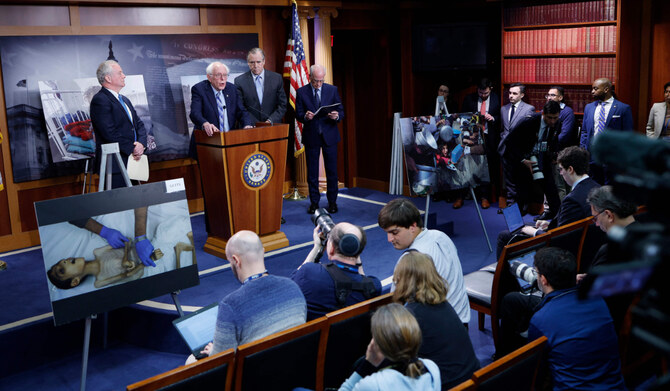
U.S. Sen. Bernie Sanders (I-VT), joined by fellow senators U.S. Sen. Chris Van Hollen (D-MD), U.S. Sen. Jeff Merkley (D-OR) and U.S. Sen. Peter Welch (D-VT), speaks at a news conference on restricting arms sales to Israel at the U.S. Capitol on November 19, 2024 in Washington, DC. (AFP)
2 / 4
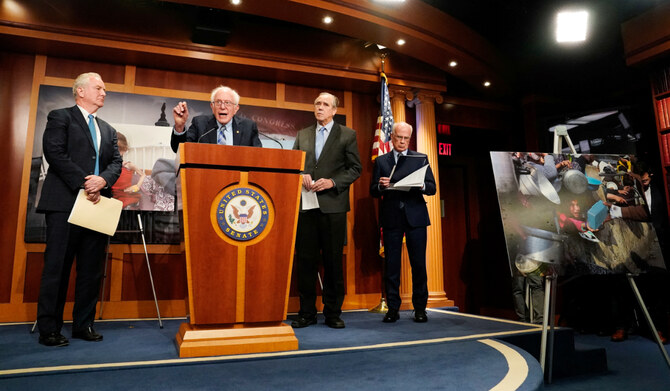
U.S. Senator Bernie Sanders (I-VT) speaks during a press conference regarding legislation that would block offensive U.S. weapons sales to Israel, with Senators Chris Van Hollen (D-MD), Jeff Merkley (D-OR) and Peter Welch (D-VT) at the U.S. Capitol in Washington, U.S., November 19, 2024. (REUTERS)
3 / 4
A Palestinian woman bids farewell to a people killed in an Israeli strike, at the al-Aqsa Martyrs Hospital in Deir Al-Balah in the central Gaza Strip on November 17, 2024, amid the ongoing war between Israel and the Palestinian Hamas militant group. (AFP)
4 / 4
A Palestinian man reacts as he sits next to a body of a person killed in an Israeli strike, inside the al-Aqsa Martyrs Hospital in Deir Al-Balah in the central Gaza Strip on November 17, 2024, amid the ongoing war between Israel and the Palestinian Hamas militant group. (AFP)
Short Url
Updated 20 November 2024
Follow

Progressive senators call to block US arms sales to Israel

  • The Vermont representative told reporters that “what is happening in Gaza today is unspeakable,” pointing in particular to the deaths of tens of thousands of civilians in the Palestinian territory, as well as large-scale destruction of buildings
  • The health ministry in Hamas-run Gaza says the death toll from the ongoing war has reached 43,972 people, the majority civilians

WASHINGTON: A handful of left-leaning senators on Tuesday called on the Biden administration to halt arms sales to Israel, accusing the United States of playing a key role in the “atrocities” of the war in Gaza.
The four senators gave the media conference ahead of a Wednesday vote on resolutions condemning the US weapons sales — measures that are expected to fail given the large number of lawmakers who support Israel, a historic American ally.
The resolutions were put forth by progressive Senator Bernie Sanders, alongside several other Democrats.


A Palestinian man bids carries the remains of a person killed in an Israeli strike, at the al-Aqsa Martyrs Hospital in Deir Al-Balah in the central Gaza Strip on November 17, 2024, amid the ongoing war between Israel and the Palestinian Hamas militant group. (AFP)

The Vermont representative told reporters that “what is happening in Gaza today is unspeakable,” pointing in particular to the deaths of tens of thousands of civilians in the Palestinian territory, as well as large-scale destruction of buildings and infrastructure.
“What makes it even more painful is that much of what is happening there has been done with US weapons and with American taxpayer support,” he said.
The health ministry in Hamas-run Gaza says the death toll from the ongoing war has reached 43,972 people, the majority civilians. The United Nations considers the figures reliable.
The war began first began when Hamas militants attacked Israel on October 7, 2023, resulting in the deaths of 1,206 people, mostly civilians, according to an AFP tally of Israeli official figures.
The administration of President Joe Biden has steadfastly backed Israel while counseling restraint for more than a year.
“The United States of America is complicit in these atrocities,” Sanders said. “That complicity must end and that is what these resolutions are about.”
Democratic Senator Chris Van Hollen, also speaking at the media conference, questioned whether America’s foreign policy and commitment to Israel had forced the United States to “be blind to the suffering before our very eyes?“


Iran war unsettles India’s packaged water makers as bottles, caps get pricey

Updated 55 min 10 sec ago
Follow

Iran war unsettles India’s packaged water makers as bottles, caps get pricey

  • Higher polymer ‌prices hurt bottled water industry
  • Industry worth $5 billion has big multinational players like Pepsi, Coca-Cola

NEW ​DELHI: The Iran war is rattling India’s $5 billion packaged water market just ahead of the sweltering summer season.
One of the world’s fastest growing bottled water markets is seeing some manufacturers hike prices for distributors, as supply disruptions linked to the war fuel higher costs in everything from plastic bottles to caps, labels and cardboard boxes.
Though retail prices are yet to feel the heat and bigger companies are absorbing the pain, about 2,000 smaller bottled water makers have increased rates for their resellers by around 1 rupee per ‌bottle, a ‌5 percent hike, which will rise by a further 10 percent in ​coming ‌days, ⁠according ​to the ⁠Federation of All India Packaged Drinking Water Manufacturers’ Association.
Consumers usually pay less than 20 rupees, or around 20 US cents, for a one-liter bottle.
“There is chaos and within the next 4-5 days, this will start impacting customer prices,” said Apurva Doshi, the federation’s secretary general.
Rising oil prices have increased the cost of polymer, which is made from crude oil and is a key material for the industry’s plastic bottles. The cost of material used in making ⁠plastic bottles has risen by 50 percent to 170 rupees per kilogram, ‌while the price of the caps has more than ‌doubled to 0.45 rupees apiece. Even corrugated boxes, labels and ​adhesive tape are costing much more, ‌industry letters showed.
Clean water is a privilege in the country of 1.4 billion people where ‌researchers say 70 percent of the groundwater is contaminated, leaving people reliant on bottled water. Companies including Bisleri, Coca-Cola’s Kinley, Pepsi’s Aquafina, billionaire Mukesh Ambani’s Reliance and Tata all compete for a share of the $5 billion market. The companies did not respond to Reuters request for comment.
PREMIUM WATER FACES HEAT ‌TOO
Within the broad bottled water market, natural mineral water is a $400 million business in India and a new, fast-growing wellness product for ⁠India’s wealthy.
The premium ⁠water segment accounted for 8 percent of the bottled water market last year in India, compared to just 1 percent in 2021, Euromonitor says.
Aava, which sells mineral water sourced from the foothills of the Aravalli mountains, has increased prices of its water bottles by 18 percent for resellers, Shiroy Mehta, CEO of the company, told Reuters.
“Most manufacturers are absorbing 40-50 percent of the cost to ensure that they don’t lose clients. It’s a poor situation for the beverage industry ahead of the summer season,” he said.
The mass market, however, is dominated by companies that produce “drinking water” to be sold in 1-liter bottles to customers. Clear Premium Water, a brand of India’s Energy Beverages, said in a notice to its distributors there ​had been an “unprecedented and continuous surge” in ​prices of key raw materials used in packaging and production.
“It is no longer possible for us to absorb the escalating costs while maintaining existing product prices,” the notice said.