

Sustainable technologies, innovations discussed at COP29 to mitigate climate change

As governments now heavily prioritize sustainability, the integration of innovative technologies is a growing demand for fostering economic growth and environmental stewardship. (Abdulrhman Bin Shalhoub)
Short Url
Updated 16 November 2024
Follow

Sustainable technologies, innovations discussed at COP29 to mitigate climate change

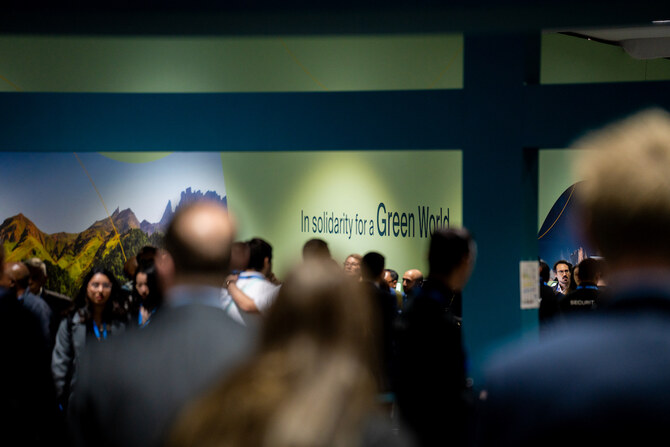
BAKU: Azerbaijan, an oil-producing country and host of the COP29 UN climate change conference, is focusing on green innovation and development, showcasing its efforts at the global gathering in Baku.

“We are collaborating with international companies and research institutions to ensure that COP29 showcases cutting-edge technologies in renewable energy, water management and carbon capture,” said Mukhtar Babayev, COP29 president.

Although Azerbaijan remains reliant on fossil fuels, it is working with international organizations and educational institutions to ensure that COP29 is not only about policies and funding, but also a platform for presenting environmental innovations.

“Our focus is on delivering a conference that fosters practical solutions, showcases Azerbaijan’s leadership in the energy transition, and reinforces our commitment to a sustainable and resilient future,” said Babayev.

According to an article by Elkhan Nuriyev, a global energy associate at the Brussels Energy Club and senior expert on Russia, Eastern Europe, and Central Asia at L&M Political Risk and Strategy Advisory in Vienna, published on the Ceeenergy News website: “The government has advocated for stronger commitments to enhancing financial mechanisms for green projects worldwide. A standout project is the ‘Green Energy Hub,’ a multi-faceted initiative focused on harnessing renewable energy sources. This hub includes large-scale solar farms, wind turbines and hydropower facilities, serving as a key export resource.”

In addition, an agreement was signed four years ago between Azerbaijan’s Ministry of Energy and Masdar, a UAE clean energy company, to establish the country’s first solar energy facility — the 230-megawatt Garadagh Solar Power Plant.


Saudi Arabia is one of the examples to prioritize sustainable development through its Vision 2030. (Abdulrhman Bin Shalhoub)

The project covers 550 hectares and features 570,000 bifacial photovoltaic panels, which capture both direct sunlight and the reflection of sunlight from the ground.

Masdar is not the only company involved in renewable energy technologies in Azerbaijan. Earlier this year, ACWA Power, a leader in the energy transition and a pioneer in green hydrogen, partnered with Azerbaijan’s national oil company, SOCAR, to develop projects that will accelerate renewable energy in the country.

According to ACWA Power’s website, the private company is “currently constructing Azerbaijan’s and the region’s largest 240 MW wind power plant in the Absheron-Khizi region at an investment cost of $345 million.”

As governments increasingly prioritize sustainability, the integration of innovative technologies is becoming a key demand for fostering both economic growth and environmental stewardship.

Saudi Arabia is also prioritizing sustainable development through its Vision 2030.

According to the Kingdom’s national source for government services and information, which outlines the Sustainable Development Goals of Saudi Vision 2030, “the Kingdom of Saudi Arabia endeavors to tackle the issues of poverty, inequality, climate change, prosperity, peace, justice, education, health, social protection and the availability of employment opportunities, and, recognizing the intersecting nature of these issues, ensures they are all included in its national strategy.”

In addition, many other technologies have been developed worldwide to combat climate change, including an innovative solution launched 2017 to develop renewable energy: solar-powered trains.

According to an article by Justyna Matuszak on the Know-How website, this type of green transportation can run for an entire day without needing to recharge. The railway also releases 75 percent of the energy it generates into the ground, as reported by the BBC.

Bladeless wind energy is another technology designed in 2012 by the Spanish startup Vortex Bladeless.

It features is an elastic rod that secures the company’s three-meter tall bladeless turbine vertically into the ground. According to the previously mentioned report, the turbine sways with the wind speed, generating energy from the resulting vibrations.

Due to its design, it is suitable for use in cities or residential areas as it does not require as much space as a traditional wind turbine.

Another new sustainable technology is 3D-printed solar energy trees. Developed by researchers at VTT Technical Research Centre of Finland, the technology, as described in the Know-How report by Matuszak, is a prototype tree that collects solar energy, heat and kinetic energy from its surroundings, whether indoors or outdoors, to generate electricity for small appliances.

By embracing modern sustainable innovations and fostering joint partnerships between the public and private sectors, tackling climate change may become more achievable.


Saudi National Development Fund sees 45 agreements worth $1.6bn at Momentum 2025

Updated 42 min 12 sec ago
Follow

Saudi National Development Fund sees 45 agreements worth $1.6bn at Momentum 2025

RIYADH: Saudi Arabia’s National Development Fund and its affiliates signed 45 agreements with a total value of SR6 billion ($1.59 billion), with several local and international partners at the conclusion of the Momentum 2025 development finance conference.

The event, held from Dec. 9 to 11 at the King Abdulaziz International Conference Center in Riyadh, was organized by the NDF under the patronage of Prince Mohammed bin Salman bin Abdulaziz Al Saud, crown prince, prime minister, and chairman of the NDF board of directors.

The new agreements seek to accelerate the pace of investment, empower the private sector, and unlock new opportunities in priority sectors including small and medium sized enterprises, tourism, and sustainable development.

On the institutional level, the fund signed two strategic agreements with two leading global partners in technology and professional services, aiming to enable artificial intelligence, data, and digital solutions within the development finance ecosystem. 

The two memorandum of understandings aim to enhance the institutional capabilities of the fund, encourage innovation in products and services, and improve the efficiency and overall impact of development financing in the Kingdom.

The NDF signed a memorandum of understanding through the National Infrastructure Fund aimed at unifying the efforts of the development system to support small enterprises by cooperating on designing a developmental financing model for SMEs.

The Saudi SME Bank signed 19 cooperation agreements and MoUs with a value exceeding SR3 billion, to support the developmental finance system and enhance integration between public and private sector entities.

The Tourism Development Fund concluded 6 agreements with entities from both the government and private sectors, strengthening its partnerships with an impact exceeding SR4 billion. These aim to enhance financing solutions through the “Tourism Enablement Programs” offered by the fund to micro, small, and medium enterprises.

The Cultural Development Fund signed five credit facility agreements within the framework of the “Cultural Financing” program, with a total value exceeding SR63 million, to finance numerous cultural projects.

As part of its efforts to support human capital development, the Human Resources Development Fund concluded 3 agreements aimed at supporting and enabling 2,191 male and female job seekers in multiple sectors, with a value exceeding SR324 million.

The Saudi Industrial Development Fund signed a cooperation agreement with the Saudi Railways Co. to identify cooperation opportunities in enabling the industrial sector, including the railway sector, and supporting investors in localizing goods and services to increase local content.

The Saudi Fund for Development signed five developmental memoranda of understanding with Imam Mohammad Ibn Saud Islamic University, the Islamic Military Counter Terrorism Coalition, and the Middle East Green Initiative, as well as the Saudi Agricultural and Livestock Investment Co., and the Arab Urban Development Institute.

The Investment Events Fund signed a partnership agreement with entertainment firm Legends Global to enhance the events sector by leveraging international expertise in organizing major global events.

The agreements and MoUs signed during the Momentum 2025 conference represent a significant step in the Kingdom’s efforts to build a diverse, inclusive, and sustainable economy.

These partnerships contribute to bridging financing gaps, mitigating risks for strategic projects, and achieving long-term value for Saudi citizens, companies, and communities. Furthermore, they advance global sustainable development goals by aligning public and private capital with national priorities in infrastructure, SMEs, and green growth. 

Dialogue sessions embody development transformation message

The conference agenda included over 35 sessions addressing sustainable investment, climate adaptation, and the role of development finance institutions in expanding economic opportunities. It also featured an exhibition with participation from more than 20 public and private sector entities. 

Over 100 speakers from more than 100 countries participated to discuss ways to develop financing for development efforts, tackle emerging global challenges, and accelerate national and international priorities.

The confernce saw many dialogue sessions and discussions. SPA

The conference concluded with a session titled “The Role of Development Finance Institutions: Enabling Development by Enhancing Financial Capabilities,” which brought together the Governor of the NDF, Stephen Groff, and the CEOs of various development funds and banks.

The session discussions focused on enhancing joint coordination, improving investment readiness, and expanding developmental impact across multiple sectors including tourism, infrastructure, and SMEs.

During the roundtable discussion, participants reviewed the pivotal role led by the Fund and its development ecosystem across various sectors and their role in supporting the economic transformation of the Kingdom.

Groff explained that the strength of this ecosystem lies in the diversity of the funds and the integration of their mandates, adding that achieving the targets of Saudi Vision 2030 requires flexibility in resource allocation and the ability to adapt to national development priorities.

In support of expanding the presence of international companies in the Kingdom and enhancing the competitiveness of the financial sector, the Minister of Investment, Khalid Al-Falih, presented the regional headquarters license to HSBC Bank on the sidelines of the conference, a step that reflects growing confidence in and the attractiveness of the Saudi market to global financial institutions.

To enrich the development sector, the Digital Cooperation Organization launched, on the sidelines of the conference, the Digital Economy Trends 2026 report. The report predicted that the global digital economy will grow by 9.5 percent next year, three times faster than global economic growth.
