

What is Bluesky, the fast-growing social platform welcoming fleeing X users?

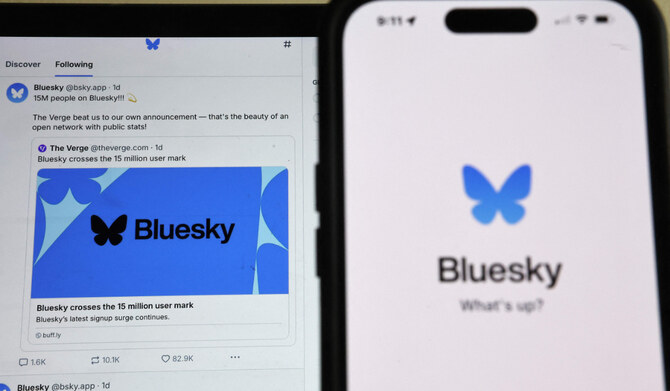
In this photo illustration, the Bluesky logo is displayed on a cell phone and computer monitor on November 14, 2024 in Pasadena, California. (AFP)
Short Url
Updated 16 November 2024
Follow

What is Bluesky, the fast-growing social platform welcoming fleeing X users?

  • Bluesky said in mid-November that its total users surged to 15 million, up from roughly 13 million at the end of October, as some X users look for an alternative platform to post their thoughts and talk to others online

SAN FRANCISCO: Disgruntled X users are again flocking to Bluesky, a newer social media platform that grew out of the former Twitter before billionaire Elon Musk took it over in 2022. While it remains small compared to established online spaces such as X, it has emerged as an alternative for those looking for a different mood, lighter and friendlier and less influenced by Musk.
What is Bluesky?
Championed by former Twitter CEO Jack Dorsey, Bluesky was an invitation-only space until it opened to the public in February. That invite-only period gave the site time to build out moderation tools and other features. The platform resembles Musk’s X, with a “discover” feed and a chronological feed for accounts that users follow. Users can send direct messages and pin posts, as well as find “starter packs” that provide a curated list of people and custom feeds to follow.
Why is Bluesky growing?
Bluesky said in mid-November that its total users surged to 15 million, up from roughly 13 million at the end of October, as some X users look for an alternative platform to post their thoughts and talk to others online. The post-election uptick in users isn’t the first time Bluesky has benefited from people leaving X. The platform gained 2.6 million users in the week after X was banned in Brazil in August — 85 percent of them from Brazil, the company said. About 500,000 new users signed up in one day in October, when X signaled that blocked accounts would be able to see a user’s public posts.
Across the platform, new users — among them journalists, left-leaning politicians and celebrities — have posted memes and shared that they were looking forward to using a space free from advertisements and hate speech. Some said it reminded them of the early days of Twitter more than a decade ago.
Despite Bluesky’s growth, X posted after the election that it had “dominated the global conversation on the US election” and had set new records.
Beyond social networking
Bluesky, though, has bigger ambitions than to supplant X. Beyond the platform itself, it is building a technical foundation — what it calls “a protocol for public conversation” — that could make social networks work across different platforms — also known as interoperability — like email, blogs or phone numbers.
Currently, you can’t cross between social platforms to leave a comment on someone’s account. Twitter users must stay on Twitter and TikTok users must stay on TikTok if they want to interact with accounts on those services. Big Tech companies have largely built moats around their online properties, which helps serve their advertising-focused business models.
Bluesky is trying to reimagine all of this and working toward interoperability.


BBC backs Israel’s participation in Eurovision Song Contest amid expanding boycott

Updated 06 December 2025
Follow

BBC backs Israel’s participation in Eurovision Song Contest amid expanding boycott

  • Ireland, Spain, the Netherlands and Slovenia withdraw, citing concerns about the war in Gaza, after organizers clear Israel to compete
  • Critics accuse organizers of double standards, given that Russia was banned from Eurovision in 2022 after invasion of Ukraine

LONDON: The BBC has backed the European Broadcasting Union’s decision to allow Israel to participate in the 2026 Eurovision Song Contest, despite mounting opposition and an expanding boycott by European countries and public broadcasters.

National broadcasters in Ireland, Spain, the Netherlands and Slovenia have formally withdrawn from next year’s event, citing what they described as Israel’s violations of international law during its ongoing war on Gaza, which has killed more than 70,000 people, left much of the territory in ruins and prompted accusations of war crimes.

The BBC, however, said it backed the decision to allow Israel to take part in the contest.

“We support the collective decision made by members of the EBU,” a BBC spokesperson said. “This is about enforcing the rules of the EBU and being inclusive.”

Israel’s participation in the 2026 event, set to take place in the Austrian capital Vienna in May, was confirmed during the EBU’s general assembly in Geneva on Thursday. 

However, pressure continued to build in opposition to the decision, with broadcasters from four countries pulling out and critics accusing organizers of double standards, given that Russia was banned from Eurovision in 2022 after the invasion of Ukraine.

Following the EBU decision, Irish public broadcaster RTE said it would neither participate in nor screen the contest. It said Ireland’s participation “remains unconscionable given the appalling loss of lives in Gaza and the humanitarian crisis there.” It also condemned the killing of journalists in Gaza and the denial of access to the international media. More than 200 Palestinian journalists have reportedly been killed since the start of the war.

Slovenian broadcaster RTV said it was withdrawing from the competition “on behalf of the 20,000 children who died in Gaza.” Chairperson Natalija Gorscak said the decision reflected growing public demand to uphold European values of peace and press freedoms, noting that the international media are still banned from Gaza.

She added that Israel’s 2025 Eurovision performance had been overtly political, and contrasted the decision about Israel with the ban on Russia’s participation following the invasion of Ukraine.

Dutch broadcaster AVROTROS also withdrew from the contest, describing the decision of the EBU as “incompatible with the public values that are essential to us.”

CEO Taco Zimmerman said: “Culture unites, but not at all costs. What happened last year touches our boundaries … Universal values like humanity and a free press have been seriously violated.”

The EBU did not hold a vote on Israel’s participation in the contest. Instead, member broadcasters voted in favor of new rules for contest voting to prevent governments or other groups from unfairly promoting songs to manipulate the result.

Austria, which is set to host the competition after Viennese singer JJ won this year with “Wasted Love,” supports Israel’s participation. Germany, too, was said to back Israel.