ISLAMABAD: Pakistan and Russia on Thursday called for greater collaboration among regional states to address the situation in Afghanistan, amid shared concerns over militant violence emanating from the war-torn country.
The call came during a visit by Moscow’s special representative for Afghanistan, Ambassador Zamir Kabulov, who met with Pakistan’s foreign secretary, Amna Baloch, and held detailed discussions with the additional secretary, Ahmad Naseem Warraich, at the Ministry of Foreign Affairs in Islamabad.
“The two sides exchanged views on relations with Afghanistan and called for enhanced coordination among regional countries for a peaceful and prosperous Afghanistan,” the foreign office said. “The two sides agreed to remain engaged toward this end.”
The talks come as both nations grapple with security threats linked to Afghanistan. Russia has voiced alarm over Daesh and its attacks, including a concert bombing in Moscow earlier this year that was linked to militants with ties to Afghanistan.
While the Afghan Taliban and Daesh are sworn enemies, Pakistan accuses the Afghan administration of facilitating the Tehreek-e-Taliban Pakistan (TTP), a proscribed militant network blamed for cross-border attacks, an allegation Kabul denies.
Pakistan’s approach to Afghanistan has grown increasingly confrontational since last year as it pressures Kabul to rein in the TTP. By contrast, Russia announced last month it would remove the Taliban from its list of terrorist organizations, signaling a step toward normalizing ties with Afghanistan’s rulers.
Beyond security, Russia is keen to retain its influence in Central Asia and engage in Afghanistan’s economic reconstruction, particularly in energy and infrastructure projects.
Initiatives such as the Turkmenistan-Afghanistan-Pakistan-India (TAPI) Gas Pipeline and the Trans-Afghan Railway remain key priorities for Moscow, though persistent security challenges have delayed progress.
For Pakistan also, Afghanistan is critical for regional connectivity. Islamabad has offered landlocked Central Asian nations access to its ports, aiming to facilitate trade with global markets via sea routes.
Despite security concerns shared by Afghanistan’s neighboring countries, its stability is viewed as vital to unlocking the economic potential of regional projects.


![]()
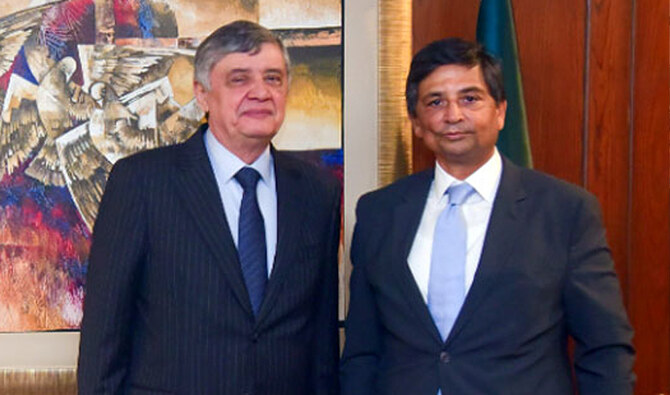
Pakistan, Russia call for regional collaboration on Afghanistan amid shared security concerns

Short Url
https://arab.news/v4828
Pakistan, Russia call for regional collaboration on Afghanistan amid shared security concerns
- The call comes as Moscow’s special representative for Afghanistan visits Pakistan for a day
- Despite security issues, Afghanistan’s neighboring states view its stability as vital for progress
Latest updates


© 2026 SAUDI RESEARCH & PUBLISHING COMPANY, All Rights Reserved And subject to Terms of Use Agreement.