

Indonesia, China seal $10bn in deals on President Prabowo’s first overseas trip

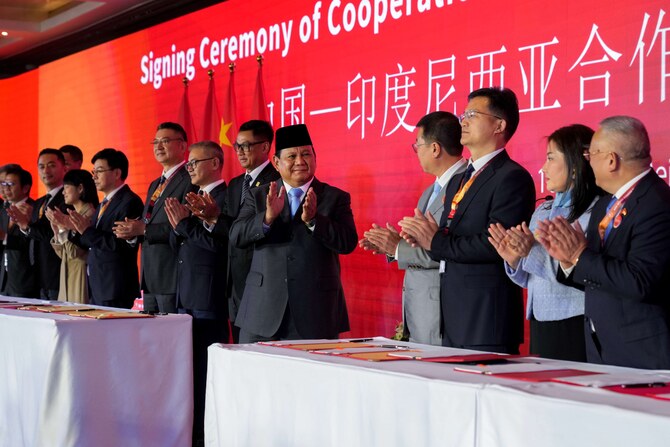
Indonesian President Prabowo Subianto, center, applauds after presiding over a signing ceremony of cooperation documents between Indonesia and China during the Indonesia-China Business Forum in Beijing, on Nov. 10, 2024. (AP Photo)
Short Url
Updated 10 November 2024
Follow

Indonesia, China seal $10bn in deals on President Prabowo’s first overseas trip

  • China is Indonesia’s largest trading partner and source of $7bn worth of investment
  • Prabowo will continue his first overseas tour to US, South America, UK, Middle East

Jakarta: Indonesian and Chinese companies signed business agreements worth more than $10 billion on Sunday, as the two countries agreed to strengthen ties during a state visit by President Prabowo Subianto to Beijing.

Prabowo on Sunday wrapped up the first stop of his first overseas tour since taking office last month. After China, he will head to the US before making his way to South America for the APEC and G20 summits, which will be followed by trips to the UK and the Middle East.

He and Chinese President Xi Jinping agreed to deepen ties on Saturday, elevating security to a fifth “pillar” of cooperation, on top of political, economic, maritime and people-to-people exchange. The two countries will hold a first-ever joint meeting of their foreign and defense ministers next year, according to a joint statement.

“Indonesia and the People’s Republic of China are committed to strengthening our friendship and furthering the prosperity of our two nations,” Prabowo wrote on X on Sunday.

Before leaving Beijing for Washington, Indonesia’s new leader presided over a ceremony between the Indonesian Chamber of Commerce and Industry and top Chinese corporations, during which they inked billions of dollars worth of deals on renewable energy, and health and food security, among other issues.

“The strong participation of Chinese businesses in Asia is an important element in close cooperation between our two countries. I have met the president and prime minister, where we agreed to continue this collaboration,” Prabowo said at the Indonesia-China Business Forum in Beijing, as reported by state news agency Antara.

“This is part of our synergy across all sectors, in education, business, industries, people-to-people … we are very optimistic about the prospects,” he added.

“We must give an example that in this modern age, collaboration — not confrontation — is the way for peace and prosperity.”

China, which was also Prabowo’s initial foreign destination as president-elect in April, is Indonesia’s biggest trading partner and the source of more than $7 billion of investment.

“The visit to China is significant because China currently supports Indonesia’s ambitious economic program through investment, including industrial downstreaming programs. China also supports various infrastructure projects … Prabowo has met Xi Jinping before and this visit strengthens the ties,” Dr. Ahmad Rizky Mardhatillah Umar, an Indonesian political researcher at the UK’s Aberystwyth University, told Arab News.

Economic and defense affairs appear to be a top priority for Prabowo for his overseas tour, which includes China and the US, the world’s two biggest economies.

“He's trying to balance and hedge between two sides,” Umar said. “He is trying to maximize economic benefits with China with trade and investment, and to bolster defense ties with the US for defense modernization.”

His choice of China as the first stop on his multi-country trip is likely a strategy to lure more investment from the US, said Teuku Rezasyah, an international relations expert from Padjadjaran University in West Java.

“This development will become an ammunition for Prabowo when he speaks with American businesses,” he said. “He’ll be able to say: If you want to make a comeback in Southeast Asia and be part of the economy, this is now the time.”

Prabowo is trying to establish his own legacy early on, Rezasyah added. Though the president has said he will continue the programs started by his predecessor, Joko Widodo, those are matters related to domestic affairs.

“He wants to give the international community some confidence that they’re dealing with the right person in their language because Prabowo speaks more than one international language,” Rezasyah said, referring to Prabowo’s ability to speak English, Dutch, French and German.

“So, he can easily convince the world.”


New ‘superfood’ transforms livelihoods in India’s rural east

A farmer harvests makhana, or lotus seeds, in Kapchhahi village in India’s eastern state of Bihar. (Mahesh Mukhia)
Updated 08 December 2025
Follow

New ‘superfood’ transforms livelihoods in India’s rural east

  • Known as fox nut or lotus seed, makhana is rich in protein, dietary fiber, minerals
  • Most of the world’s makhana production is in Bihar, one of India’s poorest states

BIHAR: Wading through knee-deep, stagnant water, Mahesh Mukhia plunges his hands into the mud, pulling up handfuls of sludge that he and others toss into a large, partially submerged basket.

After a while, they shake the basket to drain away the water and debris. What remains is makhana — round black seeds that have lately gained popularity as India’s new superfood.

A regional Indian snack, also known as fox nut or lotus seed, makhana is the edible seed of the prickly waterlily. The plant grows in freshwater ponds and wetlands in southern and eastern Asia.

After makhana seeds are handpicked from pond beds, cleaned, and sun-dried, they are roasted at high heat so their hard black shells crack open and release the white, popcorn-like puffed kernels, which are eaten as snacks or used in dishes.

It has long been known for its nutritional value — high in plant-based protein and dietary fiber, the seeds are also rich in minerals and gluten-free — which over the past few years have helped it gain global attention and are transforming farmlands in Bihar, one of India’s poorest states.

“Earlier, people were not researching it but now, after research, makhana’s nutritional values have been highlighted. Now this is a superfood. That’s why demand is growing everywhere,” said Mahesh Mukhia, a farmer in Kapchhahi village in Bihar’s Darbhanga district, whose family has been harvesting the seeds for generations.

“The difference is that my forefathers did farming in a traditional way, but we’ve learnt to do it in a scientific way,” Mukhia told Arab News.

“There is Bhola Paswan Shastri Agricultural College in the neighboring Purnea district. I went there for training. After I started practicing farming the way I learnt, the yield increased by more than 30 percent.”

Makhana farming is highly labor-intensive, starting with the cultivation of water lilies in shallow ponds. The plants require constant monitoring as they are sensitive to water levels and pests.

Harvesting takes place between August and October. Workers pluck the seeds by hand and then dry them under the sun for several days before they can be processed.

The processing and roasting of makhana also require significant effort. The dried seeds are first de-shelled by manually cracking them, followed by multiple rounds of roasting to make them crisp.

Whole families are involved in the production, which has been expanding since 2020, when the state government introduced the Makhana Development Scheme.

Besides training in farming and processing, growers who cultivate fox nut receive $820 per hectare.

“The rate has also gone up. The makhana that we used to sell at 200-300 ($2-$3) rupees per kg is now selling at 1,000 ($12) or 1,500 rupees per kg,” Mukhia said.

“Makhana farmers are now making a profit. Those who are growing makhana are earning well, those who are popping it are also doing well, and those involved in trading are making profits too. We are getting good demand from everywhere. I just received an order for 25 tonnes recently.”

Bihar currently produces over 85 percent of India’s makhana and accounts for most of the world’s production, according to Ministry of Commerce and Industry estimates.

According to reports by the Indian Brand Equity Foundation and the Agricultural and Processed Food Products Export Development Authority, India accounts for roughly 85 to 90 percent of the world’s production.

Farmland where the crop is grown has increased many times over the past decade and can now be compared to the area covering half of New York City.

More than 600,000 people are involved in the makhana industry in Bihar, according to Niraj Kumar Jha, Darbhanga district’s horticulture officer.

“Earlier, we were cultivating 5,000 hectares in the Kosi and Mithlanchal regions. But now it has expanded to 35,000 hectares, and with many supportive schemes, farmers are increasingly encouraged to grow makhana,” he said.

“We are strengthening our marketing channels. We’ll reach the metro cities as well as world markets ... We can see that makhana is growing very popular, not only in India.”