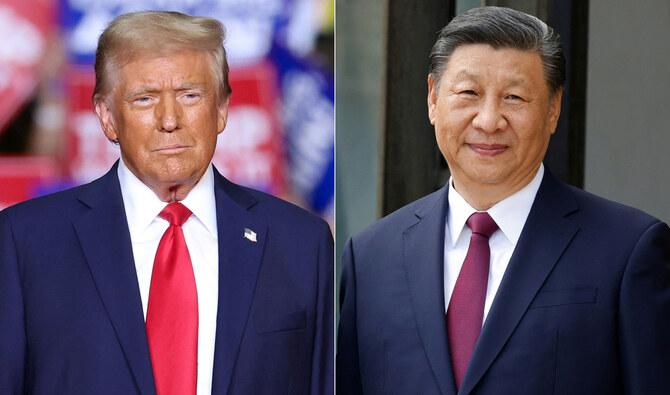
ISLAMABAD: Pakistan can help bridge differences between the United States (US) and China, Islamabad’s envoy to Washington said on Thursday, amid the South Asian country’s efforts to strike a balance in its ties with the two world powers.
Relations between the US and China have been strained over the past several years as both world powers seek to increase their global influence in several domains. The two nations have often had disagreements over trade, Taiwan, the South China Sea and China’s Belt and Road Initiative.
Pakistan maintains a delicate balance in its relations with China and the US. While aligned with the US for military cooperation and counter-terrorism efforts, Islamabad has strengthened economic ties with Beijing through initiatives like the China-Pakistan Economic Corridor (CPEC).
In a talk delivered at the University of California, Pakistan’s Ambassador to Washington Rizwan Saeed Sheikh underscored the strength of Pakistan-US relations and highlighted the role of the Pakistani-American community in fostering mutual growth, the state-run Radio Pakistan broadcaster reported.
“Pakistan has the potential to serve as a bridge between China and the United States,” Sheikh was quoted as saying at the event.
The statement came hours after the Pakistani Foreign Office said its relations with key longtime ally China would remain “unaffected” by Donald Trump winning the US presidential election
“Pakistan’s relations with China are all-weather,” Foreign Office Spokesperson Mumtaz Zahra Baloch said during a weekly press briefing when asked if Trump’s victory will affect the country’s China policy.
“They are strategic and a source of stability in our foreign policy.”
Baloch said Islamabad does not even need to consider the possibility that its relationship with China will be affected by any domestic development in another country.
The complex US-China rivalry impacts Pakistan as it navigates its strategic partnerships with both world powers while grappling with a prolonged economic crisis.
“Our relations with the United States are decades old, and we look forward to further strengthen and broaden Pakistan-US relationship in all fields,” Baloch said.
“As the Deputy Prime Minister said in a tweet yesterday, we look forward to fruitful and mutually beneficial cooperation between Pakistan and the United States.”
Pakistan and the US cultivated strong defense ties during the Cold War days yet their relationship was also tested by divergent priorities on various issues.
In recent years, Washington and Islamabad’s ties deteriorated as the former suspected the latter of supporting the Taliban in their 2021 takeover of Kabul, allegations which Islamabad rejected. Tensions rose further in 2022 when former Pakistan Prime Minister Imran Khan accused the Biden administration of orchestrating his ouster via a parliamentary vote, a charge the US denied.
Pakistan, under PM Shehbaz Sharif’s two separate stints as prime minister in 2022 and 2024, has actively sought to improve its relations with the US.


![]()

Pakistan can serve as bridge between China and US — Islamabad envoy to Washington
Short Url
https://arab.news/wm53w
Pakistan can serve as bridge between China and US — Islamabad envoy to Washington
- Relations between the US and China have been strained over the past several years as both world powers seek to increase their global influence
- The complex US-China rivalry impacts Pakistan as it navigates its strategic partnerships with both while grappling with a prolonged economic crisis
Latest updates




© 2026 SAUDI RESEARCH & PUBLISHING COMPANY, All Rights Reserved And subject to Terms of Use Agreement.