

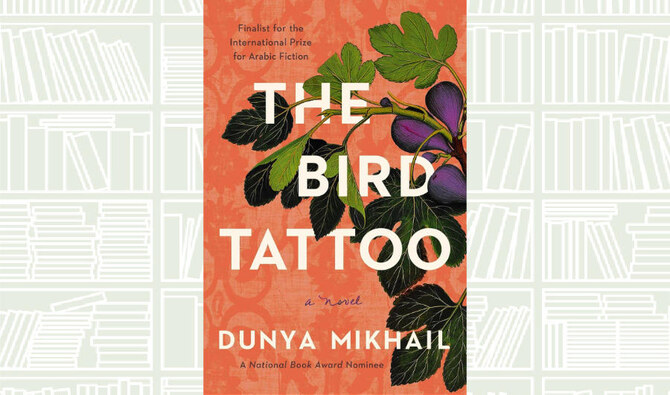
Book Review: ‘The Bird Tattoo’ by Dunya Mikhail

Short Url
Updated 08 November 2024
Follow

Book Review: ‘The Bird Tattoo’ by Dunya Mikhail

Reading Dunya Mikhail’s “The Bird Tattoo,” published in 2020, is embarking on a journey through the intricate layers of identity, loss and hope.

From the very first pages, readers will be drawn into the world of the unnamed protagonist, a journalist returning to her war-torn homeland of Iraq.

Mikhail’s writing envelops you, making you feel the weight of memories and the pulse of a country struggling to heal. One of the most striking aspects of the novel is its unflinching exploration of the painful subject of the sale of Yazidi women as slaves by Daesh.

Mikhail addresses this trauma with a delicate touch, balancing the harsh realities of this atrocity with an exploration of the astonishing world of Yazidi customs and legends.

This duality adds depth to the narrative, allowing readers to appreciate the richness of Yazidi culture even in the face of such unspeakable suffering. Mikhail tells these stories without exaggeration or sentimentality, which makes the emotional weight all the more impactful.

Many readers will find themselves reflecting on their own experiences with home and belonging. The tattoo of the bird, a symbol of freedom and escape, will resonate deeply with them.

It beautifully encapsulates the protagonist’s yearning for liberation from the constraints of her past and the chaos surrounding her.

Mikhail’s prose is both lyrical and haunting, painting vivid images of Baghdad that linger in the mind. Readers will hear the sounds of the city and feel the warmth of the sun, yet the underlying tension of conflict is always present.

This duality will strike a chord with them, as it mirrors the complexities of life — how beauty and pain often coexist.

The flashbacks woven throughout the story are particularly poignant. They allow readers to witness the protagonist’s childhood and the impact of war on her family relationships. They will feel her loss and her struggle to reconcile her past with her present.

One of the most powerful aspects of “The Bird Tattoo” is its exploration of resilience. Despite the heavy themes of loss and trauma, Mikhail instills a sense of hope throughout the narrative.

Readers will find themselves rooting for the characters, marveling at their strength and determination to find their place in a world that often feels unforgiving. This theme will inspire them.

The novel is not just a story about war; it is a profound meditation on identity, love, and the quest for freedom.

The fact that Mikhail, an Iraqi-American, went on to become the English translator of her own work, which is now available in several languages, speaks to her commitment to sharing these stories with the world.

This book left me with a deeper understanding of the complexities of human experience and the enduring spirit of those who face unimaginable challenges.

It has certainly stayed with me, encouraging me to think more deeply about my own journey and the stories that shape who we are.


Book Review: ‘Gut: the inside story of our body’s most under-rated organ’

Updated 29 January 2026
Follow

Book Review: ‘Gut: the inside story of our body’s most under-rated organ’

The New York Times bestseller “Gut: the inside story of our body’s most underrated organ” by Dr. Giulia Enders is an eye-opener.

Originally published in German in 2014 as “Darm mit Charme,” the English version, “Gut,” translated by David Shaw, has gone through several revisions, the most recent of which was published in January 2026.

Layering her medical knowledge with lived human experience, Enders shapes the material at hand into a tangible map of digestion, metabolism and immunity while weaving in real life stories to tie it all in.

She begins with her own personal story, before providing additional context as an expert who specializes in internal medicine and gastroenterology, with a focus on gut health, microbiology and the gut-brain connection.

While some parts might seem like an oversimplification, I like her storytelling style — she makes the dense science accessible for the masses.

Viewers of Netflix might have seen her animated antidotes more recently as one of the main experts in the 2024 documentary, “Hack your Health: The Secrets of Your Gut.”

Similarly, in this book, she expressively explores the microbiome’s connection to the brain and delves into psychobiotics — the microbes that influence mood, stress and even depression.

Enders showcases how and why the gut is powerful; it is not just background machinery within the human body, or even an organ often oddly used as a punchline in a joke.

She highlights how digestion, immunity, metabolism, and mental health are all intertwined and that the gut might arguably be the most vital and predictable organ we could use as a metric to predict overall imminent and immune health.

Some of the things she mentions at the beginning of the book hit me in the gut, as they say. She touches on some key things that are intricately linked and might unlock some of the digestive issues one might develop throughout one’s life. I feel seen.

Nodding along with nearly each page flip, I found my stomach flipping with excitement too, finally finding the parallels between her early experiences and connecting it to my own eventual gut issues.

By the last page, “Gut” will leave you aware that everything does happen for a reason.

You feel those butterflies in your stomach? It is not merely poetic — it signals much more than a seemingly fleeting feeling. It is central to how your whole body works. The “gut feeling” is not just a feeling but also a fact.

“Seen under the microscope, bacteria look like nothing but little, bright spots. But taken together, their sum is much greater than their parts,” she writes.

“Most sit in our mucus membrane, training our immune system, soothing our villi, and producing vitamins. If the good and the bad are in equilibrium, the bad ones can make us stronger and the good ones can keep us healthy.”

When the science parts get slightly too heavy, the whimsy illustrations scattered throughout the book will make you feel grounded. Illustrated by her older sister, Jill Enders, the playful drawings make the complex concepts even easier to digest.