Record drought in Amazon impacts 420,000 children: UNICEF

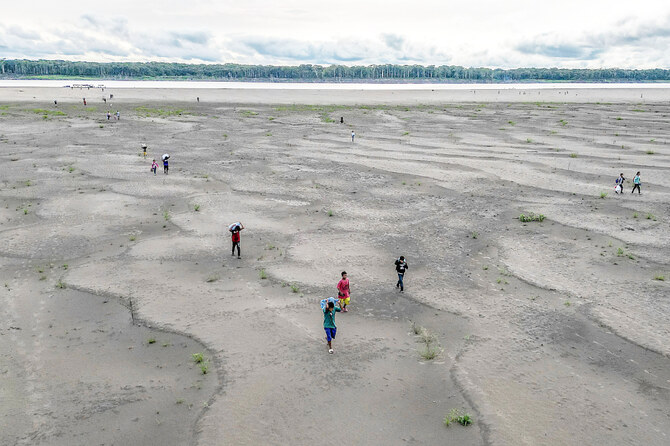
Aerial view of Yagua Indigenous people carrying water and other goods due to the low level of the Amazon river at Isla de los Micos, Amazonas department, Colombia. (AFP)
Short Url
Updated 07 November 2024
Follow

Record drought in Amazon impacts 420,000 children: UNICEF

RIO DE JANEIRO: More than 420,000 children in the Amazon basin are being badly affected by a drought parching much of South America that is impacting water supplies and river transport, UNICEF said Wednesday.
The record-breaking drought is taking a toll on Indigenous and other communities in Brazil, Colombia and Peru reliant on boat connections, the UN agency said.
“We are witnessing the devastation of an essential ecosystem that families rely on, leaving many children without access to adequate food, water, health care and schools,” UNICEF chief Catherine Russell said in a statement.
The resulting food insecurity increased the risk of child malnutrition, the agency said, while less access to drinking water could spur a rise in infectious diseases.
In Brazil’s Amazon region alone, more than 1,700 schools and more than 760 medical clinics had to close or became inaccessible because of low river levels.
In Colombia’s Amazon, lack of drinking water and food forced 130 schools to suspend classes. In Peru, more than 50 clinics were inaccessible.
UNICEF said it needs $10 million in coming months to help the stricken communities in those three countries, including by providing water and sending out health brigades.
Weather observation agencies such as NASA’s Earth Observatory and the EU’s Copernicus service say the drought across the Amazon basin since the latter half of last year was caused by the 2023-2024 El Nino climate phenomenon in the Pacific.
Brazilian experts said the climate crisis was also to blame.
The insufficient rain and shrinking of the vital rainforest’s rivers exacerbated forest fires, disrupted hydroelectric power generation and dried out crops in parts of Brazil, Bolivia, Colombia, Ecuador, Peru and Venezuela.


Australia hits Afghan Taliban officials with sanctions, travel bans

Updated 6 sec ago
Follow

Australia hits Afghan Taliban officials with sanctions, travel bans

  • The Taliban has said it respects women’s rights, in line with its interpretation of Islamic law and local custom
  • The measures were part of a new Australian government framework that enabled it to “directly impose its own sanctions and travel bans to increase pressure on the Taliban, targeting the oppression of the Afghan people,” Wong said

SYDNEY: Australia on Saturday imposed financial sanctions and travel bans on four officials in Afghanistan’s Taliban government over what it said was a deteriorating human rights situation in the country, especially for women and girls.
Australia’s Foreign Minister Penny Wong said the officials were involved “in the oppression of women and girls and in undermining good governance or the rule of law” in the Taliban-run country.
Australia was one of several nations which in August 2021 pulled troops out of Afghanistan, after being part of a NATO-led international force that trained Afghan security forces and fought the Taliban for two decades after Western-backed forces ousted the Islamist militants from power.
The Taliban, since regaining power in Afghanistan, has been criticized for deeply restricting the rights and freedoms of women and girls through bans on education and work.
The Taliban has said it respects women’s rights, in line with its interpretation of Islamic law and local custom.
Wong said in a statement the sanctions targeted three Taliban ministers and the group’s chief justice, accusing them of restricting access for girls and women “to education, employment, freedom of movement and the ability to participate in public life.”
The measures were part of a new Australian government framework that enabled it to “directly impose its own sanctions and travel bans to increase pressure on the Taliban, targeting the oppression of the Afghan people,” Wong said.
Australia took in thousands of evacuees, mostly women and children, from Afghanistan after the Taliban retook power in the war-shattered South Asian country, where much of the population now relies on humanitarian aid to survive.