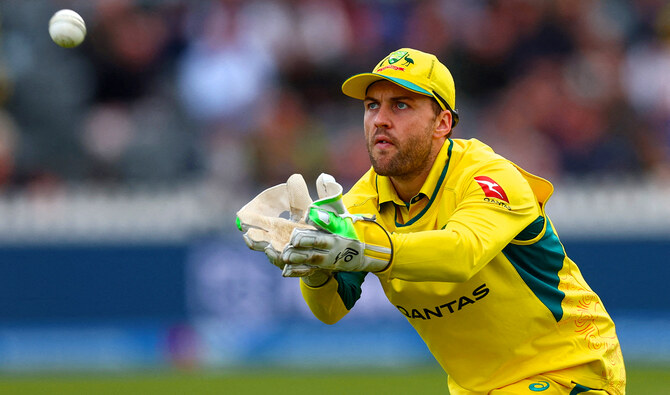
SYDNEY: Josh Inglis will captain Australia for the first time in the third ODI against Pakistan and in the following Twenty20 series, selectors said Wednesday, with a number of stars absent.
Regular one-day skipper Pat Cummins plus Mitchell Starc, Josh Hazlewood, Marnus Labuschagne and Steve Smith will not play the third ODI in Perth on Sunday so they can prepare for the Test series against India.
Xavier Bartlett, Spencer Johnson and Josh Philippe all come into the squad.
With Twenty20 skipper Mitchell Marsh on paternity leave, the 29-year-old wicketkeeper Inglis will also captain the hosts in the three-match T20 series against Pakistan starting November 14.
“Josh is an integral member of the ODI and T20I teams and a highly respected player on and off the field,” George Bailey, chairman of selectors, said.
“He has led Australia A previously and will bring strong tactical nous and a positive approach to the role.”
Australia won the first one-dayer on Monday by two wickets. The second match is on Friday.
Australia’s Test team, led by Cummins, will play five matches against India.
The first Test starts on November 22 in Perth.

Josh Inglis named Australia’s white-ball captain in ongoing series against Pakistan
https://arab.news/9gbgz
Josh Inglis named Australia’s white-ball captain in ongoing series against Pakistan
- Most Australian stars will be absent from Pakistan matches to prepare for Test series with India
- The 29-year-old wicketkeeper Inglis will captain both the ODI and T20 series against Pakistan
Arab Cup 2025 attendance surpasses recent AFCON and AFC Asian Cup
- The tournament, held under FIFA jurisdiction for the second time, achieved a record average attendance of 38,644 fans per match
- Total attendance more than doubled since 2021, with Algeria vs. UAE quarter-final pushing it past one million spectators
RIYADH: For a tournament often dismissed by critics as little more than a friendly or “B-team” competition, the 2025 Arab Cup delivered a compelling response.
A total of 1,236,600 people attended the 32 matches across the tournament, an average of 38,644 spectators per game, as the Arab Cup returned to Qatar for a second consecutive time after its successful staging in 2021. That earlier tournament, initially launched as a Confederations Cup-like test event ahead of the World Cup, drew 571,605 spectators in total.
Despite those figures, the Arab Cup has faced persistent criticism. Questions have been raised around the quality of play and refereeing standards, with some supporters – both within and beyond the Arab world – branding the tournament “meaningless.”
Yet when placed alongside recent continental competitions, the attendance figures tell a different story.
The 2023 African Cup of Nations in Ivory Coast attracted 1,109,593 fans across 52 matches, an average of 21,338 per game. Meanwhile, the 2023 AFC Asian Cup, also hosted in Qatar, recorded 1,507,790 spectators over 51 matches — roughly 29,565 per game, the highest average in the competition’s history.
Direct comparisons, however, require context. Continental — as opposed to regional — competitions draw support from across vast geographies, while the Arab Cup benefits from strong expatriate communities based in the host nation. Expecting the same travel patterns from fans in East Asia or West Asia would be, to say the least, unrealistic.
Even so, the attendance of more than 38,000 fans per game is significant. The Arab Cup was not always popular, with the attendance in 2021 struggling to rise above an average of 17,000 per game. Only four games at the 2025 edition fell below the 20,000 mark.
Historical context further underlines this shift. The 2011 AFC Asian Cup in Qatar, along with multiple editions of the West Asian Football Federation Championship held across the region, struggled to surpass a figure of 13,000 fans per game.
While Morocco will bask in the glory of the 2025 Arab Cup, the tournament itself has shown a broader shift in football engagement across the Arab World — one no longer driven solely by interest in European leagues, but by growing confidence in domestic teams, national projects and regional competitions.
From Saudi Arabia’s ambitions in club football to Morocco’s recent international success and Qatar’s continued role as a host, momentum continues to build across the Middle East and North Africa, with the Arab Cup one of the latest competitions offering tangible evidence of that change.


