

In Sudan’s old port of Suakin, dreams of a tourism revival

1 / 4
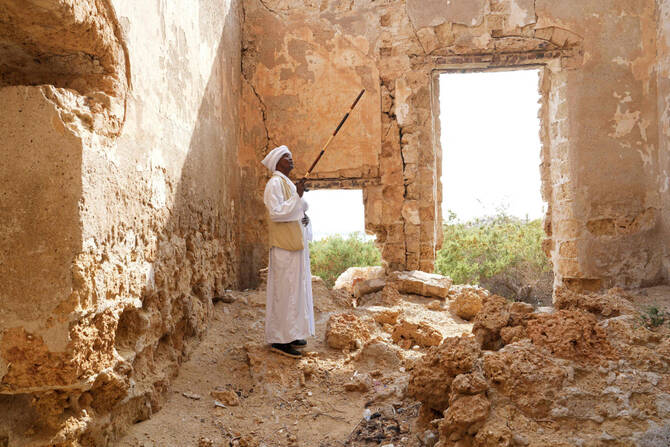
The once-booming transit port-turned tourist site of Suakin sits on the water, effectively forgotten for nearly three years as Sudan remains mired in a devastating war between the army and paramilitary forces. (AFP)
2 / 4
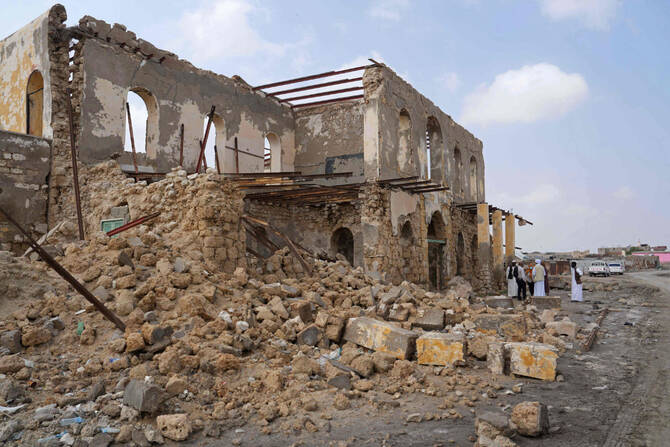
The once-booming transit port-turned tourist site of Suakin sits on the water, effectively forgotten for nearly three years as Sudan remains mired in a devastating war between the army and paramilitary forces. (AFP)
3 / 4
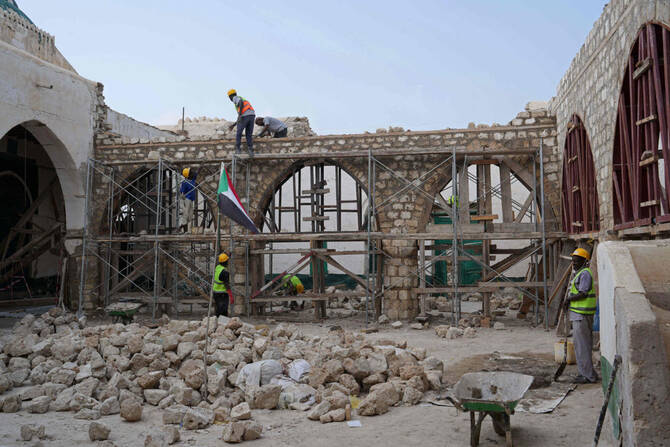
The once-booming transit port-turned tourist site of Suakin sits on the water, effectively forgotten for nearly three years as Sudan remains mired in a devastating war between the army and paramilitary forces. (AFP)
4 / 4
The once-booming transit port-turned tourist site of Suakin sits on the water, effectively forgotten for nearly three years as Sudan remains mired in a devastating war between the army and paramilitary forces. (AFP)
Short Url
Updated 01 February 2026
Follow

In Sudan’s old port of Suakin, dreams of a tourism revival

  • Inside the ruins of a mosque, a restoration crew is hard at work rebuilding this piece of Suakin, over a century after the city was abandoned

SUAKIN, Sudan: The mayor of Suakin dreams of a rebirth for his town, an ancient Red Sea port spared by the wars that have marked Sudan’s history but reduced to ruins by the ravages of time.
“It was called the ‘White City’,” for its unique buildings made of coral stone taken from the seabed, said mayor Abu Mohamed El-Amin Artega, who is also the leader of the Artega tribe, part of eastern Sudan’s Beja ethnic group.
Now the once-booming port and tourist draw languishes on the water, effectively forgotten for years as Sudan remains mired in a devastating war between the army and paramilitary forces.
But inside the ruins of a mosque, a restoration crew is hard at work rebuilding this piece of Suakin, over a century after the city was abandoned.
“Before the war, a lot of people came, a lot of tourists,” said Ahmed Bushra, an engineer with the association Safeguarding Sudan’s Living Heritage from Conflict and Climate Change (SSLH).
“We hope in the future, when peace comes to Sudan, they will come and enjoy our beautiful historic buildings here,” he told AFP.


The once-booming transit port-turned tourist site of Suakin sits on the water, effectively forgotten for nearly three years as Sudan remains mired in a devastating war between the army and paramilitary forces. (AFP) 

Architecture student Doha Abdelaziz Mohamed is part of the crew bringing the mosque back to life with funding from the British Council and support from UNESCO.
“When I came here, I was stunned by the architecture,” the 23-year-old said.
The builders “used techniques that are no longer employed today,” she told AFP. “We are here to keep our people’s heritage.”

Abandoned

The ancient port — set on an oval island nestled within a lagoon — served for centuries as a transit point for merchant caravans, Muslim and Christian pilgrims traveling to Makkah and Jerusalem, and the regional slave trade, according to the Rome-based heritage institute ICCROM.
It became a vibrant crossroads under the Ottoman Empire, said Artega, 55, and its population grew to around 25,000 as a construction boom took off.
“The streets were so crowded that, as our forefathers said, you could hardly move.”
Everything changed in 1905, when the British built a deeper commercial port 60 kilometers (37 miles) north, to accommodate increased maritime traffic with the opening of the Suez Canal.
“Merchants and residents moved to Port Sudan,” the mayor said, lamenting the decline of what he calls “Sudan’s great treasure.”
But his Artega tribe, which has administered the city since the sixth century with powers “passed from father to son,” refused to leave.
His ancestor, he said, scolded the British: “You found a port as prosperous as a fine hen — you took its eggs, plucked its feathers and now you spit its bones back at us.”


The once-booming transit port-turned tourist site of Suakin sits on the water, effectively forgotten for nearly three years as Sudan remains mired in a devastating war between the army and paramilitary forces. (AFP) 

As proof of the Artega’s influence, he keeps at home what he says are swords and uniforms gifted to his ancestors by Queen Victoria during the British colonial period.
The rise of Port Sudan spelled disaster for Suakin, whose grand public buildings and elegant coral townhouses were left to decay, slowly eaten away by the humid winds and summer heat.
But the 1990s brought new hope, with the opening of a new passenger port linking Suakin to Jeddah in Saudi Arabia.
Today, the Sudanese transport company Tarco operates daily crossings, carrying around 200 passengers per trip from the modern port of Suakin, within sight of the ancient city and its impoverished environs.

Lease to Turkiye

The city’s optimism grew in 2017 when then-president Omar Al-Bashir granted the old port to his Turkish counterpart, Recep Tayyip Erdogan, under a 99-year lease for touristic development.
A Turkish company restored the old governor’s palace, customs house and two mosques, but the project stalled in 2019 after Bashir fell from power in the face of mass protests.
Then, in April 2023, the cruise passengers and scuba divers who once stopped in Suakin completely vanished when fighting erupted between the army and the paramilitary Rapid Support Forces (RSF).


The once-booming transit port-turned tourist site of Suakin sits on the water, effectively forgotten for nearly three years as Sudan remains mired in a devastating war between the army and paramilitary forces. (AFP) 

rusting cargo ship now lies stranded on a sandbank in the blue lagoon, where only a handful of fishing boats float around.
But Bushra, from SSLH, remains optimistic. He hopes to see the mosque, which houses the tomb of a Sufi sheikh, host a traditional music festival when the renovation is complete, “in five months.”
“When we finish the restoration, the tourists can come here,” he said.


US transfers thousands of Daesh detainees from Syria to Iraq

Updated 8 sec ago
Follow

US transfers thousands of Daesh detainees from Syria to Iraq

BAGHDAD: The United States Central Command said it has completed the transfer of more than 5,700 detained Daesh group suspects from Syria to Iraq.
The detainees from some 60 countries had for years been held in Syrian prisons run by Kurdish-led forces before the recapture of surrounding territory by Damascus prompted Washington to step in.
CENTCOM said it “completed a transfer mission following a nighttime flight from northeastern Syria to Iraq on Feb 12 to help ensure Daesh detainees remain secure in detention facilities.”
“The 23-day transfer mission began on Jan 21 and resulted in US forces successfully transporting more than 5,700 adult male Daesh fighters from detention facilities in Syria to Iraqi custody,” it added in a statement.
The US had previously announced it would transfer around 7,000 detainees.
Daesh swept across Syria and Iraq in 2014, committing massacres and forcing women and girls into sexual slavery.
Backed by US-led forces, Iraq proclaimed the defeat of Daesh in the country in 2017, and the Kurdish-led Syrian Democratic Forces (SDF) ultimately beat back the group in Syria two years later.
The SDF went on to jail thousands of suspected jihadists and detain tens of thousands of their relatives in camps.

- 61 countries -

Last month, Syrian troops drove Kurdish forces from swathes of northern Syria, sparking questions over the fate of the Daesh prisoners.
Lingering doubts about security pushed Washington to announce it would transfer them to Iraq to prevent “a breakout” that could threaten the region.
“We appreciate Iraq’s leadership and recognition that transferring the detainees is essential to regional security,” said head of CENTCOM Admiral Brad Cooper.
“Job well done to the entire Joint Force team who executed this exceptionally challenging mission on the ground and in the air,” he added.
Iraq’s National Center for International Judicial Cooperation (NCIJC) said 5,704 Daesh detainees of 61 nationalities have arrived in Iraq.
They include 3,543 Syrians, 467 Iraqis, and another 710 detainees from other Arab countries.
There are also more than 980 foreigners including those from Europe, Asia, Australia and the United States.
The NCIJC said Iraq’s judiciary will interrogate the detainees before taking legal action against them.
Many prisons in Iraq are already packed with Daesh suspects.
Iraqi courts have handed down hundreds of death sentences and life terms to those convicted of terrorism offenses, including foreign fighters.
Under Iraqi law, terrorism and murder offenses are punishable by death, and execution decrees must be signed by the president.
The detainees in Syria were transferred to Baghdad’s Al-Karkh prison, once a US Army detention center known as Camp Cropper, where former ruler Saddam Hussein was held before his execution.
To make space for the newcomers, authorities moved thousands of prisoners from the Karkh prison to other facilities, a lawyer and an inmate told AFP on condition of anonymity.

- Repatriation -

Iraq has issued calls for countries to repatriate their nationals among the Daesh detainees, though this appears unlikely.
For years, Syria’s Kurdish forces also called on foreign governments to take back their citizens, but this was done on a small scale limited to women and children held in detention camps.
Most foreign families have left northeast Syria’s Al-Hol camp, which holds relatives of Daesh fighters, since the departure of Kurdish forces who previously guarded it, humanitarian sources told AFP on Thursday.
Last month, the Syrian government took over the camp from Kurdish forces who ceded territory as Damascus extended its control across swathes of Syria’s northeast.