

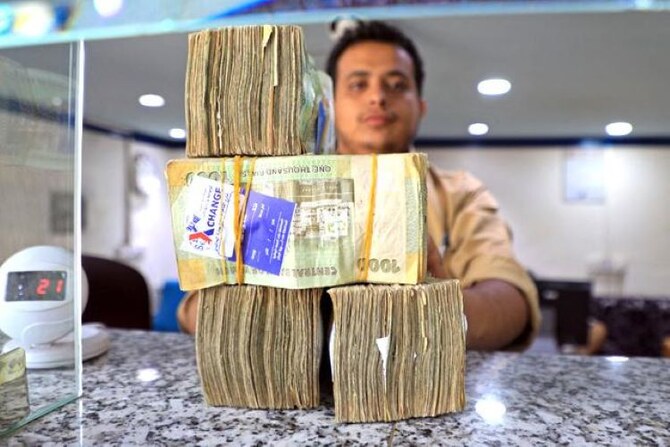

AL-MUKALLA: The Yemeni riyal stabilized on Monday near its all-time low of 2050 against the dollar in government-controlled areas, as the Yemeni government launched a campaign targeting unlicensed exchange firms.
Local money traders and media said that the riyal was trading at 2050 against the dollar, maintaining the same record low, days after breaking the historic low of 2000 against the dollar. In early 2015, the Yemeni riyal was worth 215 per dollar.
This comes as the Yemeni government closed dozens of exchange firms in Aden, Yemen’s interim capital, Hadramout, Shabwa, and Mahra that lack or have expired licenses.
Local officials, escorted by armed policemen, were seen in the streets of Aden, Al-Mukalla in Hadramout, Attaq in Shabwa, and Al-Ghaydah in Mahra province, inspecting exchange firms and shops’ licenses and closing the doors of unlicensed firms to slow the devaluation of the Yemeni riyal.
The Yemeni government has long accused local money traders of engaging in currency speculation, which resulted in the Yemeni riyal’s rapid devaluation.
Another reason for the devaluation, according to the Yemeni government, is the Houthis’ attacks on oil terminals in Hadramout and Shabwa in late 2022, which resulted in a complete halt to oil exports.
Saleh Fadaeq, the head of the central bank branch in Shabwa, said on Monday that the campaign against unauthorized exchange firms would continue to stop the Yemeni riyal’s devaluation, end currency speculation, and combat money laundering, according to the official news agency SABA.
The Presidential Leadership Council and the Yemeni government have recently requested financial assistance from international donors to help stabilize the Yemeni riyal, pay employees, and fund critical projects.
Yemenis across the political and social spectrum have warned of a major humanitarian crisis in Yemen, as the rapid devaluation of the riyal has driven up the prices of food, fuel, and other essential commodities, pushing people deeper into poverty.
Ismael Al-Sharabi wrote on Facebook that the riyal’s depreciation is causing “a humanitarian crisis,” with the prices for basic food items reaching unprecedented highs. He urged the Yemeni government to quickly bring under control the riyal’s fall.
“A tomato now costs 1,000 riyals. This is a humanitarian disaster and a historical curse that has befallen these people, who are now fighting death to survive, swallowing all burdens, high prices, and extreme poverty,” Al-Sharabi said.
High prices caused by the riyal’s devaluation have sparked violent protests in Aden and Al-Mukalla, as well as other Yemeni cities under government control, over the last several years.
Mustafa Nasr, director of the Studies and Economic Media Center, said the government’s campaign against unlicensed exchange firms did not lead to the riyal’s recovery as it only targeted small firms and not the large exchange firms that control the market, calling for stricter government measures to prevent the riyal’s fall.
“The exchange sector has become disorganized, bloated, and has sufficient liquidity to influence the exchange market,” Nasr told Arab News.
In its most recent report on the Yemeni economy, released late last month, the World Bank depicted a bleak economy in 2025, saying that Yemen’s gross domestic product is expected to fall by 1 percent in 2024, compared to a 2 percent drop last year.
Sixty percent of Yemenis have insufficient access to food due to an unprecedented level of insecurity brought about by the war, and the Houthis’ attacks on oil terminals slashed 42 percent of the government’s revenues, making it difficult for it to provide public services and devaluing the Yemeni riyal, according to the World Bank.


