CAIRO: A member of a criminal group linked to a mass grave containing the bodies of 21 migrants will stand trial on a charge of human trafficking, Libya’s attorney general’s office said Friday.
The office said in a statement on Facebook that the gang member was being referred to court.
Authorities found evidence that the criminal gang organized illegal migration and trafficked people in Al-Kufra city in southeast Libya and Ajdabiya city in the eastern part of the country. The attorney general’s statement didn’t identify the gang.
Libya has been a main transit point for migrants fleeing war and poverty in Africa and the Middle East. The country plunged into chaos after a 2011 uprising toppled and killed longtime dictator Muammar Qaddafi.
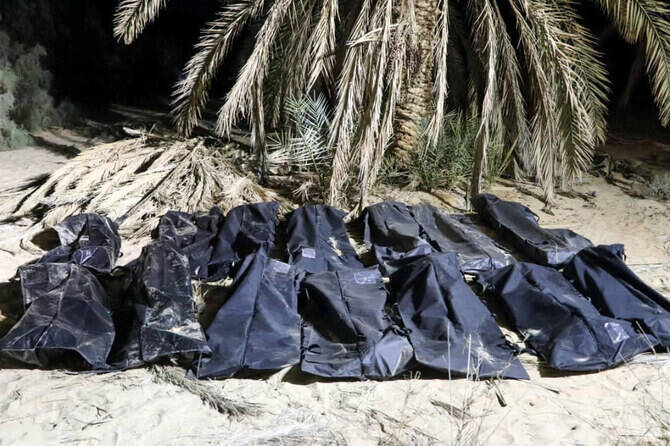
It remains unclear how the 21 migrants died or when, or exactly when and where they were found. The attorney general’s office released images Friday showing bodies wrapped in black plastic bags, with some remains partially covered in dirt. The Associated Press could not immediately independently verify the images.
The statement said 195 migrants were released by the criminal group after being detained and subjected to torture aimed at extorting ransom from their families. Authorities arrested one of the members of the group, while remaining members are still being pursued, according to the attorney general’s office.
Many migrants who take the risky sea route to reach Europe seeking a better lives do not survive. Most recently, at least 42 people went missing and were presumed dead after a boat carrying migrants capsized off the coast of Libya, according to the International Organization for Migration.
The latest shipwreck adds to the rising death toll in the Central Mediterranean, where more than 1,000 people have died since the beginning of 2025, including over 500 lost off the coast of Libya, according to the IOM’s Missing Migrants Project.
After Qaddafi was killed, Libya was split in two, with rival administrations in the east and west, each backed by armed groups and foreign governments. The western part of the country is governed by Prime Minister Abdul-Hamid Dbeibah’s government in Tripoli, and the administration of Prime Minister Ossama Hammad rules in the east.

Libya to try a gang member linked to a mass grave of 21 migrants for human trafficking
https://arab.news/zfjnu
Libya to try a gang member linked to a mass grave of 21 migrants for human trafficking
- Authorities found evidence that the criminal gang organized illegal migration and trafficked people in Al-Kufra city
- It remains unclear how the 21 migrants died or when, or exactly when and where they were found
Israeli tank fires near Lebanese army and UNIFIL patrol amid escalating tensions
- On Friday, President Joseph Aoun met with Parliament Speaker Nabih Berri to address the Israeli escalation
- Aoun has faced mounting criticism from Hezbollah-aligned activists for his repeated insistence on the state’s exclusive authority over arms
BEIRUT: An Israeli tank opened fire near a joint Lebanese army and UNIFIL patrol on Friday afternoon, in the latest incident to heighten tensions along the Blue Line.
The tank shell reportedly landed near Wadi Al-Asafir, south of the town of Khiam, where the Lebanese army and UNIFIL were conducting a field operation. The fire was said to have come from a newly established Israeli position in the Hamams area, according to eyewitnesses.
A Lebanese military source told Arab News: “This is not the first time Israeli forces have targeted Lebanese army and UNIFIL units. Similar incidents have occurred during operations south of the Litani River, and UNIFIL has previously issued statements condemning such actions.”
Earlier on Friday, an Israeli drone fired three missiles at a vehicle in Baalbek, eastern Lebanon, in a failed assassination attempt. Witnesses said the first strike hit a car traveling on the Majdaloun-Baalbek road. The driver, believed to be Palestinian, managed to escape, tossing his phone out before parking near Dar Al-Amal Hospital.
The drone fired a second missile that missed, resulting in material damage only. A third strike followed, but the target was not injured.
The attacks come amid renewed Israeli skepticism over Lebanon’s efforts to confiscate weapons south of the Litani River. Israeli officials dismissed Beirut’s recent announcement of completing the first phase of the disarmament plan as a “media stunt to buy time.” Lebanese officials insisted that progress was being made under a phased national strategy backed by international partners.
On Friday, President Joseph Aoun met with Parliament Speaker Nabih Berri to address the Israeli escalation, which this week included the bombing of residential areas north of the Litani River, displacing dozens of families.
Aoun has faced mounting criticism from Hezbollah-aligned activists for his repeated insistence on the state’s exclusive authority over arms. A social media campaign launched Thursday accused the president of betraying the resistance, using defamatory language in videos widely circulated online.
Despite the backlash, Berri is said to be supportive of Aoun’s position. A Lebanese official told Arab News, “Berri continues to play a mediating role and agrees that the real problem lies in the lack of international pressure on Israel to respect the ceasefire and end its violations.”
Aoun told a visiting delegation from the Southern Border Towns Association on Friday that Lebanon’s stability is impossible without security in the south. “We are coordinating with the army to reinforce their presence in the border villages,” he said. “Our primary demand in the mechanism meetings remains the safe return of displaced residents and the release of prisoners.”
Meanwhile, the Public Prosecutor’s Office has begun summoning individuals accused of insulting Aoun online, including journalist Hassan Alik, who failed to appear on Friday.
The Presidential Palace told Arab News that the president had not filed a complaint and that the judiciary acted independently in accordance with Lebanese law, which criminalizes insults against the head of state.
Alik’s lawyer, Alia Moallem, filed a legal memorandum arguing that the summons violated the constitution and press laws, stating the remarks fall within the scope of journalistic work and freedom of expression.
In a statement, the Lebanese Press Editors Syndicate urged journalists to uphold responsible discourse during this sensitive time, while reaffirming the importance of safeguarding freedom of speech under Lebanese law.


