

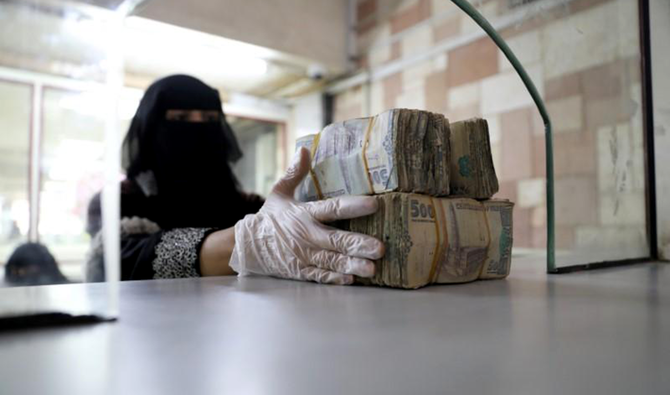

AL-MUKALLA: The Yemeni riyal fell to an all-time low of 1,770 against the dollar on Monday in Yemeni-government-controlled districts, a drop likely to drive up prices and spark violence.
Local money traders and local media said on Monday that the Yemeni riyal was edging closer to a historic record low of 1,800 against the dollar in Aden, Al-Mukalla and other Yemeni districts controlled by the internationally recognized Yemeni government.
In January, the riyal reached a record low of 1,600 against the dollar in government-controlled provinces, two months after it had fallen to a new low of 1,500 against the dollar.
The local currency was trading at 215 to the dollar in late 2014 when the war in Yemen broke out after the Houthis took control of the capital, Sanaa.
It reached an all-time low of 1,700 against the dollar in December 2021, but rebounded to 1,200 after Saudi Arabia injected hundreds of millions of dollars into the central bank in Aden.
The rate of the currency in the Houthi-controlled areas has stayed consistent at 527 against the dollar since late 2016.
The Yemeni government and the central bank in Aden have not commented on the latest drop in the currency, but they usually blame currency speculation by black-market money traders as well as the Houthis, who deprived the Yemeni government of oil revenues by attacking oil terminals in southern Yemen.
In an attempt to control a chaotic market, Adens central bank has previously shut down unlicensed exchange companies, held public auctions to sell the dollar to local food and fuel importers, ordered financial institutions to submit annual statements to the bank, and linked local exchange companies in a unified remittance system under its supervision.
These measures failed to slow the riyal’s devaluation.
The Yemeni riyal used to rebound once a new government was formed or when Saudi Arabia and the UAE made additional deposits into the central bank.
The depreciation of the currency has led to increases in fuel, food and transport costs, forcing millions of Yemenis into poverty, according to local and international aid agencies.
The riyal’s decline in government-controlled provinces of Yemen was attributed to the central bank’s diminishing foreign currency reserves, the cessation of oil exports, and a decrease in remittances from outside the country, according to the World Food Programme’s most recent regular bulletin on food security in Yemen, which was released on Saturday.
The bulletin said, referring to the internationally recognized government of Yemen based in southern Yemen, that the “disruption of oil exports resulted in a nearly $2 billion loss in IRG revenues. The worsening economic situation has also increased food and fuel prices in the south.”
State workers say their wages have not risen in more than a decade and have lost more than 200 percent of their value while prices have skyrocketed.
The devaluation of the riyal has prompted teachers in Yemen’s Hadramout province to go on strike to demand a pay raise.
Taha Bafadhel, a teacher from Ghayel Bawazer in Hadramout, told Arab News that he was currently required to work three jobs to support his family and make ends meet and that educators have fallen into poverty as a result of the devaluation of the riyal and poor salaries.
“The salary has become insufficient to cover a third of the family’s expenses, necessitating additional work to cover the remaining expenses. Even a second job would not meet the expenses,” he said. “The reason for this is the currency collapse, which has resulted in a rise in prices, and also unchanged salaries.”


