

Israel officially informs UN of end to relations with Palestinian relief agency

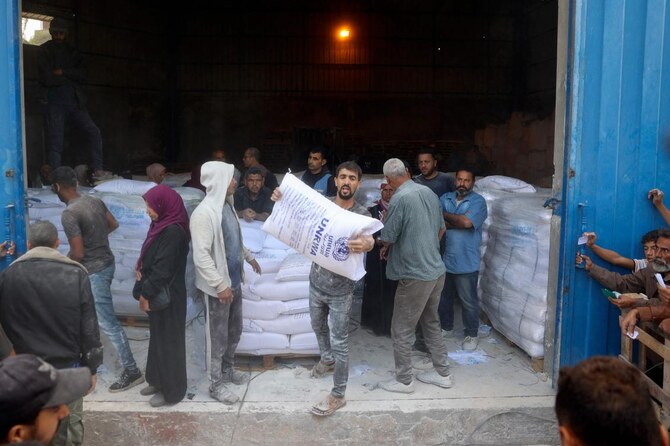
Volunteers distribute sacks of flour at a United Nations Relief and Works Agency (UNRWA) aid distribution center in Deir el-Balah on November 4, 2024, amid the ongoing war between Israel and the Palestinian militant group Hamas. (AFP)
Short Url
Updated 04 November 2024
Follow

Israel officially informs UN of end to relations with Palestinian relief agency

  • The Israeli parliament passed legislation banning UNRWA from operating in Israel and stopping Israeli authorities from cooperating with the organization
  • UNRWA says Israel ban likely to cause ‘collapse’ of Gaza aid work

JERUSALEM: Israel has officially notified the United Nations that it was canceling the agreement that regulated its relations with the main UN relief organization for Palestinian refugees (UNRWA) since 1967, the country’s foreign ministry said on Monday.
Last month, the Israeli parliament passed legislation banning UNRWA from operating in Israel and stopping Israeli authorities from cooperating with the organization, which provides aid and education services to millions of Palestinians in the occupied West Bank and Gaza.

The UNRWA warned on Monday that Israel’s ban on its operations would lead to the “collapse” of humanitarian work in the war-torn Gaza Strip.
“If this law is implemented, it would be likely to cause the collapse of the international humanitarian operation in the Gaza Strip — an operation of which UNRWA is the backbone,” Jonathan Fowler, an UNRWA spokesman, told AFP.
Israel has long been critical of UNRWA, set up in the wake of the 1948 war that broke out at the time of the creation of the state of Israel, accusing it of anti-Israel bias and saying it perpetuates the conflict by maintaining Palestinians in a permanent refugee status.
Since the start of the Gaza war in October last year, it has also said that the organization has been deeply infiltrated by Hamas in Gaza, accusing some of its staff of taking part in the Oct. 7 attack on Israel.
The legislation has alarmed the United Nations and some of Israel’s Western allies who fear it will further worsen the already dire humanitarian situation in Gaza, where Israel has been fighting Hamas militants for a year. The ban does not refer to operations in the Palestinian territories or elsewhere.
Israel’s UN Ambassador Danny Danon said in a statement that despite the overwhelming evidence “we submitted to the UN highlighting how Hamas infiltrated UNRWA, the UN did nothing to address this reality.”
The legislation does not directly outlaw UNRWA’s operations in the West Bank and Gaza, both considered by international law to be outside the state of Israel but under Israeli occupation.
But it will severely impact its ability to work in those areas and there has been deep alarm among aid groups and many of Israel’s partners.
The Israeli foreign ministry said activity by other international organizations would be expanded and “preparations will be made to end the connection with UNRWA and to boost alternatives to UNRWA.”


Supplies running out at Syria’s Al-Hol camp as clashes block aid deliveries

Updated 4 sec ago
Follow

Supplies running out at Syria’s Al-Hol camp as clashes block aid deliveries

DAMASCUS: An international humanitarian organization has warned that supplies are running out at a camp in northeast Syria housing thousands of people linked to the Daesh group, as the country’s government fights to establish control over an area formerly controlled by Kurdish fighters.
The late Friday statement by Save the Children came a week after government forces captured Al-Hol camp, which is home to more than 24,000 people, mostly children and women, including many wives or widows of Daesh members.
The capture of the camp came after intense fighting earlier this month between government forces and members of the Kurdish-led and US-backed Syrian Democratic Forces during which forces loyal to interim President Ahmad Al-Sharaa captured wide areas in eastern and northeastern Syria.
The SDF signed a deal to end the fighting after suffering major defeats, but sporadic clashes between it and the government have continued.
Save the Children said that “critical supplies in Al-Hol camp are running dangerously low” as clashes are blocking the safe delivery of humanitarian aid.
It added that last week’s clashes around the camp forced aid agencies to temporarily suspend regular operations at Al-Hol. It added that the main road leading to the camp remains unsafe, which is preventing humanitarian workers from delivering food and water or running basic services for children and families.
“The situation in Al-Hol camp is rapidly deteriorating as food, water and medicines run dangerously low,” said Rasha Muhrez, Save the Children Syria country director. “If humanitarian organizations are unable to resume work, children will face still more risks in the camp, which was already extremely dangerous for them before this latest escalation.”
Muhrez added that all parties to the conflict must ensure a safe humanitarian corridor to Al-Hol so basic services can resume and children can be protected. “Lives depend on it,” she said.
The SDF announced a new agreement with the central government on Friday, aiming to stabilize a ceasefire that ended weeks of fighting and lay out steps toward integrating the US-backed force into the army and police forces.