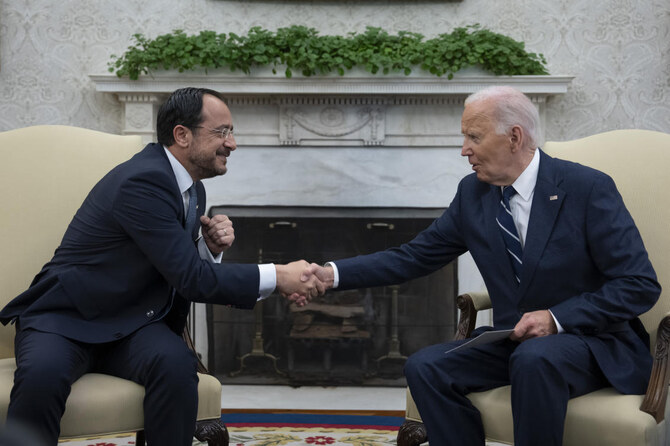
NICOSIA: The president of Cyprus said Sunday his administration is committed to expanding defense and security cooperation with the US, as his meeting with American President Joe Biden last week charted a course for the “next ambitious steps” in bilateral relations that are currently at a “historic high.”
President Nikos Christodoulides says his government’s “clear foreign policy orientation” has resulted in deepening the Cyprus-US strategic partnership over the first 18 months of his five-year term in fields including law enforcement cooperation on countering money laundering and sanctions evasion, as well as energy.
A centerpiece of that security cooperation is the US-funded center for port and maritime security known by its acronym CYCLOPS where officials from neighboring countries including Libya, Yemen and Lebanon, receive key training ranging from cybersecurity to ship inspections.
Christodoulides said his Oct. 30 visit to the White House “is proof and recognition of the geostrategic role of Cyprus and the country’s potential and capabilities.”
“Cyprus can be a reliable ‘port of stability’ and at the same time a country that has a vision to transform its immediate region, alongside its partners, into a region of promise, stability, cooperation and prosperity,” Christodoulides said in an email response to an Associated Press questionnaire.
The Cypriot president said his administration is “certainly considering” procuring US-made weapons following the 2020 lifting of a decades-long arms embargo. But what must precede such purchases is for the US Congress to lift its embargo for an extended period. Currently, that is renewed annually.
Christodoulides said Cyprus’ geostrategic role is highlighted by the fact that since Sept. 27, some 3,635 third-country nationals from 29 countries have been repatriated through the island nation following their evacuation from Lebanon. He said several countries consider Cyprus an “assisted departure hub and a Temporary Safe Location (TSL)” where the island’s ports, airports and designated temporary accommodations are used for civilian or military-led departures. He did not specify those countries.
He said Cyprus is ready to respond if and when a mass evacuation from Lebanon is set in motion.
Another key initiative for which Cyprus has gained international plaudits and was singled out by Biden is the so-called Amalthea plan that saw the establishment of the Cyprus-Gaza maritime corridor through which some 20,000 metric tons of aid flowed into the Palestinian territory earlier this year.
Most of that aid reached Gaza through a US-built, $230 million temporary pier project that lasted about four months after being beset by turbulent weather, security threats and sweeping personnel restrictions.
Christodoulides said work is underway in cooperation with the US, the UK, the United Arab Emirates, and the European Union, to re-activate the maritime route to Gaza through the Israeli port of Ashdod. Collected aid will be security-screened in Cyprus and shipped to Ashdod “for swift onward delivery to Gaza.”
“We maintain excellent, longstanding relations with our neighboring countries, underpinned by trust, and we have consistently acted as the region’s voice in the European Union, and as a reliable interlocutor and partner with all the states of the region,” Christodoulides said.
On his decision to invite FBI and US Department of Justice officials to help Cypriot law enforcement to halt Russian sanctions evasion through Cypriot lawyers and accountants, Christodoulides said, “we are strongly determined to clear our country’s name internationally and prove that Cyprus is a state fully aligned with the principles and values of the West.”
He said “several cases” of possible sanctions evasion are under investigation” and the aim is to bring them to justice as quickly as possible.”
Regarding energy cooperation, Christodoulides said the fact that both US energy giants ExxonMobil and Chevron are active in the search for hydrocarbons in Cyprus’ offshore economic zone is “a vote of confidence” in the island nation.
He said next year will be a “milestone” for both energy companies. ExxonMobil and partner QatarEnergy, which discovered a sizeable natural gas deposit in one of two areas, or blocks, they hold exploration licenses for, are scheduled to drill two additional wells in January of next year.
Chevron is expected to complete fine-tuning a revised development plan for its Aphrodite gas field, estimated to hold around 4.2 trillion cubic feet of natural gas.
“As the first gas from the Aphrodite is directed to the market, this automatically makes Cyprus a gas seller, which is extremely important not only in monetary terms but also for geopolitical reasons,” said Christodoulides.


![]()

Cyprus is committed to expanding defense ties with the US, says president
Short Url
https://arab.news/gceev
Cyprus is committed to expanding defense ties with the US, says president
- Centerpiece of security cooperation is the US-funded center for port and maritime security known by its acronym CYCLOPS
- Officials from neighboring countries including Libya, Yemen, and Lebanon, receive key training ranging from cybersecurity to ship inspections


Latest updates


Recommended


© 2026 SAUDI RESEARCH & PUBLISHING COMPANY, All Rights Reserved And subject to Terms of Use Agreement.