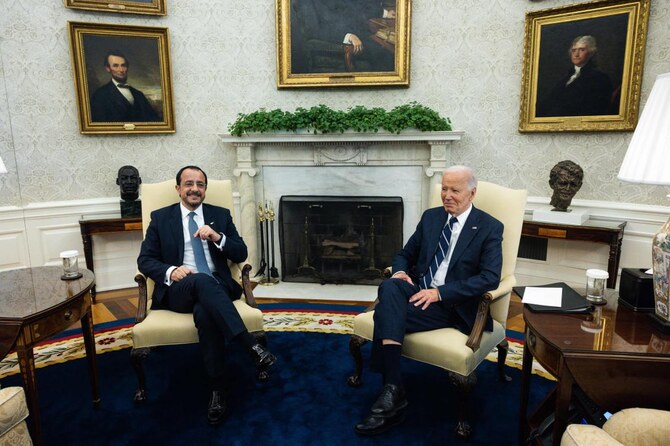
WASHINGTON: President Joe Biden and Cypriot President Nikos Christodoulides on Wednesday discussed a new effort by the US administration and mediators in the Middle East to forge ceasefires to end fighting in Lebanon and Gaza.
Christodoulides leads the European Union nation closest to Gaza. The small Mediterranean island nation has played a critical role in efforts to get humanitarian aid into Gaza since the war between Hamas and Israel began more than a year ago.
He said that Biden and White House officials briefed him on the latest stepped-up efforts by the US administration and other mediators but declined to offer further details about the discussion.
“The most important, the number one priority of the international community now is to have a ceasefire in the region,” Christodoulides told reporters after his Oval Office talks with Biden.
He added that situation on the ground changes daily but that he was “quite optimistic” that a Lebanon ceasefire deal could emerge in one to two weeks.
Senior White House officials Brett McGurk and Amos Hochstein will visit Israel on Thursday for talks on possible ceasefires in both Lebanon and Gaza, and on the release of hostages held by Hamas, White House press secretary Karine Jean-Pierre said. She said CIA Director Bill Burns will head to Egypt on Thursday to discuss those efforts.
A proposal to end the war between Israel and Hezbollah calls for a two-month ceasefire during which Israeli forces would withdraw from Lebanon, and Hezbollah would end its armed presence along the country’s southern border, according to two US officials familiar with the talks said. The officials were not authorized to comment publicly and spoke on the condition of anonymity.
Biden, meanwhile, thanked Cyprus for helping move badly needed humanitarian aid into Gaza and for the Mediterranean nation’s cooperation in response to Russia’s war in Ukraine.
The meeting, the first Oval visit by a Cypriot president since 1996, comes days after US and Cypriot officials announced the countries are launching a strategic dialogue aimed at bolstering security and stability in a crisis-wracked region through initiatives including counterterrorism training of personnel from Middle Eastern countries and fighting sanctions evasion.
The new coordination is just the latest example of Cyprus tightening relations with the US after decades of walking a tightrope between Washington and Moscow. Cyprus has moved closer to the US since Russia’s 2022 invasion of Ukraine.
“Today we stood against Russia’s vicious onslaught against Ukraine, we launched a strategic dialogue, we increased cooperation across a range of issues, from energy security to artificial intelligence, and we surged humanitarian aid, delivering 8000 metric tons to Gaza,” Biden said.
The US is also funding a center on the island nation under the acronym CYCLOPS that trains personnel from Cyprus and neighboring countries on maritime and cybersecurity as well as counterterrorism techniques.
The Cyprus government has also stepped up coordination with local law enforcement, the US Department of Justice and the FBI to help combat the evasion of sanctions against Russia and other countries.
The FBI is helping train Cypriot police in identifying and prosecuting cases of illegal financing and attempts to evade US, European Union and UN sanctions imposed on any third country.
Last month, Cyprus and the US signed a defense cooperation framework agreement that outlines ways the two countries can enhance their response to regional humanitarian crises and security concerns.
Christodoulides said Cyprus has proven to be a “predictable and reliable partner of the United States in a region of great geopolitical importance.”
Earlier this year, Cyprus helped the US establish a Gaza maritime corridor for the shipborne delivery of humanitarian aid to the Palestinian territory.
The $230 million temporary pier project was derided as a boondoggle by critics and was beset by turbulent weather, security threats and sweeping personnel restrictions. The Pentagon pulled the plug on the effort after about four months.
The Biden administration had set a goal of the US sea route and pier providing food to feed 1.5 million people for 90 days. It fell short, bringing in enough to feed about 450,000 people for a month before shutting down, according to a USAID inspector general’s report.


Biden, Cyprus president discuss administration push to win ceasefires in Gaza and Lebanon
https://arab.news/vm8ad
Biden, Cyprus president discuss administration push to win ceasefires in Gaza and Lebanon

- Christodoulides said he was “quite optimistic” that a Lebanon ceasefire deal could emerge in one to two weeks


Australia to deploy long-range reconnaissance plane to Gulf
- The government says there are about 115,000 Australian nationals across the Middle East, of whom about 2,600 have returned home.
SYDNEY: Australia will deploy a long-range military reconnaissance plane to the Gulf to protect civilians, Prime Minister Anthony Albanese said Tuesday.
An E-7A Wedgetail aircraft and supporting defense force personnel will be sent for an initial period of four weeks to help “protect and secure the airspace above the Gulf,” Albanese told a news conference.
Australia also plans to provide advanced, medium-range air-to-air missiles to the United Arab Emirates “in response to a request,” the prime minister said.
The UAE, in which there are an estimated 24,000 Australians, has shot down more than 1,500 rockets and drones fired by Iran in reprisal following US-Israeli strikes, he said.
Albanese said he decided to send the advanced radar surveillance plane to the Gulf following a discussion with UAE President Mohammed bin Zayed Al Nahyan.
“The first priority of my government is, and always will be, to keep Australians safe,” the prime minister said.
“Helping Australians means also helping the UAE and other Gulf nations to defend themselves against what are unprovoked attacks,” he added.
“My government has been clear that we’re not taking offensive action against Iran, and we’ve been clear that we are not deploying Australian troops on the ground in Iran.”
The government says there are about 115,000 Australian nationals across the Middle East, of whom about 2,600 have returned home.
“Significant challenges remain, and further work is underway to support those still seeking to leave,” Albanese said.
Australia said last week it had deployed a heavy transport plane and a fuel transport plane to the Middle East as part of plans to get its citizens out of the region.
Canberra has been careful to make clear that its forces are not engaging in offensive operations against Iran.
On Friday, Albanese revealed that Australian military personnel were aboard an American submarine that sank an Iranian navy ship off Sri Lanka.
The personnel were on the submarine as part of training arrangements under AUKUS, a multi-decade defense pact with Britain and the United States, he said, stressing that they did not take part in the attack.


