

Pakistan’s maritime sector records $360 million profits in 2025 — minister

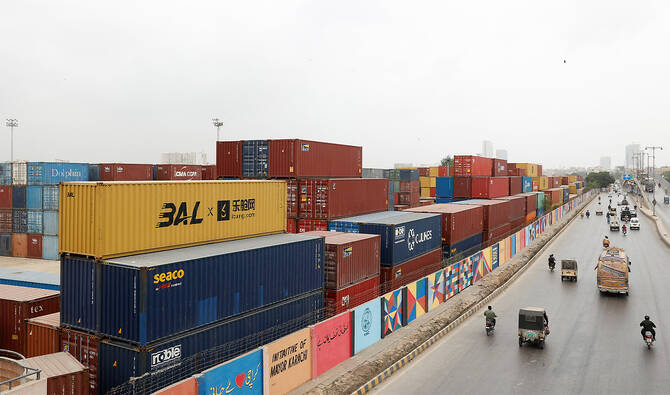
Vehicles move past a warehouse yard with shipping containers near port area in Karachi, Pakistan, on July 31, 2025. (REUTERS/File)
Short Url
Updated 24 January 2026
Follow

Pakistan’s maritime sector records $360 million profits in 2025 — minister

  • The reforms aimed to improve port efficiency, cut costs and implement long-delayed policies to position Pakistan as trade, logistics hub
  • In 2025, Karachi Port handled a record 54 million tons of cargo, while average vessel dwell time was cut by 24-36 hours, minister notes

KARACHI: Pakistan’s maritime sector posted a record Rs100 billion ($360 million) profit in 2025 following a year of sweeping reforms, Maritime Affairs Minister Junaid Anwar Chaudhry said on Saturday.

In recent years, Islamabad has taken a number of reforms to improve port efficiency, cut costs and cleared long-delayed policies to position the South Asian country as a regional trade and logistics hub.

Outlining his ministry’s annual performance, Chaudhry described 2025 as a “transformative year” marked by more than two dozen initiatives spanning legislation, digitization, infrastructure development and human resources.

In 2025, Karachi Port handled a record 54 million tons of cargo, while average vessel dwell time was cut by 24-36 hours through closer coordination among port authorities, customs and other agencies aimed at an average turnaround of five days, according to the minister.

“These reforms are modernizing our ports, shipping and fisheries to unlock the true potential of the blue economy,” the minister said, adding that Pakistan had aligned its regulatory framework with international standards, including conventions of the International Maritime Organization and the Hong Kong Convention on ship recycling.

He said a central plank of the overhaul was the finalization of the National Maritime Policy, which brings shipping, ports, fisheries and maritime security under a single framework to guide sustainable growth.

“The government also approved a National Shipping Policy aimed at expanding the Pakistan-flagged fleet to reduce reliance on foreign carriers, a longstanding drain on foreign exchange,” he added.

Pakistan concluded stakeholder consultations on the National Fisheries and Aquaculture Policy, which targets annual seafood exports of $2 billion and the creation of around two million jobs across coastal communities and allied industries, according to the minister.

Cost-cutting measures delivered substantial savings, Junaid Chaudhry said, and added: Reduced overtime at the Karachi Port Trust alone saved about Rs70 million a month, while the abolition of 2,152 redundant posts across maritime entities lowered human resource costs by billions of rupees.

“The Karachi Port Trust and the Port Qasim Authority reclaimed about 150 acres of encroached land valued at roughly Rs110 billion, while Port Qasim recovered an additional eight acres,” the minister stated.

Chaudhry said they introduced the Pakistan Maritime Century Framework 2047–2147 to advance the maritime sector, established an Artificial Intelligence Maritime Secretariat to monitor ports, shifted to paperless governance through a 100 percent e-office rollout, integrated the Pakistan Single Window with the Port Community System to streamline trade procedures, and introduced an electronic public asset disposal system to enhance transparency and efficiency.

The reform agenda supported several United Nations Sustainable Development Goals, including decent work and economic growth, industry and infrastructure, responsible consumption, life below water and strong institutions, according to the minister.

“Sustained implementation will be key to maintaining the momentum of these achievements, and the gains made in 2025 provide a strong foundation for turning Pakistan’s long coastline and strategic location into a durable blue economic advantage,” he added.


Pakistan urges UN Security Council to sanction separatist BLA group after recent attacks

Updated 6 sec ago
Follow

Pakistan urges UN Security Council to sanction separatist BLA group after recent attacks

  • Separatist BLA launched attacks in multiple Balochistan cities last week, killing over 50 as per official figures
  • Pakistan envoy says since Taliban assumed control of Afghanistan, BLA, other militant groups have a “new lease of life“

ISLAMABAD: Pakistan’s UN Ambassador Iftikhar Ahmed this week urged the Security Council to impose sanctions against the separatist Baloch Liberation Army (BLA) militant group and designate it as a “terrorist” group, after its recent coordinated attacks in southwestern Balochistan province. 

Pakistan’s military said on Thursday it has concluded security operations in Balochistan against separatists that was launched since Jan. 29, killing 216 militants. The military launched counteroffensive operations in Balochistan after the BLA said it launched coordinated attacks in several parts of the province last Friday and Saturday. 

The attacks killed 36 civilians and 22 law enforcement and security forces personnel, Pakistan’s military said. Pakistan’s government has accused India of being involved in the attacks, charges that New Delhi has dismissed. 

“We hope the Council will act swiftly to designate BLA under the 1267 sanctions regime acceding to the listing request that is currently under consideration,” Iftikhar said on Wednesday during a UNSC briefing on the topic ‘Threats to International Peace and Security caused by Terrorist Acts.’

The 1267 sanctions regime is a UNSC program that seeks to impose sanctions on individuals and entities associated with “terrorism.”

The regime seeks to impose travel bans, freeze assets and impose an arms embargo on individuals and groups primarily associated with Al-Qaeda or the Taliban. 

Ahmad said that after the Taliban takeover of Afghanistan in 2021, “externally sponsored and foreign-funded proxy terrorist groups” such as the Tehreek-e-Taliban Pakistan and the BLA have got a “new lease of life.”

“Operating with virtual impunity from Afghan soil and with the active support of our eastern neighbor, these groups are responsible for heinous terrorist attacks inside Pakistan,” he said. 

The Pakistani envoy said it has become imperative to prevent billions of dollars of sophisticated weapons and equipment, which were left behind by foreign forces in Afghanistan, “from falling into the hands of terrorists.”

“There must be accountability of external destabilizing actors who support, finance and arm these groups, including their proxies in Afghanistan,” Ahmad said in a veiled reference to India. 

Pakistan’s largest and poorest province, mineral-rich Balochistan borders Iran and ‌Afghanistan and is home to China’s investment in the Gwadar deep-water ‍port and other projects.

Balochistan has been the site of a ‍decades-long insurgency led by ethnic Baloch separatists seeking greater autonomy and a larger share of its natural ‍resources. 

They accuse the state of denying locals a fair share of the province’s mineral wealth, charges that are denied by the Pakistani government.