

Pakistan eyes enhanced trade, economic ties with Uzbekistan amid investment push

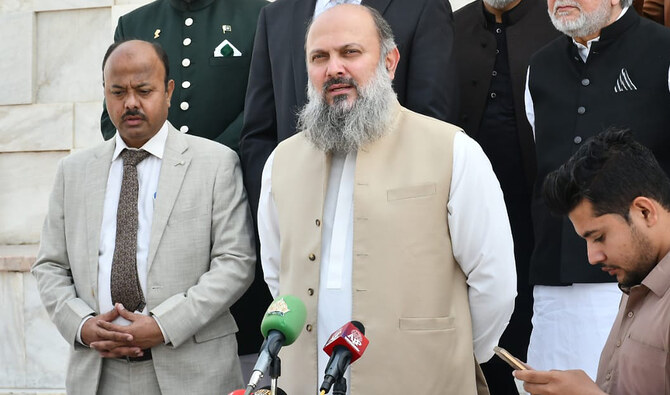
Pakistan’s Commerce Minister Jam Kamal Khan address media in Karachi, Pakistan, on March 25, 2024. (Team Jam Kamal Khan/X)
Short Url
Updated 03 November 2024
Follow

Pakistan eyes enhanced trade, economic ties with Uzbekistan amid investment push

  • Commerce Minister Jam Kamal Khan arrives in Tashkent for three-day official visit
  • Khan to take part in fourth Uzbekistan-Pakistan Business Forum, says commerce ministry

ISLAMABAD: Pakistan’s Commerce Minister Jam Kamal Khan is in Uzbekistan on a three-day visit aimed at enhancing bilateral trade, commerce and economic ties with the Central Asian state, his ministry confirmed on Sunday, amid Islamabad’s efforts to attract foreign investment to improve its economic prospects.

Pakistan has increasingly sought to enhance regional connectivity to landlocked Central Asian states by providing them access to its warm water ports. It recently offered Central Asian states to become part of the China-Pakistan Economic Corridor project, under which Beijing has pledged around $65 billion in energy, infrastructure and other projects in Pakistan.

Khan arrived in Tashkent on Saturday evening marking the start of his three-day visit to Uzbekistan, the commerce ministry said.

“Key agenda items include strategic meetings with top Uzbek officials such as Deputy Prime Minister Mr. Jamshed Khujaev and Transport Minister Mr. Ilkhom Makhkamov to discuss pivotal projects in trade, investment, and logistics,” the ministry said.

Khan’s visit will feature the ninth session of the Pakistan-Uzbekistan Inter-Governmental Commission (IGC) on Trade-Economic and Scientific-Technical Cooperation, and the fourth Uzbekistan-Pakistan Business Forum, the commerce ministry said. The session will be co-chaired by Khan and Uzbek Minister for Investment, Industry and Trade Mr. Laziz Kudratov.

The ministry said that the Business Forum will host 33 Pakistani business delegates across various sectors for B2B meetings aimed at fostering new partnerships and enhancing trade.

“The minister’s visit reflects both nations’ dedication to deepening economic and technical collaborations and supporting mutual goals, including Uzbekistan’s ongoing WTO accession,” the ministry concluded.

Pakistan has increasingly sought to promote closer ties with regional allies to bolster its fragile $350 billion economy, which is currently suffering from a prolonged macroeconomic crisis.

The South Asian country narrowly avoided a sovereign default last year when it secured a last-gasp $3 billion financial assistance package from the International Monetary Fund (IMF).

Pakistan’s economic crisis saw its inflation reach double-digit figures, foreign exchange reserves plummet to historic lows and its currency weaken significantly against the US dollar over the past two years.


Pakistan terms climate change, demographic pressures as ‘pressing existential risks’

Updated 4 sec ago
Follow

Pakistan terms climate change, demographic pressures as ‘pressing existential risks’

  • Pakistan has suffered frequent climate change-induced disasters, including floods this year that killed over 1,000
  • Pakistan finmin highlights stabilization measures at Doha Forum, discusses economic cooperation with Qatar 

ISLAMABAD: Pakistan’s Finance Minister Muhammad Aurangzeb on Saturday described climate change and demographic pressures as “pressing existential risks” facing the country, calling for urgent climate financing. 

The finance minister was speaking as a member of a high-level panel at the 23rd edition of the Doha Forum, which is being held from Dec. 6–7 in the Qatari capital. Aurangzeb was invited as a speaker on the discussion titled: ‘Global Trade Tensions: Economic Impact and Policy Responses in MENA.’

“He reaffirmed that while Pakistan remained vigilant in the face of geopolitical uncertainty, the more pressing existential risks were climate change and demographic pressures,” the Finance Division said. 

Pakistan has suffered repeated climate disasters in recent years, most notably the 2022 super-floods that submerged one-third of the country, displaced millions and caused an estimated $30 billion in losses. 

This year’s floods killed over 1,000 people and caused at least $2.9 billion in damages to agriculture and infrastructure. Scientists say Pakistan remains among the world’s most climate-vulnerable nations despite contributing less than 1 percent of global greenhouse-gas emissions.

Aurangzeb has previously said climate change and Pakistan’s fast-rising population are the only two factors that can hinder the South Asian country’s efforts to become a $3 trillion economy in the future. 

The finance minister noted that this year’s floods in Pakistan had shaved at least 0.5 percent off GDP growth, calling for urgent climate financing and investment in resilient infrastructure. 

When asked about Pakistan’s fiscal resilience and capability to absorb external shocks, Aurangzeb said Islamabad had rebuilt fiscal buffers. He pointed out that both the primary fiscal balance and current account had returned to surplus, supported significantly by strong remittance inflows of $18–20 billion annually from the Middle East and North Africa (MENA) and Gulf Cooperation Council (GCC) regions. 

Separately, Aurangzeb met his Qatari counterpart Ali Bin Ahmed Al Kuwari to discuss bilateral cooperation. 

“Both sides reaffirmed their commitment to strengthening economic ties, particularly by maximizing opportunities created through the newly concluded GCC–Pakistan Free Trade Agreement, expanding trade flows, and deepening energy cooperation, including long-term LNG collaboration,” the finance ministry said. 

The two also discussed collaboration on digital infrastructure, skills development and regulatory reform. They agreed to establish structured mechanisms to continue joint work in trade diversification, technology, climate resilience, and investment facilitation, the finance ministry said.