

Pakistan eyes plan to connect to Uzbekistan through rail link

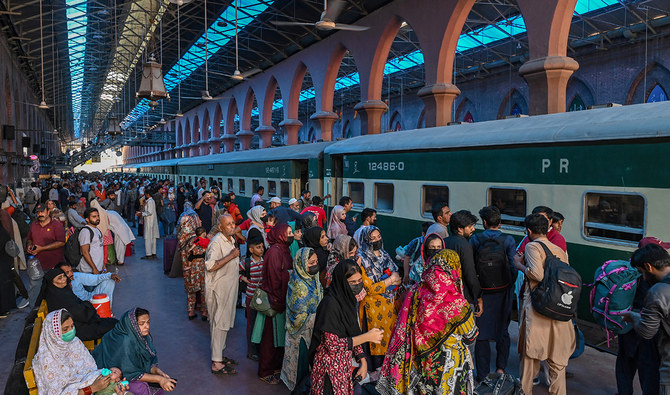
People wait to board a train at a railway station in Lahore on June 15, 2024, as they travel back home ahead of Eid al-Adha, the feast of the sacrifice marking the end of the Hajj pilgrimage to Mecca. (AFP/File)
Short Url
Updated 08 July 2024
Follow

Pakistan eyes plan to connect to Uzbekistan through rail link

  • If built, the railway line will expand multi-billion-dollar China-Pakistan Economic Corridor into Central Asia
  • Pakistan says CPEC open to all regional stakeholders, among whom Central Asia is important in geopolitical terms

ISLAMABAD: A provincial governor has said Pakistan was looking into a plan to connect the city of Rawalpindi with Uzbekistan through a railway link, potentially expanding the multi-billion-dollar China-Pakistan Economic Corridor (CPEC) into Central Asia, state-run APP reported on Monday. 

Pakistan wants to enhance its role as a pivotal trade and transit hub connecting the landlocked Central Asian countries with the world, leveraging its strategic geographical position. In recent weeks, there has been a flurry of visits, investment talks and economic activity between Pakistan and Central Asian states. 

Last month, the Pakistani Ministry of Commerce and Trade Development Authority organized the Pakistan-Uzbekistan Logistics Forum in Tashkent, where officials agreed to set up a joint chamber of commerce and enhance direct flights. In May, Uzbekistan Foreign Minister Bakhtiyor Saidov visited Pakistan for talks on bilateral trade and regional connectivity. The Pakistani PM also visited Tajikistan and Kazakhstan last week. 

CPEC, under which Beijing has pledged more than $60 billion for infrastructure, energy and other projects in Pakistan, is part of the Belt and Road Initiative (BRI), China’s modern-day revival of the ancient Silk Road which aims to connect Asia, Europe and Africa through more than 60 countries.

“The proposed expansion aims to lay tracks from Rawalpindi to Kohat [Pakistan] and from Kohat to Parachinar [Pakistan], ultimately connecting to Uzbekistan,” the Associated Press of Pakistan reported on Monday, quoting Faisal Karim Kundi, the governor of the northwestern Khyber Pakhtunkhwa province.

“The governor expressed optimism that this initiative would significantly benefit both regions, enhancing economic ties between Pakistan and Uzbekistan.”

Last year, Chinese President Xi Jinping unveiled a grand plan for Central Asia’s development, from building infrastructure to boosting trade, taking on a new leadership role in a region that has traditionally been a Russian sphere of influence. 

The five former Soviet republics, with a network of trade corridors, offer China alternative routes to transport fuel, food and other commodities in the event of disruptions elsewhere.

Pakistan says the CPEC project is open to all interested regional stakeholders, among whom Central Asia is one of the most important in geopolitical terms. 

Located in a landlocked but resource-rich region, Central Asian countries need better access to regional markets including Pakistan, China, India, and the countries of West Asia. Meanwhile, Pakistan and China have huge energy demands that can be satisfied by growing trade with Central Asia. CPEC also presents a strategic opportunity for Central Asian states to transport their goods more easily in regional and global markets.


Pakistan says $50 million meat export deal with Tajikistan nearing finalization

Updated 09 December 2025
Follow

Pakistan says $50 million meat export deal with Tajikistan nearing finalization

  • Islamabad expects to finalize agreement soon after Dushanbe signals demand for 100,000 tons
  • Pakistan is seeking to expand agricultural trade beyond rice, citrus and mango exports

ISLAMABAD: Tajikistan has expressed interest in importing 100,000 tons of Pakistani meat worth more than $50 million, with both governments expected to finalize a supply agreement soon, Pakistan’s food security ministry said on Tuesday.

Pakistan is trying to grow agriculture-based exports as it seeks regional markets for livestock and food commodities, while Tajikistan, a landlocked Central Asian state, has been expanding food imports to support domestic demand. Pakistan currently exports rice, citrus and mangoes to Dushanbe, though volumes remain small compared to national production, according to official figures.

The development came during a meeting in Islamabad between Pakistan’s Federal Minister for National Food Security and Research Rana Tanveer Hussain and Ambassador of Tajikistan Yusuf Sharifzoda, where agricultural trade, livestock supply and food-security cooperation were discussed.

“Tajikistan intends to purchase 100,000 tons of meat from Pakistan, an import valued at over USD 50 million,” the ambassador said, according to the ministry’s statement, assuring full facilitation and that Islamabad was prepared to meet the demand.

The statement said the two sides agreed to expand cooperation in meat and livestock, fresh fruit, vegetables, staple crops, agricultural research, pest management and standards compliance. Pakistan also proposed strengthening coordination on phytosanitary rules and establishing pest-free production zones to support long-term exports.

Pakistan and Tajikistan have long maintained political ties but bilateral food trade remains below potential: Pakistan produces 1.8 million tons of mangoes annually but exported just 0.7 metric tons to Tajikistan in 2024, while rice exports amounted to only 240 metric tons in 2022 out of national output of 9.3 million tons. Pakistan imports mainly ginned cotton from Tajikistan.