

Kazakh president in Pakistan on two-day visit to discuss trade, connectivity, bilateral ties

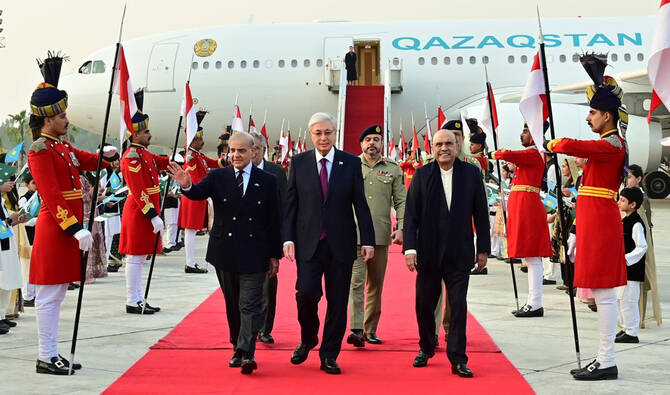
President Asif Ali Zardari (Right) and Prime Minister Shehbaz Sharif (Left) received the President of Kazakhstan H.E.Kassym-Jomart Tokayev (Center) at Nur Khan Airbase, Rawalpindi, Pakistan, on February 3, 2026. (APP/X)
Short Url
Updated 03 February 2026
Follow

Kazakh president in Pakistan on two-day visit to discuss trade, connectivity, bilateral ties

  • Pakistan, Kazakhstan share strong ties and strategic partnership, with Islamabad offering landlocked Central Asian republics access to key seaports
  • The visit provides an opportunity for both sides to discuss new avenues for cooperation, explore collaboration at regional and global forums, FO says

ISLAMABAD: Kazakhstan’s President Kassym-Jomart Tokayev on Tuesday arrived in Pakistan on a two-day official visit to hold talks with the country’s leadership on trade, regional connectivity and bilateral cooperation, according to the Pakistani foreign ministry.

The development comes as Kazakhstan, a landlocked Central Asian state, seeks greater access to maritime trade routes via ports in Pakistan, which has sought to position itself as a major transit hub in the region. Both sides have also been looking for ways to boost cooperation in trade, investment and other areas in recent years.

According to the government of Kazakhstan, bilateral trade between the two countries amounted to $53.7 million in 2024. Pakistan’s main exports to Kazakhstan include citrus fruits, pharmaceutical products, garments, soap, sports equipment, while imports primarily include onions and garlic, dried leguminous vegetables, oats, buckwheat, seeds and fruits.

PM Sharif and President Asif Ali Zardari welcomed President Tokayev upon arrival at Noor Khan Air Base in Rawalpindi on the two-day visit, which Islamabad has said aims to strengthen bilateral cooperation and promote regional peace and prosperity.

“The visit will provide the two sides an important and timely opportunity to undertake a comprehensive review of bilateral relations, discuss new avenues for broadening cooperation, particularly in trade, logistics, regional connectivity, people-to-people contacts, and explore collaboration at regional and international forums,” the Pakistani foreign ministry said.

Both sides are expected to sign memorandums of understanding (MoUs) in areas of mutual interest during the high-profile visit.

During the visit, President Zardari will also confer the Nishan-e-Pakistan, the highest civilian award of Pakistan, on the visiting Kazakh president, according to the Pakistan presidency.

The Nishan-e-Pakistan is awarded to individuals who have rendered services of highest distinction to the national interest of Pakistan and has often been conferred on visiting Heads of State as a mark of respect and friendship.

Relations between Pakistan and Kazakhstan are rooted in shared Islamic heritage and the growing economic partnership. Pakistan was among the first countries to recognize Kazakhstan when it gained independence in December 1991 and formally established diplomatic relations with it on Feb. 24, 1992.

The two countries have held regular interactions over the past couple of years on the sidelines of the Shanghai Cooperation Organization (SCO) meetings and other international events. Kazakhstan’s Deputy Prime Minister Murat Nurtleu visited Pakistan in September 2025 to discuss economic and trade cooperation with Islamabad.

Islamabad and Astana engage with each other to promote business and political ties via three forums mainly, which are: Bilateral Political Consultations, the Intergovernmental Joint Commission on Trade, Economic, Scientific, Technological and Cultural Cooperation, and the Joint Business Council.


Pakistan to maintain hard line on Afghanistan after strikes as Taliban vows military response

Updated 5 sec ago
Follow

Pakistan to maintain hard line on Afghanistan after strikes as Taliban vows military response

  • Islamabad blames Afghanistan’s ‘guerrilla mindset’ for escalating tensions between the two countries
  • Afghan Taliban spokesperson denies militant presence in his country, accuses Pakistan of hitting civilians

ISLAMABAD: Pakistan vowed on Wednesday to continue its current policy toward Afghanistan unless the Taliban leadership abandons its “guerrilla mindset,” days after Islamabad carried out airstrikes inside Afghan territory, sharply escalating tensions between the two neighbors once again.

Pakistan conducted intelligence-based strikes overnight into Sunday in Afghanistan’s eastern Nangarhar and southeastern Paktika provinces, saying it had targeted camps of the banned Tehreek-e-Taliban Pakistan (TTP), its affiliates and Daesh-linked fighters.

Islamabad has long accused Kabul of allowing militant groups to use Afghan soil to launch attacks on Pakistani civilians and security forces, a charge the Taliban deny. The two sides also clashed in October last year, leading Pakistan to close key border crossings for bilateral and transit trade.

State Minister for Interior Talal Chaudhry told Geo News that Pakistan had attempted dialogue but would now persist with practical measures if the Taliban failed to change course.

“They call themselves a state, but they have not yet emerged from their guerrilla mindset,” he said.

“Now, with the practical steps we are taking, we want to change their behavior and see them in the form of a state,” he added.

Pakistan blamed a string of recent suicide bombings in Islamabad, Bajaur and Bannu on militants operating from Afghan territory before launching the latest strikes.

Chaudhry said Afghanistan had been acting like “an irresponsible neighbor,” warning that his country’s current approach would continue if attacks inside Pakistan persisted.

“This war will be won, and all this will end,” he said. “If it is not resolved the straight way, then it will be completely ended by a hard-line approach.”

Meanwhile, Kabul has condemned the airstrikes as violations of its sovereignty and said civilians were killed.

In an interview with Al Arabiya, Taliban government spokesman Zabihullah Mujahid also pledged to respond militarily.

“It would be a military response, but its details are confidential and I cannot explain further,” he said.

Mujahid rejected Pakistan’s allegations that TTP or Daesh militants operate from Afghan soil, saying security problems inside Pakistan were domestic in nature.

“Afghan soil is not allowed to be used against anyone,” he said, adding that Kabul had carried out extensive operations against Daesh and eliminated its presence in Afghanistan.

The 2,600-kilometer border between the two countries remains a vital trade and transit route, but crossings have faced repeated closures amid rising tensions, disrupting commerce and humanitarian movement.

Several regional countries, including Saudi Arabia, Türkiye and Qatar, have sought to mediate between the two countries, though their military exchanges risk further destabilizing their ties.