


RIYADH: Saudi Arabia aims to achieve 40 percent female workforce participation in the Kingdom by the end of this decade, having already surpassed its Vision 2030 target of 30 percent, according to a senior official.
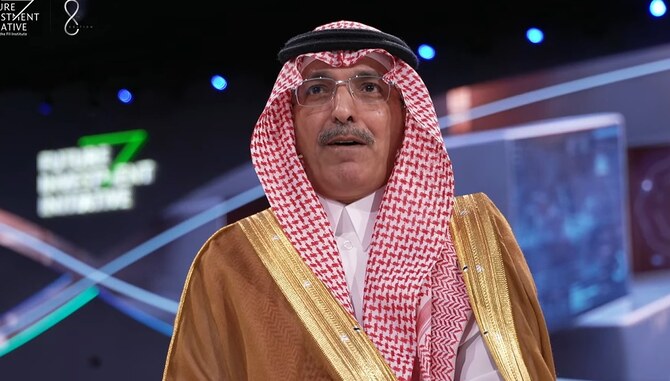
During the eighth edition of the Future Investment Initiative in Riyadh on Oct. 30, Saudi Arabia’s Minister of Finance Mohammed Al-Jadaan said that 45 percent of the small and medium enterprises in the Kingdom are headed by women.
Strengthening the role of females in the country’s labor force and bridging the gender gap is one of the key goals outlined in the Kingdom’s economic diversification Vision 2030 program.
To propel this plan, Saudi Arabia also organized the HERizon Summit on Oct. 28 under the theme “Invest in Women,” where experts discussed ways to make females a formidable force in the global employment sector.

Saudi Arabia is hosting the eighth edition of the Future Investment Initiative summit in Riyadh. AN/Abdulrahman bin Shalhuob
“Moving from almost 17 percent of female workforce participation when we started Vision 2030, we are currently at 35 percent. And our target for 2030 was 30 percent,” said Al-Jadaan.
He added: “If you look at women’s participation today, not only as employees but also as entrepreneurs, it is significant. We doubled the number of SMEs in the last seven years. What is interesting is that 45 percent of these are female-led SMEs.”
According to Al-Jadaan, the rise in female workforce participation is visible in various areas, including consumption and household income.
“We are now targeting female workforce participation in the workforce to more than 35 percent or around 40 percent by 2030. And I think we will be able to achieve that,” Al-Jadaan said.
He further said that women in Saudi Arabia are also making their presence felt in new sectors like tourism.
During the recent HERizon Summit, Princess Reema bint Bandar, the Kingdom’s ambassador to the US also echoed similar views, highlighting that Vision 2030 has reshaped the lives of women in the nation, as regulatory reforms helped females pursue more opportunities in the public and private sectors.
Vision 2030 progress
During the speech, Al-Jadaan also outlined the country’s Vision 2030 progress and underlined that the government’s economic diversification program has started reaping the results.
“Saudi Arabia’s non-oil gross domestic product now represents 52 percent of our economy. It is very significant for a country like Saudi Arabia. The unemployment rate among Saudi nationals now stands at 7.1 percent. We have a target of 7 percent in 2030, and we are about to hit that target,” said the finance minister.
Al-Jadaan added that almost 87 percent of the Kingdom’s Vision 2030 targets are either achieved or on track, and the nation is currently working to materialize the remaining 13 percent.
The finance minister added that the government is pursuing the Vision 2030 goals without pressuring the Kingdom’s economy and ensuring stability.

Saudi Arabia is hosting the eighth edition of the Future Investment Initiative summit in Riyadh. AN/Abdulrahman bin Shalhuob
“We are trying to make sure that our plans are very synchronized together. We want to make sure that we don’t have too much leakage from the economy,” said Al-Jadaan.
He added: “If you do too much at the same time and do not allow the economy to grow with you, you could actually have a lot of leakage from your spending by importing rather than actually manufacturing in the country. We are monitoring that and recalibrating our plans, and we are actually successful so far.”
According to Al-Jadaan, investment inflows to Saudi Arabia remain resilient despite geopolitical tensions, as the Kingdom offers a safe and stable environment for business people.
“Investors are investing in Saudi Arabia despite all the geopolitical tensions because Saudi plays a very important role as the anchor of stability. What the investors want is that stability. What the investors want is to be a part of the national transformation that is taking place in a country which is as big as Saudi Arabia, which is the largest country in the region,” said the finance minister.
Despite this strong outlook, Al-Jadaan also outlined some challenges Saudi Arabia faces as it pursues its Vision 2030 journey, including a lack of human resources.
“We are actually not shying away from challenges. Challenges related to human resources and the ability to execute. And we want to make sure that we bring up more execution capacity. We want to make sure that we don’t overheat the economy,” he said.
Global outlook
During the talk, Al-Jadaan said that the global economy still faces obstacles despite an expected soft landing with inflation rates under control.
He also emphasized that international cooperation and multilateralism are needed to tackle global economic challenges at a time when the world is grappling with geopolitical tensions and wars.
“There are countries which are struggling. Sovereign debt is a serious challenge that we discuss extensively globally. Fragmentation is getting more serious. Under the current circumstances of serious geopolitical uncertainties, we need to build bridges rather than really burn them,” said Al-Jadaan.
He added: “Global communities need to come together. There are serious challenges around the world that cannot be resolved by one country alone. Therefore, a cooperative approach is necessary. Even though there are challenges, still the global community feels the importance of multilateralism.”
The minister further said that Saudi Arabia plays a very important role as the anchor of stability globally, becoming a torchbearer of economic reforms in the Middle East.
“We are trying to make sure that we play a role model for the region. And the countries in the region see what we are doing and focussing on our people and our economy, and hopefully, a call for them to do the same,” he said.


