

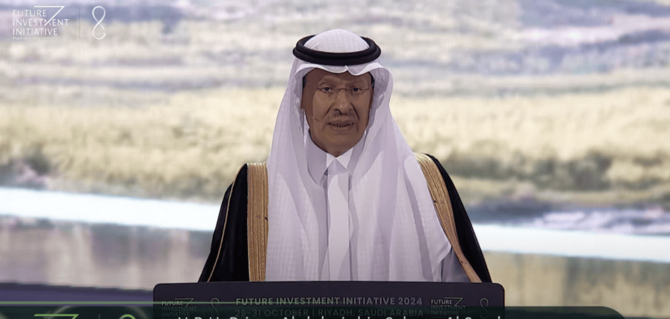

RIYADH: Saudi Arabia is committed to keeping its crude oil capacity at 12.3 million barrels per day, despite a shift to renewable power, according to the Kingdom’s energy minister.
During a speech on the first day of the Future Investment Initiative taking place in Riyadh from Oct. 29 to 31, Prince Abdulaziz bin Salman set out how Saudi Arabia is seeking to revolutionize its energy supplies, thanks to developments such as hydrogen power and promoting a circular carbon economy.
The minister highlighted the Kingdom’s progress in energy efficiency, saying the country’s achievements in the area matched developed countries, but had been achieved in a fifth of the time.
Speaking at FII8, which is set to welcome more than 7,000 attendees, Prince Abdulaziz said: "We are committed to maintaining 12.3 million of crude capacity and we are proud of that.”
Saudi Arabia has pledged to have 50 percent of its power generated from renewable sources by 2030, and Prince Abdulaziz was keen to state how proud the government is of its successes as it strives towards this goal.
The minister went on: "We are not ashamed of our record when it comes to emissions.
"We are proud of it, but the pundits try to create a smoke screen not to allow us to be on the so-called higher moral ground."
Reflecting on the Kingdom’s achievements in the context of global trends in energy efficiency, he said: “Look at what we have achieved in less than six years, in less than 11 years. When it comes to efficiency of air conditioning, we are almost at par with the US, a little short of the EU, but certainly, we will continue trying to catch up.”
He added: “If the OECD achieved all of these numbers in almost 50 years and we are achieving similar conclusions or results in a lesser period, 20 percent of the time that was spent on these programs, again, I will ask you, what is it that we will not be able to do?”
He continued to say: “This country, the people of this country, and our partners were capable to do this mammoth historical transformation, which in my judgment, and I hope I’m not wrong, and I’ll leave it for you and I’ll leave it for history to come up with the conclusion and the verdict, but show me any country on planet Earth that had underwent this transformation in such short period.”
He also shed light on how the Kingdom is evolving when it comes to delivering lower emissions alongside boosting renewable energy capacity.
“We’re transitioning with a purpose, and that purpose, you could see it in front of you, that we’re trying to export all forms of energy. We’re trying to use our circular carbon economy as an approach to give us guidance on where we are going to go, and we are also … exporting manufactured and engineered products. Why? Very simple. We want to enhance our economic diversification, value creation, supply chain resilience, and job creation, which is a fundamental and important thing for all of us,” he said.
Moving on to the tendered renewable energy projects, the energy minister drew a comparison between Saudi Arabia and other countries.
“This is what we have tendered as renewable projects. We can’t hide that it’s all in the public – 44 gigawatts of renewables is exactly about 50 percent of the installed capacity with the UK, 90 percent of it installed capacity of Sweden, 100 percent of the installed capacity of both combined Switzerland and Australia and 100 percent of what Malaysia capacity is,” he said.
“Now, when it comes to growth — comparing what the US had installed last year, 44 GW, Germany – 18 GW, and ourselves this year, we will be doing 20 GW. I didn’t want to compare with China because we will all look small comparatively,” Prince Abdulaziz added.
The minister highlighted ongoing efforts to link every region in Saudi Arabia to ensure that each area has access to at least two sources of electricity. He added that extensive transmission lines will be dedicated to support this undertaking across the Kingdom.
“This country, I can vouch here in front of you, not a single consumer that does not have smart meters. I don’t want to compare because it would be an embarrassment for so many countries among the top G20. They don’t have it,” Prince Abdulaziz said.
Moving on to the topic of hydrogen, the minister stressed that Saudi Arabia is the biggest producer of hydrogen.
He concluded his speech by saying: “We welcome the idea of joint venturing, and we succeeded in mastering the art of joint venturing, and we want you to be our partners.”


