

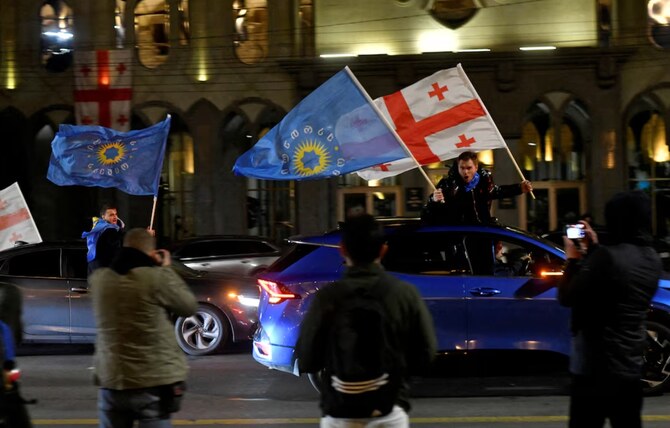

TBILISI: For some Georgians who supported the ruling Georgian Dream party in Saturday’s disputed parliamentary election, the aspiration to go West toward the European Union had to be balanced by the brutal reality of the need to keep the peace with Russia.
The opposition and foreign observers had cast the election as a watershed moment that would decide if Georgia moves closer to Europe or leans back toward Russia amid the war in Ukraine. The ruling party, which is seen as loyal to its billionaire founder Bidzina Ivanishvili, says it wants to one day join the EU but that it must also avoid confrontation with President Vladimir Putin’s Russia that could leave the South Caucasus republic devastated like Ukraine.
“We’ve had peace these 12 years in Georgia,” said Sergo, a resident of the capital Tbilisi who has voted for Georgian Dream in every election since the party rose to power in 2012. Georgian Dream clinched 54 percent of the vote on Saturday, the electoral commission said, while opposition parties and the president claimed the election had been stolen and the West called for investigations into reports of voting irregularities.
Observer groups, including the 57-nation Organization for Security and Co-operation in Europe (OSCE), said alleged violations, including ballot-stuffing, bribery, voter intimidation and violence, could have affected the election’s outcome.
The EU and the United States said there was not a level playing field but stopped short of saying the result was stolen by Georgian Dream. Russia accused the West of meddling. Beyond the rhetoric, though, the result poses a challenge to Tbilisi’s ambitions to join the European Union, which polls show the overwhelming majority of Georgians support.
Brussels has effectively frozen Georgia’s EU accession application over concerns of democratic backsliding under Georgian Dream and what it casts is its pro-Russian rhetoric.
Georgian Dream backers say that while they want to join Europe, they don’t want to sacrifice Georgia’s traditional values of family and church.
EU ASPIRATIONS?
For them, Georgian Dream’s party slogan, “Only with peace, dignity, and prosperity to Europe,” appeals.
Official results, which the opposition says are fraudulent, showed the party securing huge margins of up to 90 percent in rural areas, even as it underperformed in Tbilisi and other cities.
Ghia Abashidze, a political analyst close to Georgian Dream, attributed the party’s showing to its emphasis on keeping the peace and preserving traditional values. The Georgian parliament passed a law this year curbing LGBT rights and Pride events have been attacked by violent mobs in years past. The topic remains sensitive in conservative Georgia, which is devoutly Orthodox Christian. Abashidze said that Georgian Dream was still committed to EU integration, but found more to like in some of the bloc’s Eastern European members such as Hungary, whose premier Viktor Orban flew to Tbilisi on Monday and hailed the election as free.
He said Orban’s Hungary, which has also been accused of democratic backsliding, shared the Georgian ruling party’s core values of “family, traditions, statehood, sovereignty, peace.”
In Isani, a working class Tbilisi neighborhood and one of the few in the capital where Georgian Dream received more votes than the four main opposition parties combined, Sergo, who did not want to give his last name, echoed the sentiment.
“We want to go to the European Union with our customs, our traditions, our mentality,” the 56-year-old said, passing freshly-baked bread to customers from his shop window. He said he believed LGBT people should receive medical treatment and go to church to become “normal people.”
RUSSIA OR EU?
By contrast, opposition supporters say the ruling party’s positions on foreign policy and social issues are incompatible with Europe’s, and keeping the peace with Russia depends on Georgia aligning with the West.
At a thousands-strong protest against the election results on Monday, Salome Gasviani said the opposition was fighting to preserve Georgia’s freedom and independence.
“We’re here to say out loud that Georgia is a very European country and our future is in the EU, in the West,” she said.
Russia, which ruled Georgia for about 200 years, won a brief war against the country in 2008, and memories of Russian tanks rolling toward Tbilisi are still fresh for many. During the campaign, Georgian Dream played on fears of war, with posters showing devastated Ukrainian cities beside picturesque Georgian ones to illustrate the threat.
“The main thing is that we don’t have a war,” 69-year-old Otar Shaverdashvili, another Isani resident, said before the vote. “I remember the last war very well. No one wants another one.”
Kornely Kakachia, head of Georgian Institute of Politics think tank, said the opposition had struggled to allay fears that a change of government could risk Georgia being sucked into the Ukraine war.
“If someone asks you to choose between war and the European Union and you have this kind of choice, then of course people will choose the status quo,” he said.


