

Saudi oil giant Aramco launches first branded gas station in Pakistan

People visit Saudi Aramco's first branded gas station during the innaugration ceremony in Lahore on October 29, 2024. (Photo courtesy: X/@ranjha001)
Short Url
Updated 30 October 2024
Follow

Saudi oil giant Aramco launches first branded gas station in Pakistan

  • The development follows Aramco’s acquisition of a 40 percent stake in Gas & Oil Pakistan Ltd. petroleum company in April
  • Together with GO, Aramco plans to expand its retail network and establish a presence in the fast-growing Pakistani economy

KARACHI/ISLAMABAD: Saudi oil giant, Aramco, on Tuesday unveiled its first branded retail gas station in Pakistan in the eastern city of Lahore, months after its acquisition of a 40 percent stake in Gas & Oil Pakistan Ltd. (GO) petroleum company.
Aramco is a global integrated energy and chemicals company that produces approximately one in every eight barrels of the world’s oil supply. GO, one of Pakistan’s largest retail and storage companies, is involved in the procurement, storage, sale and marketing of petroleum products and lubricants.
The Aramco-branded stations in Pakistan will offer branded premium fuel, high-quality lubricants, professional automotive services and modern convenience stores to provide a seamless customer experience, according to a statement shared by Corporate and Marketing Communications (CMC), which handles Go and Aramco’s public relations in Pakistan.
“This is another milestone in Aramco’s downstream growth story, as we launch the first Aramco station in Pakistan — a market with significant growth potential,” Yasser M. Mufti, Aramco executive vice president of products and customers, was quoted as saying by the CMC.
“Our values of excellence, innovation and community partnerships sit at the heart of what we do, and will act as our guide as we leverage our extensive global refinery systems to ensure reliable supplies to customers while introducing our complementary world class retail offerings.”
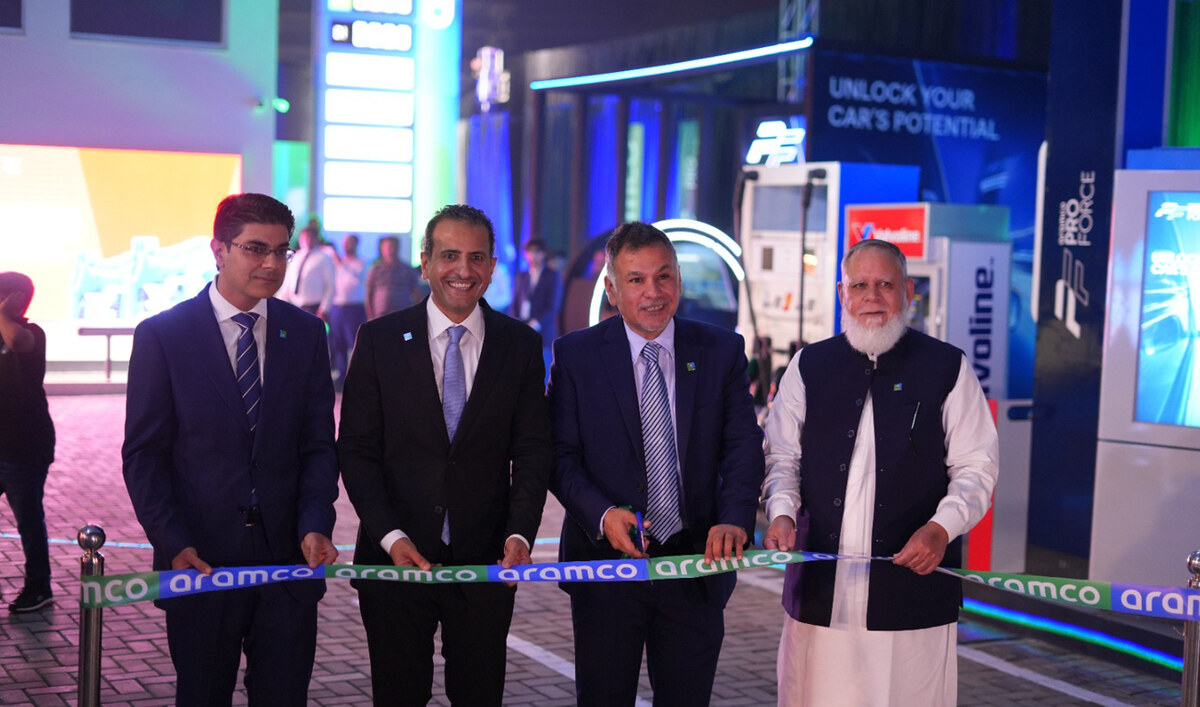


Officials inaugurate Saudi Aramco's first branded gas station in Lahore on October 29, 2024. (Photo courtesy: Saudi Aramco)

Together with GO, which has a network of over 1,200 fuel retail stations in Pakistan, Aramco plans to expand its retail network and establish a presence in the fast-growing Pakistani economy.
“We are confident that this partnership will deliver exceptional value to customers,” Mufti said.
Khalid Riaz, the GO chief executive officer, echoed the sentiment, saying the first Aramco-branded gas station in Lahore was a testament to their commitment to excellence and innovation.
“Together with Aramco, we aim to elevate the retail fuel landscape in Pakistan, setting new benchmarks for quality, service, and customer satisfaction,” he said.
Pakistan and Saudi Arabia enjoy strong trade, defense and cultural ties. The Kingdom is home to over 2.7 million Pakistani expatriates and serves as the top source of remittances to the cash-strapped South Asian nation.
In February 2019, Pakistan and Saudi Arabia inked investment deals totaling $21 billion during a visit by Saudi Crown Prince Mohammed bin Salman to Islamabad. The agreements included about $10 billion for an Aramco oil refinery and $1 billion for a petrochemical complex at the strategic Gwadar Port in Pakistan’s Balochistan province.
Both countries have been working in recent months to increase bilateral trade and investment, and the Kingdom this year reaffirmed its commitment to expedite an investment package worth $5 billion for Pakistan.


IMF board to approve Pakistan reviews today ‘if all goes well,’ say officials

Updated 4 sec ago
Follow

IMF board to approve Pakistan reviews today ‘if all goes well,’ say officials

  • IMF’s executive board is scheduled to meet today to discuss the disbursement of $1.2 billion
  • Economists say the money will boost Pakistan’s forex reserves, send positive signals to investors

KARACHI: The International Monetary Fund’s (IMF) executive board is scheduled to meet today, Monday, to approve the release of about $1.2 billion for Pakistan under the lender’s two loan facilities, said IMF officials who requested not to be named.

The IMF officials confirmed the executive board was going to decide on the Fund’s second review under the $7 billion Extended Fund Facility (EFF) and first review under the $1.4 billion Resilience and Sustainability Facility (RSF), a financing tool that provides long-term, low-cost loans to help countries address climate risks.

“The board meeting will be taking place as planned,” an IMF official told Arab News.

“The board is on today yes as per the calendar,” said another.

A well-placed official at Pakistan’s finance ministry also confirmed the board meeting was scheduled today to discuss the next tranche for Pakistan.

The IMF executive board’s meeting comes nearly two months after a staff-level agreement (SLA) was signed between the two sides in October.

Procedurally, the SLAs are subject to approval by the executive board, though it is largely viewed as a formality.

“If all goes well, the reviews should pass,” said the second IMF official.

On approval, Pakistan will have access to about $1 billion under the EFF and about $200 million under the RSF, the IMF said in a statement in October after the SLA.

The fresh transfer will bring total disbursements under the two arrangements to about $3.3 billion, it added.

Experts see smooth sailing for Pakistan in terms of the passing of the two reviews, saying the IMF disbursements will help the cash-strapped nation to strengthen its balance of payments position.

Samiullah Tariq, group head of research at Pakistan Kuwait Investment Company Limited, said the IMF board’s approval will show that Pakistan’s economy is on the right path.

“It obviously will help strengthen [the country’s] external sector, the balance of payments,” he told Arab News.

Until recently, Pakistan grappled with a macroeconomic crisis that drained its financial resources and triggered a balance of payments crisis.

Pakistan has reported financial gains since 2022, recording current account surpluses and taming inflation that touched unprecedented levels in mid-2023.

Economists also viewed the IMF’s bailout packages as crucial for cash-strapped Pakistan, which has relied heavily on financing from bilateral partners such as Saudi Arabia, China and the United Arab Emirates, as well as multilateral lenders.

Saudi Arabia, through the Saudi Fund for Development, last week extended the term of its $3 billion deposit for another year to help Pakistan boost its foreign exchange reserves, which stood at $14.5 billion as of November 28, according to State Bank of Pakistan statements.

“In our view this [IMF tranche] will be approved,” said Shankar Talreja, head of research at Karachi-based brokerage Topline Securities Limited.

“This will help strengthen reserves and will eventually help a rating upgrade going forward,” he said.

The IMF board’s nod, Talreja said, would also send a signal to the international and local investors regarding the continuation of the reform agenda by Pakistan’s government.