

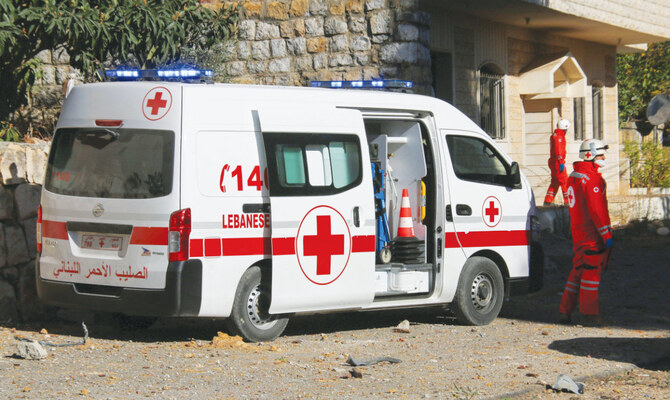

GENEVA: Local staff and volunteers — the backbone of aid agencies providing help in the world’s worst conflicts — are dying in ever greater numbers. Yet few seem to notice, the head of the Red Cross said in an interview on Monday.
“Almost 95 percent of the humanitarians who are killed are actually the local staff and local volunteers,” Jagan Chapagain, the secretary-general of the International Federation of the Red Cross and Red Crescent Societies.
But while the killing of an international staff member of large humanitarian organizations can spark global outrage, there is often little attention paid when a local aid worker suffers the same fate.
“Unfortunately, when a local staffer or volunteer gets killed, it gets hardly any attention,” Chapagain said.
The issue is of particular concern this year, one of the deadliest for humanitarians, with aid worker deaths soaring as conflicts rage in the Middle East, Sudan, Ukraine and Myanmar, among others.
“It has been really the worst year for humanitarian actors, particularly the ones from the local communities,” Chapagain said.
Since the beginning of this year alone, 30 of the network’s volunteers have been killed worldwide, while within the UN system, “they have lost hundreds,” he said.
He decried a clear “erosion” in the respect for international humanitarian law and the principles requiring humanitarians to be protected.
Growing disregard for international law in conflict was significantly “increasing the situation of extreme exposures (and) risk for our humanitarian workers, (with) volunteers getting shot, ambulances getting attacked.”
Respect for the Red Cross Red Crescent emblem, and for people wearing the network’s signatory red vest has “eroded significantly,” he warned.
Asked if he believed humanitarians were being deliberately targeted, he said: “Definitely. Unfortunately, the numbers speak for themselves.”
Chapagain said the IFRC was “seriously, seriously concerned” about the growing dangers facing humanitarians and warned that more people could die if humanitarian workers are not protected.
His IFRC will along with the International Committee of the Red Cross kick off their quadrennial international conference in Geneva on Monday, which is due to focus heavily on the need to boost compliance with international humanitarian law.
It will include participants from the 191 national Red Cross and Red Crescent societies, whose staff and volunteers are frequently the ones on the frontlines in conflicts and in the communities under attack.
Chapagain said his team estimated that when “a local gets harmed compared to an international who gets harmed, the attention is one to 500 ratio.”
“Any death is appalling, and we cannot accept that. But what we would also like to see is the same outrage when any humanitarians lose their life.”
“This is something super, super important, because globally... most of the people who are on the frontline providing ... assistance are the people from the local communities,” he said.
“Their lives should be as sacred as anyone else’s.”


