BEIRUT: Lebanon said Monday it had submitted a complaint to the United Nations Security Council over an Israeli strike last week that killed three journalists in the country’s south.
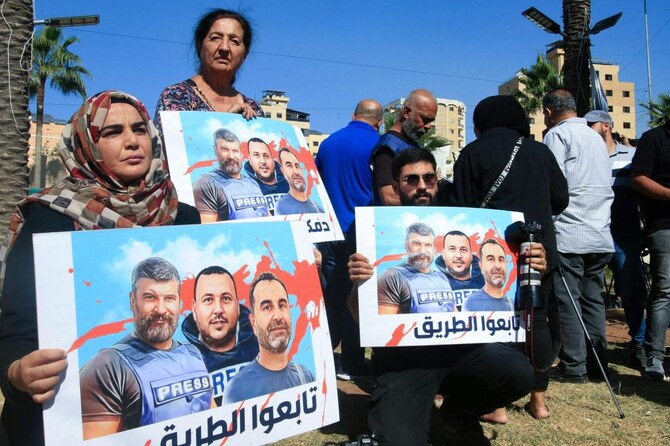
The strike early Friday hit a complex in the Druze-majority town of Hasbaya in south Lebanon where more than a dozen journalists from Lebanese and Arab media outlets were sleeping.
The Israeli army said Friday that the strike was “under review,” maintaining it had targeted Hezbollah militants.
Lebanon submitted “a complaint to the Security Council regarding the latest Israeli attacks that targeted journalists and media facilities in Hasbaya in south Lebanon, and the Ouzai area” in Beirut’s southern suburbs, a statement from the foreign ministry said on social media platform X.
“The repeated Israeli targeting of media crews is a war crime” and Israel must be “held to account and punished,” the statement added.
Cameraman Ghassan Najjar and broadcast engineer Mohammad Reda from pro-Iran, Beirut-based broadcaster Al-Mayadeen, and video journalist Wissam Qassem from Hezbollah’s Al-Manar television, were killed in the strike on the complex in Hasbaya, relatively far from the Israel-Hezbollah war’s main flashpoints.
Prime Minister Najib Mikati said the attack was deliberate and both he and Information Minister Ziad Makary labelled it a war crime.
Days earlier, Al-Mayadeen said an Israeli strike hit an office the broadcaster had vacated near Ouzai in south Beirut.
Israel launched an intense air campaign in Lebanon last month and later launched ground incursions following a year of cross-border clashes with the Iran-backed Hezbollah group over the Gaza war.
In October last year, Reuters journalist Issam Abdallah was killed by Israeli shellfire while he was covering southern Lebanon, and six other journalists were wounded, including AFP’s Dylan Collins and Christina Assi, who had to have her right leg amputated.
Last November, Israeli bombardment killed Al-Mayadeen correspondent Farah Omar and cameraman Rabih Maamari, the channel said.
Lebanese rights groups said five more journalists and photographers working for local media had been killed in Israeli strikes on the country’s south and Beirut’s southern suburbs.

Lebanon complains to UN over latest deadly Israel strike on journalists
https://arab.news/pwxt7
Lebanon complains to UN over latest deadly Israel strike on journalists
- Lebanon submitted “a complaint to the Security Council regarding the latest Israeli attacks that targeted journalists and media facilities in Hasbaya in south Lebanon
‘AI race is on’: Saudi minister at Davos stresses need for global optionality
- Minister of Investment Khalid Al-Falih said ‘we don’t know who’s going to be ahead in the next few years’ and the Kingdom therefore reserves the right for optionality
- On Tuesday, the WEF announced the first phase of a Digital Embassy Framework aimed at bringing greater clarity and consistency
DAVOS: Saudi Minister of Investment Khalid Al-Falih told Davos that the artificial intelligence “race is on,” with the Kingdom determined to use its diplomatic reach while preserving strategic “optionality.”
Speaking on Tuesday’s “AI Power Play, No Referees” panel at the World Economic Forum, Al-Falih described AI as “truly the transformation of this century,” but warned that it will soon be commoditized and not monopolized by any single company or country.
He stressed the need for global diffusion, saying: “The essence of AI’s power is that it has to be accessible. So the word ‘diffusion’ is not just within economies that have to compete, but I believe it has to be done globally.”
While acknowledging the US lead, Al-Falih said optionality is critical. “We don’t know who’s going to be ahead four or five years from now,” he said, adding that the Kingdom reserves the right for optionality amid shifting dynamics.
Riyadh has emerged as a global AI player, buoyed by its huge Davos delegation and heavy investments in technology and supporting infrastructure. Low energy costs — a factor that has driven human development worldwide — position Saudi Arabia uniquely, Al-Falih said, with renewables poised to power AI data centers as part of the Kingdom’s diversification strategy.
“We know this is not just about infrastructure, data center and the energy competitive advantage that we believe Saudi Arabia has is second to none. We’re investing across the technology stack, in applications and LLMs and in connectivity, because we believe that this is going to be a global good. Just as important as building the data hub that Saudi Arabia is building, we need to be connected, and we are connected to Europe, Asia, because we want that data, that AI power, to be transmitted across borders and across economies.”
Saudi Arabia, while strategically aligned with the US, has also backed Chinese, Korean and Japanese companies to maintain flexibility. “Optionality is very important. It’s something we have now, and we protect because we believe that we are the owners of our own destiny, and we will not let go of that.”

On Tuesday, the WEF announced the first phase of a Digital Embassy Framework aimed at bringing greater clarity and consistency to how trusted digital embassies are designed and governed worldwide.
Also known as “data embassies,” the initiative seeks to address practical challenges in cross-border sovereign AI infrastructure and data hosting, with an emphasis on trust, security and governance, and is expected to be formally launched at the forum’s meeting in Jeddah in April.
The initiative was announced during a separate panel titled “Digital Embassies for Sovereign AI” at the forum’s annual meeting on Tuesday, featuring Gobind Singh Deo, minister of digital for Malaysia and Alexandre Fasel, state secretary for foreign affairs of Switzerland.
Fasel said the value of such a global framework lies in preventing countries from having to start from scratch each time they negotiate bilateral arrangements. By setting out shared principles and approaches, spanning technical, legal and governance issues, the framework can provide common reference points for countries seeking to establish such entities, even if the term “digital embassy” itself remains imperfect.
Both speakers acknowledged that the term can be a misnomer, since it suggests traditional diplomatic arrangements. The focus, they said, is the function: allowing data and computing to be hosted abroad while maintaining safeguards around sovereignty, access and control.
Deo said the concept is driven by practical realities, as some countries lack the energy and water needed to support large-scale data centers, even though those resources are available elsewhere.
Hosting infrastructure in better-resourced countries can offer a solution, he said, provided robust safeguards are in place to ensure data is secure and that access and control stay with the originating state.
Saudi Arabia has already moved early on the concept. In April 2025, it published a draft Global AI Hub Law — described as the first G20 attempt to set out a comprehensive legal framework that embraces the “digital embassy” approach.
A key question at Davos this year is how a state can maintain data sovereignty — and apply its laws to certain categories of data - when that data must be hosted in a foreign jurisdiction.

Al-Falih said policy work on data sovereignty — from regulation and platforms to data centers — began well before the recent acceleration in AI.
“But in addition to data privacy, we had an open data we talked about diffusion and access to compute, but access to data to achieve the same purpose of research, drug discovery, productivity improvement, having a policy also of open access to data was a pillar that was launched before Covid.”
In an earlier panel, Anthropic CEO Dario Amodei said predicting exactly when AI will match a Nobel Laureate’s capabilities in multiple fields remains difficult due to internal and external factors, but said that “something fast is going to happen.”
“AI is going to be incredibly powerful. It’s just a question of exactly when. And because it’s incredibly powerful, it will do all these wonderful things, will help us cure cancer, it may help us to eradicate tropical diseases, it will help us understand the universe. But there are these immense and grave risks that we need to think about and we need to address them.”
Amodei said tackling those risks requires action on several fronts: “It’s a mixture of things that we individually need to do as leaders of the companies, and that we can do working together. And then there’s going to need to be some role for wider societal institutions, like the government.
“If we are all working together, we can address, we can learn through science to properly control and direct these creations that we’re building. But if we build them poorly, if we’re all racing and we go so fast that there’s no guardrails, then I think there is risk of something going wrong.”


