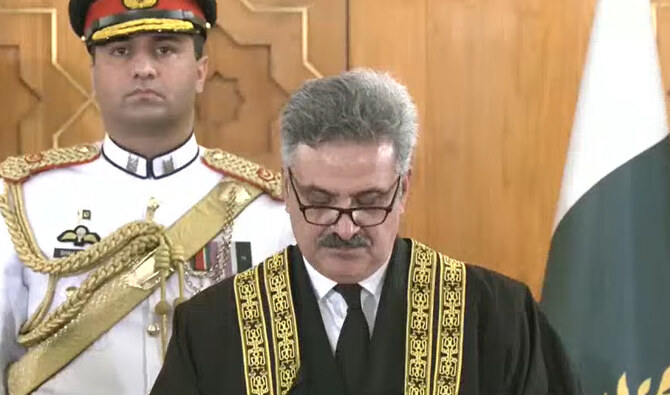
ISLAMABAD: Supreme Court judge Yahya Afridi on Saturday took oath as the 30th chief justice of Pakistan at a ceremony held at the President House in Islamabad.
Chief Justice Afridi was nominated for the top judicial post by a 12-member parliamentary committee that was empowered to make the appointment under the recently passed 26th amendment to the Constitution of Pakistan.
President Asif Ali Zardari administered oath to the new chief justice at the ceremony, attended by Prime Minister Shehbaz Sharif and other senior officials as well as former and serving judges of the Supreme Court.
“I, Justice Yahya Afridi, do solemnly swear that I will bear true faith and allegiance to Pakistan, that I, as chief justice of Pakistan, I will discharge my duties, and perform my functions, honestly to the best of my ability and faithfully in accordance with the Constitution of the Islamic Republic of Pakistan and the law,” Chief Justice Afridi said as he took the oath at the televised ceremony.
“I will not allow my personal interest to influence my official conduct or my official decisions, that I will preserve, protect and defend the Constitution of the Islamic Republic of Pakistan, and that, in all circumstances, I will do right to all manner of people, according to law, without fear or favor, affection or ill-will. May Allah Almighty help and guide me, Ameen.”
Chief Justice Afridi replaces Qazi Faez Isa who retired on Friday after serving on the post for more than a year.
Born in Dera Ismail Khan on Jan 23, 1965, Chief Justice Afridi attended Aitchison College and Government College, Lahore and later acquired a Master of Arts degree in Economics from Punjab University. He completed his LLM from Jesus College at the University of Cambridge.
Chief Justice Afridi was elevated to the Peshawar High Court (PHC) as an additional judge in 2010 and was confirmed as a PHC judge on March 15, 2012.
On Dec 30, 2016, he became the first judge from Pakistan’s erstwhile Federally Administered Tribal Areas (FATA) to assume the office of the PHC chief justice. He served in that office until his elevation to the Supreme Court on June 28, 2018.


![]()

Justice Yahya Afridi takes oath as 30th chief justice of Pakistan
Short Url
https://arab.news/6899e
Justice Yahya Afridi takes oath as 30th chief justice of Pakistan
- He was nominated by a 12-member parliamentary panel that was empowered to make the appointment under the recently passed 26th constitutional amendment
- President Asif Ali Zardari administered oath to the new chief justice at a ceremony attended by Prime Minister Shehbaz Sharif and other senior officials in Islamabad
Latest updates


© 2026 SAUDI RESEARCH & PUBLISHING COMPANY, All Rights Reserved And subject to Terms of Use Agreement.