Smog in Pakistan megacity ends outdoor play for schoolkids

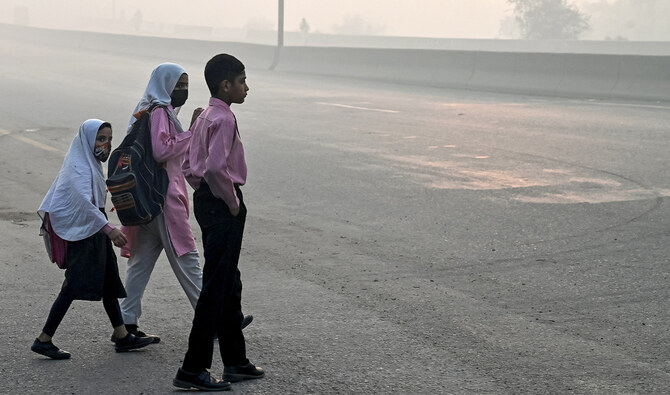
Children wearing masks walk to school amid dense smog in Lahore on October 23, 2024. (AFP)
Short Url
Updated 25 October 2024
Follow

Smog in Pakistan megacity ends outdoor play for schoolkids

  • The eastern city of Lahore near the border with India regularly registers among the world’s most polluted cities
  • Smog is particularly bad in winter due to low-grade fuel from factories, vehicles in low-lying city of 14 million

LAHORE: Schoolchildren in Pakistan’s second-largest city of Lahore have been banned from outdoor exercise until January because of hazardous smog levels, officials said Friday.
The eastern megacity near the border with India regularly registers among the world’s most polluted cities, this week recording more than 20 times the level deemed safe by the World Health Organization (WHO).
Smog is particularly bad in winter as a result of low-grade fuel from factories and vehicles in the low-lying megacity of 14 million, where denser cold air traps emissions at ground level.
Seasonal crop burn-off by farmers on the outskirts of Lahore is also a major contributing factor.
This week the Environmental Protection Agency of eastern Punjab province said that outdoor school activities in Lahore would end from Monday.
A Punjab School Education Department spokesman told AFP on Friday the ban would last for three months until January 31.
School hours will also be cut in the morning to prevent children traveling when the pollution is most punishing.
Lessons will start no earlier than 8:45 am (0345 GMT), cutting 15 minutes off learning hours for public schools and more than an hour for most private schools.
Breathing the toxic air has catastrophic health consequences, with WHO saying strokes, heart disease, lung cancer and respiratory diseases could be triggered due to prolonged exposure.
According to UNICEF nearly 600 million children in South Asia are exposed to high levels of air pollution.
Schools in Pakistan’s most populous province of Punjab in particular are increasingly disrupted by extreme heat in the summer and choking smog in the winter.
In an editorial on Friday, Pakistan’s leading English-language newspaper Dawn said measures such as shutting schools were “akin to putting band-aids on gaping wounds.”
“The long-term strategies needed to combat this environmental crisis remain elusive,” it said.



ADB approves $381 million for climate-resilient agriculture, social services in Punjab

Updated 8 sec ago
Follow

ADB approves $381 million for climate-resilient agriculture, social services in Punjab

  • Support will upgrade Punjab’s education and nursing systems, improving learning outcomes and health care capacity
  • Package includes $124 million for agriculture, $107 million for STEM schooling and $150 million for nursing reforms

KARACHI: The Asian Development Bank (ADB) said on Saturday it approved $381 million in financing for Pakistan’s Punjab province to modernize agriculture and strengthen education and health services, with a major focus on building climate resilience after monsoon floods this year caused widespread destruction across the country’s most populous province.

The package includes concessional loans and grants for farm mechanization, STEM education, and nursing sector reforms.

ADB said the investments are intended to help Punjab, home to more than half of Pakistan’s population and a key contributor to its economy, recover from climate shocks and transition toward more sustainable and resilient development.

“Investing in education, health, and agricultural mechanization will play a transformative role in driving the growth of Punjab, a vital pillar of Pakistan’s economy,” said ADB Country Director for Pakistan Emma Fan. “These strategic investments will modernize agriculture, enhance human capital, and significantly improve livelihoods for millions of people across Punjab.”

The bank approved $120 million in concessional loans and a $4 million grant for the Punjab Climate-Resilient and Low-Carbon Agriculture Mechanization Project, which will support 220,000 rural farm households.

The program aims to reduce climate vulnerability by shifting farmers toward modern, low-emission machinery, provide alternative livelihoods for agricultural workers and train 15,000 women in new skills. It will also introduce a financing model to help small farmers access advanced equipment.

Punjab produces most of Pakistan’s wheat, rice, and maize but still relies on outdated machinery, contributing to grain losses and routine burning of crop residues, a major source of air pollution, said ADB.

It noted the new project will promote modern mechanization, including rice harvesters, to address these issues.

ADB also approved $107 million for the Responsive, Ready, and Resilient STEM Secondary Education in Punjab Program, including a $7 million grant from the Asian Development Fund.

The results-based program aims to modernize secondary schooling by expanding inclusive STEM education, improving access and quality across the province.

A further $150 million concessional loan was approved for the Punjab Nursing and Health Workforce Reform Program, which will upgrade nursing curricula, develop disaster-resilient training facilities, strengthen workforce governance, and introduce digital human-resource systems.

The program seeks to expand the pool of qualified nurses to strengthen health service delivery and meet rising national and global demand.

Key components include the establishment of three centers of excellence in Lahore, Multan and Rawalpindi, equipped with simulation labs, digital learning platforms, and gender-responsive hostels.

ADB said it remains committed to supporting climate-resilient and inclusive development across Asia and the Pacific through innovative financing tools and partnerships.