

Pakistani Taliban attack kills 10 police in northwest

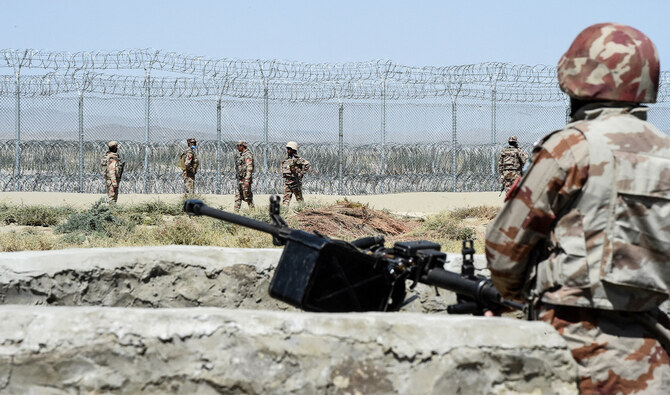
Security personnel of Pakistan's Frontier Corps patrol near the newly inaugurated Badini Trade Terminal Gateway, a border crossing point between Pakistan and Afghanistan at the Pakistan's border town of Qila Saifullah in the southwestern province of Balochistan on September 16, 2020. (AFP/File)
Short Url
Updated 25 October 2024
Follow

Pakistani Taliban attack kills 10 police in northwest

  • About 20 to 25 militants launched a heavy assault on a post of the Frontier Constabulary in the Dera Ismail Khan district
  • One policeman was killed in a separate attack carried out on Thursday night, also close to the Afghan border in Khyber district

PESHAWAR: Ten police were shot dead at a check post near the Afghan border, officials said Friday, in an attack claimed by the Pakistan Taliban.

“The intense exchange of fire lasted for nearly an hour. Ten Frontier Constabulary personnel were martyred, and seven were wounded during the attack,” a senior intelligence officer told AFP on condition of anonymity.

About 20 to 25 militants launched a heavy assault on a post of the Frontier Constabulary, a police assistance force, in the Dera Ismail Khan district of Khyber Pakhtunkhwa province.

Pakistan has seen an increase in militancy since the Afghan Taliban returned to power in 2021, with the Pakistani chapter of the movement carrying out attacks mostly targeting security forces.

A senior official from the Frontier Constabulary also confirmed the details on the condition of anonymity.

The attack was around 70 kilometer (around 43 miles) east of Afghan border.

One policeman was killed in a separate attack carried out on Thursday night, also close to the Afghan border in Khyber district.

Last month a police convoy escorting foreign ambassadors was targeted in road side blast that left a policeman dead.

The Pakistani Taliba historically has roots in Afghanistan and shares the same ideology as the Afghan Taliban.

Islamabad says such attacks are being launched from neighboring Afghanistan by various militant groups, many linked to the TTP, which the Taliban authorities in Kabul deny.


Pakistan terms climate change, demographic pressures as ‘pressing existential risks’

Updated 4 sec ago
Follow

Pakistan terms climate change, demographic pressures as ‘pressing existential risks’

  • Pakistan has suffered frequent climate change-induced disasters, including floods this year that killed over 1,000
  • Pakistan finmin highlights stabilization measures at Doha Forum, discusses economic cooperation with Qatar 

ISLAMABAD: Pakistan’s Finance Minister Muhammad Aurangzeb on Saturday described climate change and demographic pressures as “pressing existential risks” facing the country, calling for urgent climate financing. 

The finance minister was speaking as a member of a high-level panel at the 23rd edition of the Doha Forum, which is being held from Dec. 6–7 in the Qatari capital. Aurangzeb was invited as a speaker on the discussion titled: ‘Global Trade Tensions: Economic Impact and Policy Responses in MENA.’

“He reaffirmed that while Pakistan remained vigilant in the face of geopolitical uncertainty, the more pressing existential risks were climate change and demographic pressures,” the Finance Division said. 

Pakistan has suffered repeated climate disasters in recent years, most notably the 2022 super-floods that submerged one-third of the country, displaced millions and caused an estimated $30 billion in losses. 

This year’s floods killed over 1,000 people and caused at least $2.9 billion in damages to agriculture and infrastructure. Scientists say Pakistan remains among the world’s most climate-vulnerable nations despite contributing less than 1 percent of global greenhouse-gas emissions.

Aurangzeb has previously said climate change and Pakistan’s fast-rising population are the only two factors that can hinder the South Asian country’s efforts to become a $3 trillion economy in the future. 

The finance minister noted that this year’s floods in Pakistan had shaved at least 0.5 percent off GDP growth, calling for urgent climate financing and investment in resilient infrastructure. 

When asked about Pakistan’s fiscal resilience and capability to absorb external shocks, Aurangzeb said Islamabad had rebuilt fiscal buffers. He pointed out that both the primary fiscal balance and current account had returned to surplus, supported significantly by strong remittance inflows of $18–20 billion annually from the Middle East and North Africa (MENA) and Gulf Cooperation Council (GCC) regions. 

Separately, Aurangzeb met his Qatari counterpart Ali Bin Ahmed Al Kuwari to discuss bilateral cooperation. 

“Both sides reaffirmed their commitment to strengthening economic ties, particularly by maximizing opportunities created through the newly concluded GCC–Pakistan Free Trade Agreement, expanding trade flows, and deepening energy cooperation, including long-term LNG collaboration,” the finance ministry said. 

The two also discussed collaboration on digital infrastructure, skills development and regulatory reform. They agreed to establish structured mechanisms to continue joint work in trade diversification, technology, climate resilience, and investment facilitation, the finance ministry said.