


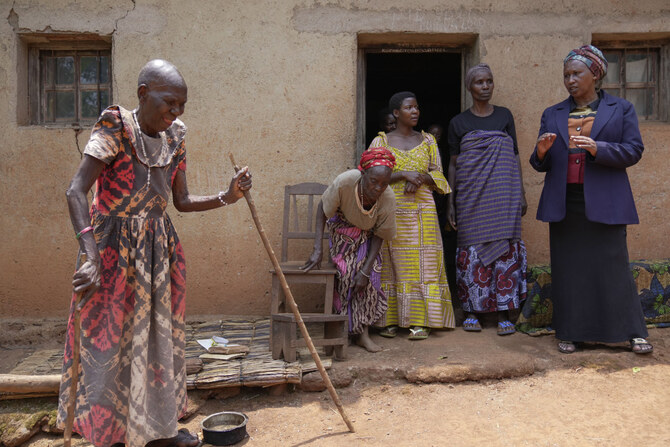


NGOZI, Burundi: The hug between the two women looked like it would last forever. A spirited 85-year-old had embraced a younger woman she hadn’t seen for months, and she chanted a number of questions in the peculiar yodeling routine of her ancestors.
How are you? How is your husband? How are the kids? How are your cows? Are you on good terms with your neighbors?
And so on.
Prudencienne Namukobwa paused in the melody to allow the younger woman’s rhythmic affirmation, a pattern she has mastered over the decades.
“Ego,” Emelyne Nzeyimana replied over and over in the local Kirundi language. “Yes.”
A group of neighbors watched in amazement. Many were seeing their first performance of the traditional form of musical greeting, known to Burundians as akazehe. It is performed exclusively by women on a range of occasions.
But akazehe is fading, despite its unique status in this central African country that is better known for its world-famous percussionists. That’s according to cultural officials, teachers and others who say the practice is worth preserving.
They cited the threat from public health measures that discourage unnecessary contact during disease outbreaks, in addition to the perceived failure to promote akazehe among school-going youth.
Among young Burundians, it is hard to find people who know what akazehe means and even harder to find someone who can perform it.
“At a certain time, unfortunately, it was abandoned,” said Sandrine Kitonze, a culture adviser in the office of the governor of Ngozi province.
She said akazehe and its minutes-long embrace “made you feel that the person who greets you loves you.”
Some academics have noted akazehe’s potential role in fostering social cohesion in Burundi, which is now largely peaceful after a period of deadly civil war followed by political instability.
Annonciate Baragahorana, a teacher in the province of Bujumbura, which includes the commercial capital, told The Associated Press that while she was not born in a place where akazehe was widely practiced, she was astonished as a young girl when women embraced and addressed her in the polyphonic way during visits to other regions.
“The women who often did this lived in the central plateau provinces. When we went there during the holidays, a woman from the interior of the country kissed you strongly while wishing you wonders and she hugged you for a long time,” she said with a chuckle. “I wanted her to finish quickly, even if it was sweet words to hear.”
Baragahorana said she feared “tenderness in social relationships will disappear” among Burundians amid threats from contagious diseases such as COVID-19 and Mpox.
“People greet each other from a distance for fear of contaminating each other,” she said. “This will contribute enormously to the demise of akazehe.”
In Ngozi, a hilly province in Burundi’s north, akazehe remains familiar to some locals, and women such as Namukobwa are impressive at performing it.

Prudencienne Namukobwa, 85, left, entertains her guests with akazehe, a Burundian traditional form of musical greeting performed exclusively by women, outside her house in Ngozi, Burundi, on Sept. 20, 2024. (AP)
She lives in a decaying house set in the side of a verdant hill. One recent morning, she was sitting on a mat outside when she glimpsed Nzeyimana, the visiting daughter of a former neighbor. She overcame her bad hip to rise and welcome the woman, whom she addressed as if she were her biological daughter.
“I felt that the first love she had when I was just a girl is kept until now,” said Nzeyimana, a broadcaster in Ngozi. “This means that I am still her daughter.”
Akazehe can seem like a race to perfect accord, a search for harmony, in the interwoven vocalizations. While most questions are routine, some can be unexpected. Nzeyimana said afterward that she had been anxious over possibly facing a question for which she was not ready with a positive response. There was none.
Serena Facci, an Italian scholar at the University of Rome Tor Vergata who has written about akazehe, said that even by 1993, when she went to Burundi for research in ethnomusicology, “this beautiful female greeting wasn’t very common in the ordinary life.” Its continuing disappearance could be due to changing lifestyles, she said.
A custom such as akazehe should be preserved at all costs because of its role in protecting families, said Isaac Nikobiba, an anthropologist in Bujumbura. Among communities that practiced it, women could alert mother figures to any turbulence at home, triggering supportive measures from the extended family, he said.
Nikobiba called the potential disappearance of akazehe symptomatic of wider cultural losses stemming from modernization.
“Normally, before starting a home in traditional Burundi, the girl would first receive advice from her paternal aunt who would tell her, ‘I will come to greet you after a certain time. If you notice an anomaly in the home, you will have to tell me everything,’” he said. “In short, if she does not find someone to whom she can confide her marital intimacies, she spends all the time in a very bad psychological atmosphere.”
Floride Ntakirutimana was among the small group of women who gathered to witness the spectacle of Namukobwa greeting Nzeyimana. She said she grew up in a farming community where no mother could perform akazehe, and only heard of it through radio programs.
The exchange she watched left her feeling she wanted to learn akazehe herself.
“I feel better, and I saw that it was good,” Ntakirutimana said.


