APIA: King Charles III took part in a traditional kava-drinking ceremony before a line of bare-chested, heavily tattooed Samoans and was declared a “high chief” of the one-time Pacific island colony Thursday.
The British monarch is on an 11-day tour of Australia and Samoa, both independent Commonwealth states — the first major foreign trip since his cancer diagnosis earlier this year.
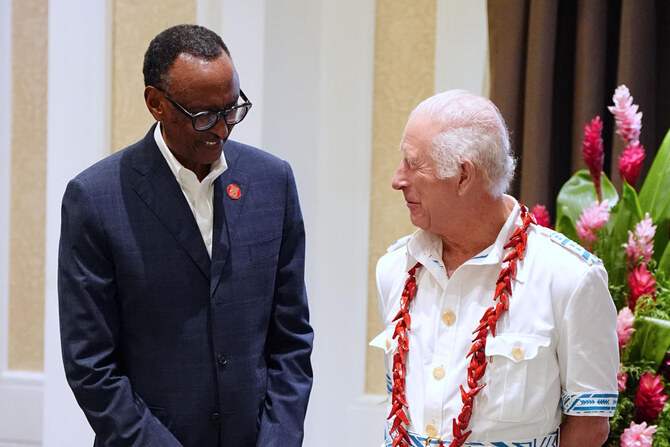
Wearing a white safari-style suit, the 75-year-old king sat at the head of a carved timber longhouse where he was presented with a polished half-coconut filled with a narcotic kava brew.
The peppery, slightly intoxicating root drink is a key part of Pacific culture and is known locally as “ava.”
The kava roots were paraded around the marquee, prepared by the chief’s daughter and filtered through a sieve made of dried bark.
Once ready, a Samoan man screamed as he decanted the drink, which was finally presented to the king.
Charles uttered the words: “May God Bless this ava” before lifting it to his lips.
Charles’s wife, Queen Camilla sat beside him, fanning herself to ease the stiffing tropical humidity.
Many Samoans are excited to host the king — his first-ever visit to the Pacific Island nation that was once a British colony.
The royal couple visited the village of Moata’a where Charles was made “Tui Taumeasina” or high chief.
“Everyone has taken to our heart and is looking forward to welcoming the king,” local chief Lenatai Victor Tamapua told AFP ahead of the visit.
“We feel honored that he has chosen to be welcomed here in our village. So as a gift, we would like to bestow him a title.”
Tamapua raised the issue of climate change and showed the king and queen around the local mangroves.
“The high tides is just chewing away on our reef and where the mangroves are,” he told AFP, adding that food sources and communities were being washed away or inundated.
“Our community relies on the mangrove area for mud crab and fishes, but since, the tide has risen over the past 20 years by about two or three meters (up to 10 feet).”
The king is also in Samoa for the Commonwealth Heads of Government Meeting, and will address a leaders’ banquet on Friday.
The legacy of empire looms large at the meeting.
Commonwealth leaders will select a new secretary-general nominated from an African country — in line with regional rotations of the position.
All three likely candidates have called publicly for reparations for slavery and colonialism.
One of the three, Joshua Setipa from Lesotho, told AFP that the resolution could include non-traditional forms of payment such as climate financing.
“We can find a solution that will begin to address some injustices of the past and put them in the context happening around us today,” he said.
Climate change features heavily on the agenda.
Tuvalu, Vanuatu and Fiji have backed calls for a “fossil fuel non-proliferation treaty” — essentially calling for Australia, Britain and Canada to do more to lower emissions.
Pacific leaders argue the trio of “big countries” have historically accounted for over 60 percent of the 56-nation Commonwealth’s emissions from fossil fuels.
Vanuatu’s special envoy for climate change Ralph Regenvanu called on other nations to join the treaty.
“As a Commonwealth family, we look to those that dominate fossil fuel production in the Commonwealth to stop the expansion of fossil fuels in order to protect what we love and hold dear here in the Pacific,” he said.
Australia’s foreign minister Penny Wong said her gas and mineral-rich nation was working to be cleaner.
“We know we have a lot of work to do, and I’ve been upfront with every partner in the Pacific,” she said.
Pacific island nations — once seen as the embodiment of palm-fringed paradise — are now among the most climate-threatened areas of the planet.


![]()

King Charles sips narcotic kava drink, becomes Samoan ‘high chief’
Short Url
https://arab.news/pxvbm
King Charles sips narcotic kava drink, becomes Samoan ‘high chief’
- The British monarch is on an 11-day tour of Australia and Samoa, both independent Commonwealth states — the first major foreign trip since his cancer diagnosis earlier this year


Latest updates



© 2026 SAUDI RESEARCH & PUBLISHING COMPANY, All Rights Reserved And subject to Terms of Use Agreement.