

Saudi Arabia surpasses FDI targets with $26bn inflows in 2023

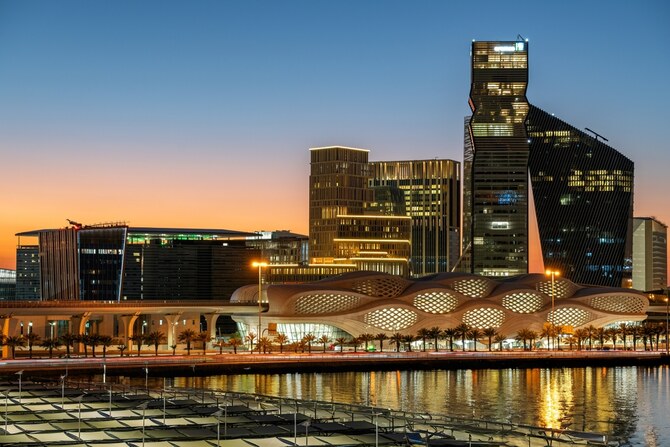
A view of the King Abdullah Financial District in Riyadh, Saudi Arabia. Shutterstock
Short Url
Updated 23 October 2024
Follow

Saudi Arabia surpasses FDI targets with $26bn inflows in 2023

  • Kingdom aims to boost FDI inflows to 5.7% of its nominal GDP by 2030
  • Saudi Arabia has rolled out a series of ambitious reforms and projects designed to foster FDI and enhance the overall business environment

RIYADH: Saudi Arabia’s foreign direct investment inflows reached SR96 billion ($25.6 billion) in 2023, marking a 50 percent annual increase from the previous year, according to recent data. 

A report from the Ministry of Investment said that these figures are calculated using a new methodology aligned with the International Monetary Fund’s sixth edition of the Balance of Payments Manual, which offers updated guidelines for compiling cross-border transaction data. 

The figures exclude the SR55 billion Aramco deal from 2022, in which a consortium led by BlackRock Real Assets and Hassana Investment Co. acquired a 49 percent stake in a newly-formed gas pipeline subsidiary. 

The reported inflows surpassed the National Investment Strategy target by 16 percent. Saudi Arabia aims to boost FDI inflows to 5.7 percent of its nominal gross domestic product by 2030, up from the current 2.4 percent, with a target of attracting $100 billion annually. 

The report also highlighted that FDI stock — the total value of foreign investments in the Kingdom — reached SR897 billion, a 13.4 percent annual increase. Net inflows surged by 91.1 percent to SR86 billion. 

Manufacturing industries led FDI inflows in 2023, amounting to SR34.44 billion, or 36 percent of the total. The financial and insurance sectors followed with SR14.86 billion, construction attracted SR13.38 billion, and wholesale and retail trade saw SR12.57 billion in inflows. 

By the end of last year, manufacturing industries also contributed the largest share of the total FDI stock, reaching approximately SR258.74 billion, or 29 percent of the total. Wholesale and retail trade activities contributed SR134.8 billion, or 15 percent, while financial and insurance sectors accounted for SR112.13 billion, or 12 percent. 

Saudi Arabia is actively working to cultivate an attractive investment environment as part of its Vision 2030 initiative, which aims to diversify the economy away from oil revenues. 

The Kingdom has rolled out a series of ambitious reforms and projects designed to foster FDI and enhance the overall business environment. 

These initiatives include streamlining regulatory processes, offering incentives to investors, and hosting high-profile events that showcase the Kingdom’s potential as a global investment hub. 

The country’s focus on localization and innovation has positioned manufacturing as a critical pillar for attracting global investments, aligning with its goals of self-sufficiency and sustainable development. 

The Saudi government’s proactive approach to improving the ease of doing business has also played a key role in attracting FDI. 

Localization efforts have evolved from mere compliance to becoming vital engines for both short-term success and long-term growth. Companies like Emerson have exemplified this journey by establishing local manufacturing facilities and expanding their operations to include a wide range of products tailored to the specific needs of the Saudi market. 

The focus on building a skilled local workforce has strengthened the manufacturing sector’s attractiveness to foreign investors. Initiatives that promote collaboration with local educational institutions ensure a continuous talent pipeline, with Saudi nationals leading the way in these operations. 

This commitment to workforce development, especially through enhancing opportunities for women in manufacturing roles, aligns with Vision 2030’s broader goals and fosters a more inclusive economy. 

Initiatives like “In-Kingdom Total Value Add,” or IKTVA, support the localization of supply chains, reducing reliance on imports while enhancing domestic manufacturing capabilities. 

By sourcing critical components locally, manufacturers can lower transportation costs and environmental footprints, making the sector even more appealing to foreign investors. 

Riyadh leads FDI inflows 

Riyadh attracted SR33 billion in FDI inflows, positioning it as the leading region in Saudi Arabia. This can be attributed to its status as the Kingdom’s capital and economic hub, where government initiatives and major infrastructure projects have bolstered investor confidence.

The Eastern Province followed with SR29 billion in inflows, benefiting from its natural resources and strategic location, which support trade and industrial activities. The region includes key cities such as Dammam, Al-Hasa, Al-Jubail, and Al-Khobar. 

Al-Khobar recently achieved the 99th position in the International Institute for Management Development’s Smart City Index for 2024, becoming the fifth Saudi city to earn smart city status alongside Riyadh, Jeddah, Makkah, and Madinah. 

This recognition highlights the Kingdom’s commitment to Saudi Vision 2030, focusing on technology-driven urban development. The IMD index evaluates cities on their ability to utilize advanced technologies to create sustainable, intelligent communities. 

The Madinah region attracted SR23 billion in FDI, driven by its religious significance and recent reforms to enhance global investment opportunities. 

As Muslim high-net-worth individuals worldwide increasingly seek property investments in the holy cities of Makkah and Madinah, the region is becoming a magnet for significant financial commitments. 

Investments in infrastructure, such as Turkish airport operation and services firm TAV Airports’ $275 million project to expand Prince Mohammad Bin Abdulaziz International Airport, further highlight the region’s growing appeal. 

This upgrade is essential to accommodate the rising passenger traffic, which soared nearly 50 percent last year to reach 9.4 million. By enhancing the airport’s capacity to handle 18 million passengers annually, the development strengthens the region’s connectivity and bolsters its appeal as a destination for religious tourism. 

In tandem with these infrastructure advancements, the hospitality sector in Madinah is also poised for transformation. Taiba Investments, a hospitality and real estate company, has announced a strategic partnership with Hilton to bring the Waldorf Astoria Hotels & Resorts brand to the city. 

The renovation of the existing Taiba Front Hotel into Waldorf Astoria Al Madinah is set to elevate the tourism experience, featuring over 300 luxurious rooms and suites, multiple dining options, and state-of-the-art facilities, including multi-functional halls and a fitness center. 

Scheduled to open in 2028, the hotel will enhance the pilgrimage experience, situated just a stone’s throw from the Prophet’s Mosque. 

Top countries driving FDI inflows 

In 2023, Saudi Arabia’s FDI inflows came from a diverse international landscape, with the top 20 countries accounting for 85 percent of the total. 

The UAE led the way, contributing 19 percent, followed by France with 11 percent. The UK and the Netherlands each contributed around 7 percent, while Egypt accounted for 6 percent. 

Among G20 nations, France was a significant player, contributing 12 percent, followed by the UK with 7 percent. The US and India also made noteworthy contributions, with 6 percent and 4 percent, respectively. 


World must prioritize resilience over disruption, economic experts warn

Saudi Arabia’s Finance Minister Mohammed Al-Jadaan urged policymakers and investors to “mute the noise” and focus on resilience.
Updated 23 January 2026
Follow

World must prioritize resilience over disruption, economic experts warn

  • Al-Jadaan said that much of the anxiety dominating markets reflected a world that had already been shifting for years
  • Pointing to Asia and the Gulf, Al-Jadaan said that some countries had already built models based on diversification and resilience

DAVOS: Saudi Arabia’s Finance Minister Mohammed Al-Jadaan urged policymakers and investors to “mute the noise” and focus on resilience, as global leaders gathered in Davos on Friday against a backdrop of trade tensions, geopolitical uncertainty and rapid technological change.

Speaking on the final day of the World Economic Forum in Davos, Al-Jadaan said that much of the anxiety dominating markets reflected a world that had already been shifting for years.

“We need to define who ‘we’ are in this so-called new world order,” he said, arguing that many emerging economies had been adapting to a more fragmented global system for decades.

Pointing to Asia and the Gulf, Al-Jadaan said that some countries had already built models based on diversification and resilience. In energy markets, he pointed out that the focus should remain on balancing supply and demand in a way that incentivized investment without harming the global economy.

“Our role in OPEC is to stabilize the market,” he said.

His remarks were echoed by Saudi Arabia’s Minister of Economy and Planning Faisal Alibrahim, who said that uncertainty had weighed heavily on growth, investment and geopolitical risk, but that reality had proven more resilient.

“The economy has adjusted and continues to move forward,” Alibrahim said.

Alibrahim warned that pragmatism had become scarce, trust increasingly transactional, and collaboration more fragile. “Stability cannot be quickly built or bought,” he said.

Alibrahim called for a shift away from preserving the status quo towards the practical ingredients that made cooperation work, stressing discipline and long-term thinking even when views diverged.

Quoting Saudi Arabia’s founding King Abdulaziz Al-Saud, he added: “Facing challenges requires strength and confidence, there is no virtue in weakness. We cannot sit idle.”

President of the European Central Bank Christine Lagarde stressed the importance of distinguishing meaningful data from headline noise, saying: “Our duty as central bankers is to separate the signal from the noise. The real numbers are growth numbers not nominal ones.”

Managing Director of the IMF Kristalina Georgieva echoed Lagarde’s sentiments, saying that the world had entered a more “shock prone” environment shaped by technology and geopolitics.

Director General of the World Trade Organization Ngozi Okonjo-Iweala said that the global trade systems currently in place were remarkably resilient, pointing out that 72 percent of global trade continued despite disruptions.

She urged governments and businesses, however, to avoid overreacting.

Okonjo Iweala said that a return to the old order was unlikely, but trade would remain essential. Georgieva agreed, saying global trade would continue, albeit in a different form.

Georgieva warned that AI would accelerate economic transformation at an unprecedented speed. The IMF expects 60 percent of jobs to be affected by AI, either enhanced or displaced, with entry-level roles and middle-class workers facing the greatest pressure.

Lagarde warned that without cooperation, capital and data flows would suffer, undermining productivity and growth.

Al-Jadaan said that power dynamics had always shaped global relations, but dialogue remained essential. “The fact that thousands of leaders came here says something,” he said. “Some things cannot be done alone.”

In another session titled Geopolitical Risks Outlook for 2026, former US Democratic representative Jane Harman said that because of AI, the world was safer in some ways but worse off in others.

“I think AI can make the world riskier if it gets in the wrong hands and is used without guardrails to kill all of us. But AI also has enormous promise. AI may be a development tool that moves the third world ahead faster than our world, which has pretty messy politics,” she said.

American economist Eswar Prasad said that currently the world was in a “doom loop.”

Prasad said that the global economy was stuck in a negative-feedback loop and economics, domestic politics and geopolitics were only bringing out the worst in each other.

“Technology could lead to shared prosperity but what we are seeing is much more concentration of economic and financial power within and between countries, potentially making it a destabilizing force,” he said.

Prasad predicted that AI and tech development would impact growing economies the most. But he said that there was uncertainty about whether these developments would create job opportunities and growth in developing countries.

Professor of international political economy at the University of New South Wales in Australia, Elizabeth Thurbon, said that China was driving a Green Energy transition in a way that should be modeled by the rest of the world.

“The Chinese government is using the Green Energy Transition to boost energy security and is manufacturing its own energy to reduce reliance on fossil fuel imports,” she explained.

Thurbon said that China was using this transition to boost economic security, social security and geostrategic security. She viewed this as a huge security-enhancing opportunity and every country had the ability to use the energy transition as a national security multiplier. 

“We are seeing an enormous dynamism across emerging market economies driven by China. This boom loop is being driven by enormous investments in green energy. Two-thirds of global investment flowing into renewable energy is driven largely by China,” she said.

Thurbon said that China was taking an interesting approach to building relationships with countries by putting economic engagement on the forefront of what they had to offer.

“China is doing all it can to ensure economic partnership with emerging economies are productive. It’s important to approach alliances as not just political alliances but investment in economy, future and the flourishment of a state,” she said.

The panel criticized global economic treaties and laws, and expressed the need for immediate reforms in economic governing bodies.

“If you are a developing economy, the rules of the WTO, for example, are not helpful for you to develop. A lot of the rules make it difficult to pursue an economic development agenda. These regulations are not allowing the economies to grow,” Thurbon said.

“Serious reform must be made in international trade agreements, economic bodies and rules and guidelines,” she added.

Prasad echoed this sentiment and said there was a need for national and international reform in global economic institutions.

“These institutions are not working very well so we can reconfigure them or rebuild them from scratch. But unfortunately the task of rebuilding falls into the hands of those who are shredding them,” he said.

WEF attendees were invited to join the Global Collaboration and Growth meeting to be held in Saudi Arabia in April 2026 to continue addressing the complex global challenges and engage in dialogue.