

Saudi Arabia pushes forward with industrial and mining strategies at UNIDO MIPF 2024

1 / 3
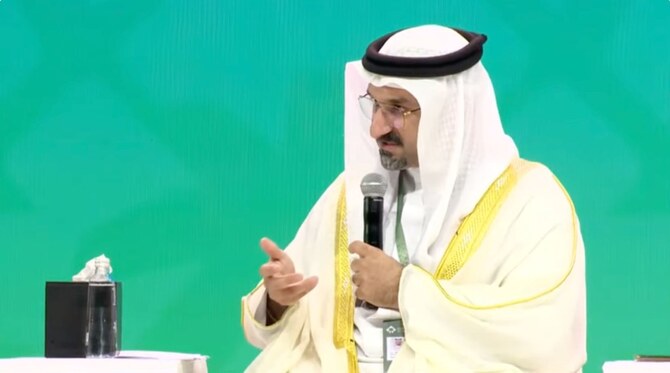
Bahrain’s Minister of Industry and Commerce Abdulla Adel Fakhro. Screenshot
2 / 3
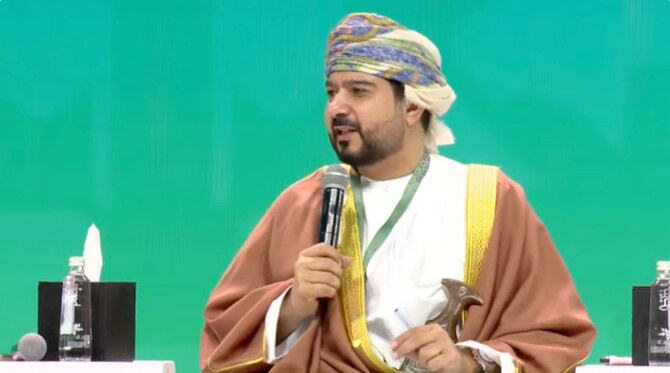
Oman’s Minister of Commerce, Industry, and Investment Promotion Qais bin Mohammed Al-Yousef. Screenshot
3 / 3
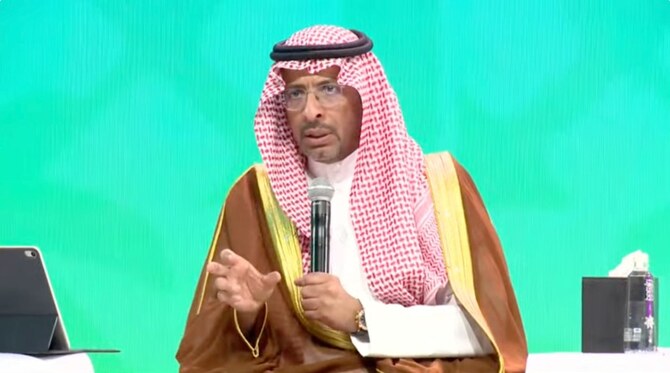
Saudi Arabia’s Minister of Industry and Mineral Resources Bandar Alkhorayef. Screenshot
Short Url
Updated 23 October 2024
Follow

Saudi Arabia pushes forward with industrial and mining strategies at UNIDO MIPF 2024

  • Saudi minister of industry and mineral resources outlined the Kingdom’s strategy of focusing on 12 key sectors
  • Saudi Arabia’s strategic position enables it to become both an industrial powerhouse and a global logistics hub

RIYADH: Saudi Arabia’s Minister of Industry and Mineral Resources has emphasized the importance of industrial and mining sectors in achieving the country’s Vision 2030 goals of economic diversification. 

At the UN Industrial Development Organization Multilateral Industrial Policy Forum panel discussion in Riyadh, Bandar Alkhorayef said that the Kingdom’s vision encompasses economic diversification, underlining that from the initiative’s beginning, it was evident that sectors like industry and mining held the greatest potential for achieving this diversification.

He underscored Saudi Arabia’s demographic advantage, with the majority of the population under 30, as a significant asset for the nation’s future. “We have a country that’s full of young people. This is a great asset to be used and considered,” he said.

Alkhorayef outlined the Kingdom’s strategy of focusing on 12 key sectors, grouping them into three pillars. The first group includes national security and resilience divisions, such as food security, pharmaceuticals, water security, and defense. 

The second pillar focuses on leveraging Saudi Arabia’s competitive advantages, particularly its natural resources like oil, gas, petrochemicals, and minerals. “We have two very important competitive advantages: our natural resources and our geographical location,” he said. 

He added that Saudi Arabia’s strategic position enables it to become both an industrial powerhouse and a global logistics hub, with downstream chemicals and metal refining playing key roles.

The third group of products emphasizes research, innovation, and human capital development. “How can we ensure that Saudi Arabia is well positioned to take advantage of the next trend?” Alkhorayef questioned, highlighting the need for readiness in the face of rapid global change.

The panel also focused on regional collaboration, with Alkhorayef highlighting that Saudi Arabia and the UAE are well-positioned to attract investments in key sectors. “We are working with investors in both ways to ensure that investments do come to the sector, to ensure also the right investment coming in terms of the right product, but be very mindful of choosing the right technology,” he said. 

He further emphasized Saudi Arabia’s global ambitions, saying: “We are building manufacturing for the future, and it’s not only for Saudi Arabia, it’s for the region, for the global community.”

Bahrain’s Minister of Industry and Commerce Abdulla Adel Fakhro praised the Kingdom’s leadership in industrial transformation. 

“Saudi Arabia today is leading the region in transforming their industrial sector, and this is something we are very proud of,” Fakhro said. 

He also shared Bahrain’s progress, citing the country’s industrial strategy launch in 2022, which focuses on the Fourth Industrial Revolution, digital technology, environmental, social, and governance awareness, and supply chain efficiency.

Oman’s Minister of Commerce, Industry, and Investment Promotion Qais bin Mohammed Al-Yousef discussed his country’s diversification efforts to make manufacturing one of the top five sectors driving the country’s economy away from reliance on oil and gas.


Saudi POS stays above $4bn as Ramadan spending lifts outlays on home goods

Updated 20 February 2026
Follow

Saudi POS stays above $4bn as Ramadan spending lifts outlays on home goods

RIYADH: Saudi point-of-sale transactions remained above $4 billion in the week ending Feb. 14, with spending on furniture and home supplies rising ahead of Ramadan, central bank data showed.

Overall POS activity totaled SR15.34 billion ($4.09 billion), representing a 4.8 percent week-on-week decrease, while the number of transactions dipped 1.6 percent to 252 million, according to the Saudi Central Bank. 

Spending on furniture and home supplies rose 5.9 percent to SR697.35 million, marking the strongest weekly increase among major retail categories. 

Expenditure on electronics increased 2.9 percent, while spending on construction and building materials rose 1.1 percent.

Sectors that saw declines includes freight transport and courier services, which posted a drop of 5 percent to SR64.86 million.

Pharmacy and medical supplies spending fell 8.2 percent to SR223.81 million, but outlays on medical services rose 5.7 percent to SR539.68 million. 

Food and beverage expenditure decreased 4.3 percent, but the total spend of SR2.57 billion meant it retained the largest share of POS activity.

Restaurants and cafes followed with SR1.73 billion, despite a 4.7 percent decline. Apparel and clothing outlays represented the third-largest share of POS spending during the monitored week, up 0.5 percent to SR1.38 billion.

The Kingdom’s major urban centers mirrored the mixed national changes. Riyadh, which accounted for the largest share of total POS spending, saw a 3.4 percent drop to SR5.32 billion. The number of transactions in the capital reached 80.7 million, down 0.8 percent week on week. 

In Jeddah, transaction values decreased 4.4 percent to SR2.12 billion, while Dammam reported a 3.3 percent decrease to SR746.29 million. 

POS data, tracked weekly by SAMA, provides an indicator of consumer spending trends and the ongoing growth of digital payments in Saudi Arabia.  

The data also highlights the expanding reach of POS infrastructure, extending beyond major retail hubs to smaller cities and service sectors, supporting broader digital inclusion initiatives.  

The growth of digital payment technologies aligns with Saudi Arabia’s Vision 2030 objectives, promoting electronic transactions and contributing to the Kingdom’s broader digital economy.