

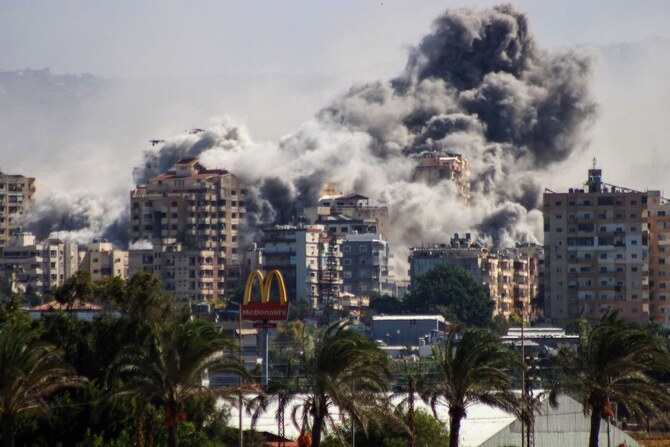

BEIRUT: Intense Israeli raids targeted the southern coastal city of Tyre on Wednesday following evacuation warnings by the Israeli army.
Although the number of people in the city had decreased, panic gripped the remaining residents, prompting them to flee.
Half an hour after the warnings by Israeli army spokesperson Avichay Adraee, the city was targeted, with plumes of black smoke filling the sky.
The raids destroyed several neighborhoods, including hotels, restaurants and commercial institutions.
Tyre often hosts UN peacekeepers on their first break from deployments along the border region.
It comprises rich Phoenician, Byzantine and Roman remains recorded on the World Heritage List 1984.
A portion of the city, formerly known as “the onshore Tyre,” also includes Qana, Sarafand and the surroundings of Naqoura.
Maha Al-Khalil Chalabi, chief of the International Association to Save Tyre, described what was happening as “brutal.”
The destructive Israeli bombing, she said, besieged Tyre and the old town specifically.
UNESCO has warned of the need to take immediate measures to protect Tyre and Baalbek from the dangers of bombing and destruction to protect its population.
The Israeli army says that it is targeting Hezbollah’s infrastructure, while simultaneously invading several border villages to bulldoze them after bombing houses and facilities.
These villages include Aita Al-Shaab, notably the old town, as well as other villages in Bint Jbeil, which was subject to artillery shelling.
Israeli raids also targeted more than 20 villages, including Khiam, Taybeh, Chakra, Ainata, Sarbin, Mayfadoun, Habboush, Maarakeh, Kfarsir, Aaichiyeh, Jibchit, Harouf, Blat, Kfar Reman, Arab Salim and Yohmor Chkeif, killing and injuring dozens of people.
One of the fleeing residents in the south, who wished to remain anonymous, said that after remaining in his village for 22 days, what he saw “is black hell I’ve never seen in my life.”
He added: “They left us to our fate and let us down. If you see the magnitude of the destruction, you will not believe your eyes.”
He said that “many Hezbollah members are shaving their beards and fleeing the country to Iraq.”
Hezbollah announced the execution of a series of military operations, some of which targeted “a gathering of soldiers at the eastern outskirts of the Lebanese town of Taybeh, as well as two gatherings at the Misgav Am site and at the borders of the Lebanese town of Rab El-Thalathine.”
The clashes remain intense at the triangle of Taybeh-Rab El-Thalathine-Adaisseh between Hezbollah and the Israeli army, aimed at preventing any incursion into Lebanese territory.
On Tuesday night, Israeli airstrikes hit the southern suburbs of Beirut with about eight raids targeting residential buildings that had been evacuated in the neighborhoods of Al-Laylaki and Haret Hreik, the vicinity of Al-Rayah Stadium, Al-Qaim Mosque, the Atwi complex in Al-Marija and Burj Al-Barajneh, and a building opposite Bahman Hospital, causing massive damage to the hospital.
The Israeli army reported that it intercepted “four drones on Wednesday that were attempting to approach the border, and detected the launch of 25 projectiles from Lebanon toward Haifa Bay and Upper Galilee.”
Israeli media reported “the interception of a missile in the airspace over the city of Petah Tikva, located northeast of Tel Aviv, as well as two missiles in the airspace above the Ramat David military airport in the Jezreel Valley, east of Haifa.”
The Israeli army announced that “22 soldiers were injured in battles in southern Lebanon over the past 24 hours.”
Hezbollah is mourning the head of the party’s executive council, Hashem Safieddine, who was killed in Israeli raids that targeted buildings in Al-Marija in the southern suburbs of Beirut early this October.
The Israeli raids prevented any efforts to approach the targeted site to retrieve his body to confirm his death.
Safieddine was the likely successor to the party’s secretary-general, Hassan Nasrallah, who was killed by Israel in raids that targeted his underground residence in Haret Hreik on Sept. 27.
The Israeli army announced on Tuesday evening the “elimination of Safieddine” after receiving intelligence in Beirut about the recovery of his body and the bodies of about 20 leaders.
The conflict between Israel and Hezbollah appears to be far from resolution, despite diplomatic efforts, and has entered a phase of attrition.
German Foreign Minister Annalena Baerbock, who arrived in Beirut, said: “Israel has significantly weakened Hezbollah, and the current task is to achieve an effective diplomatic solution.”
MP Ibrahim Mneimneh predicted that the conflict will be long.
“Israel has confirmed that it will not cease its operations against Lebanon until it has completely dismantled Hezbollah’s military capabilities, disarmed the group, and returned the residents of the north to their settlements.
“Conversely, Hezbollah asserts that it will continue to resist Israel until the last fighter.
“Therefore, it is unlikely that the fronts of combat will calm down in the near future, especially given that the US administration is preoccupied with the election campaigns for the presidential race.”
Mneimneh said: “This situation is accompanied by the Lebanese government’s inability to exert pressure to halt the war, and the ruling system that has led the country to this disaster remains determined to dismantle what is left of the state.
“Iran is stepping forward to negotiate on our behalf as if its previous interventions have not already brought devastation and ruin to all of Lebanon.”
Meanwhile, a meeting was held on Wednesday between the two former presidents, Amin Gemayel and Michel Suleiman, and former prime minister, Fouad Siniora, at Gemayel’s residence in Bikfaya.
The meeting praised Prime Minister Najib Mikati’s “stance against Iranian guardianship and hegemony and his affirmation of the sovereignty of the Lebanese state and its full control of its free decision.”
The attendees said that “efforts should now focus on saving Lebanon without any delay to stop the horrifying and open massacre of the Lebanese people at the hands of the Israeli aggression, through an immediate ceasefire and the implementation of Resolution 1701 under the exclusive authority of the state strictly and completely.”
The meeting called for supporting the parliament’s speaker, prime minister and Arab parties in these efforts.
The process of electing a president for the republic should be freed from any preconditions, and the elected president should have the confidence of parliament, they said.
“A national salvation government should be formed, and work should commence on preparing and implementing a plan for state-building that ensures economic recovery in all its forms, including efforts to rebuild what the Israeli aggression has destroyed, in cooperation with friendly institutions and nations,” a statement released after the meeting said.
The attendees called for “the need to re-establish the authority of the state over all Lebanese territories, in compliance with international and Arab legitimate resolutions.”
They also urged “adopting and implementing the financial, economic, administrative and institutional reform plan in the country.”
Siniora said: “From the first day after the 2006 July war, there was a failure to implement Resolution 1701 by Israel and Hezbollah. It is true that the state sent a large number of army personnel to the south, but at that time, we witnessed a laxity in implementation.”
Meanwhile, the 11th relief plane in the Saudi air bridge, operated by the King Salman Humanitarian Aid and Relief Center, arrived at Beirut Rafic Hariri International Airport, carrying food, tents and medical aid.


