TORONTO: Ottawa’s accusations this week detailing a deadly Indian campaign against its Canada-based critics may have further derailed bilateral relations — but to Sikh activists, the striking disclosures brought validation.
Canada has accused India of orchestrating the 2023 killing in Vancouver of 45-year-old naturalized Canadian citizen Hardeep Singh Nijjar, a prominent campaigner for “Khalistan,” the fringe separatist movement for an independent Sikh homeland in India’s Punjab state.
In public comments this week, Prime Minister Justin Trudeau and the national police said India’s targeting of Canadian Khalistan activists went beyond Nijjar’s killing, and has included a broad campaign of intimidation, violence and other threats.
India has dismissed the allegations.
“It was very validating,” Harinder Sohi told AFP at a thinly attended protest on Friday outside the Indian consulate in Toronto.
“This is something that we believed in for years and people weren’t listening to us,” the 42-year-old Khalistan activist said.
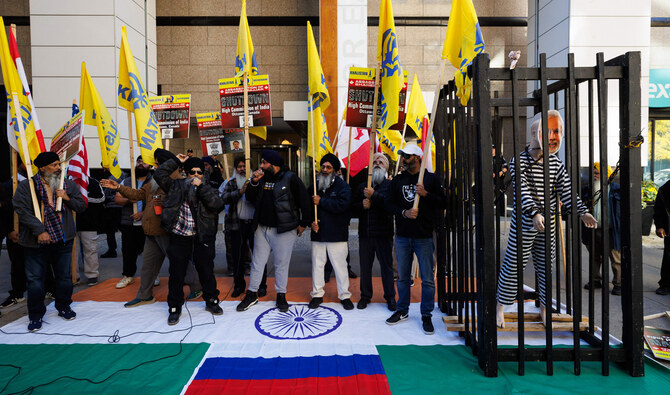
The dozens of protesters at Friday’s rally waved yellow flags with “Khalistan” written in bold blue letters and repeated a chant branding Indian Prime Minister Narendra Modi “a terrorist.”
They also erected a prison cell around an effigy of the Indian leader.
Sohi said it was meaningful that Canada has now publicly affirmed the “danger” India poses to people living across Canada.
It “is shocking that we as Canadian citizens have to live in fear of a foreign government,” he said.
Testifying Wednesday at an inquiry on foreign interference, Trudeau made clear his government was not looking to blow up relations with a major trading partner with whom Canada has deep ties.
But he said when faced with clear evidence the Indian government had directed acts of violence inside Canada and breached Canadian “sovereignty,” he and the Royal Canadian Mounted Police resolved to go public in the interest of public safety.
The Khalistan campaign dates back to India’s 1947 independence and within India today any support for the movement faces a swift crackdown.
Jatinder Singh Grewal, a director with the Sikhs for Justice advocacy group and a Khalistan supporter, argued that Modi’s government is intent on silencing support for the movement abroad because it fears discussion among the Sikh diaspora could fuel a movement at home.
“If you allow the Canadian Sikhs, or the American Sikhs or the British Sikhs to openly talk about this, you will eventually make the Punjabi Sikh say, ‘Why can’t I talk about this openly?’“
Grewal praised Trudeau’s public disclosures and Canada’s decision to expel Indian diplomats but said more was needed, endorsing the closure of Indian consulates in Toronto and Vancouver, arguing they have been used to coordinate violence against Sikhs.
There are roughly 770,000 Sikhs in Canada, about two percent of the population, the largest Sikh community outside of India.
Sikhs are heavily concentrated in suburban areas, notably around Toronto and Vancouver, and the community’s vote has been pivotal in past national elections.
Last year, days after Trudeau first accused Indian agents of killing Nijjar, one former government foreign policy adviser charged that domestic politics had influenced Trudeau’s decisions on Sikh affairs.
Writing in The Globe and Mail, the former adviser Omer Aziz said Trudeau’s Liberal party was worried about losing votes to the left-wing New Democrats, led by Jagmeet Singh, who is Sikh.
Trudeau’s poll numbers are plummeting and with an election due in the coming months, questions have again surfaced about Trudeau’s efforts to shore up Sikh votes.
Holding a Khalistan flag at Friday’s protest, Inderjeet Singh Gosal dismissed any such political motive.
“I don’t think it’s about that,” he told AFP. “I just think that Justin Trudeau is just following his principles. He believes in rights and he believes in keeping his Canadian citizens safe.”

‘Validation’ for Sikh activists after Canada slams Indian tactics
Short Url
https://arab.news/wbrmc
‘Validation’ for Sikh activists after Canada slams Indian tactics
- Canada has accused India of orchestrating the 2023 killing in Vancouver of 45-year-old naturalized Canadian citizen Hardeep Singh Nijjar
- Nijjar was a prominent campaigner for “Khalistan,” the fringe separatist movement for an independent Sikh homeland in India’s Punjab state
El Paso flights resume after US anti-drone system prompts sudden shutdown
- Aviation officials lifts restrictions after sudden overnight halt
- FAA, US Army in dispute over laser anti-drone system
WASHINGTON: A secret military laser-based anti-drone system prompted the Trump administration to ban air traffic for more than seven hours in and out of the Texas border city of El Paso after US aviation officials raised drastic concerns about the safety of commercial air traffic.
The sudden closure of the nation’s 71st busiest airport by the Federal Aviation Administration stranded air travelers and disrupted medical evacuation flights overnight. The FAA initially said the closure would last 10 days for “special security reasons,” in what would have been an unprecedented action involving a single airport. Government and airline officials, speaking on condition of anonymity, said the FAA closed the airspace due to concerns that an Army laser-based counter-drone system could pose risks to air traffic. The two agencies had planned to discuss the issue at a February 20 meeting but the Army opted to proceed without FAA approval, sources said, which prompted the FAA to halt flights.
The Army’s laser was a direct-energy weapon called LOCUST and is manufactured by AeroVironment, a Virginia-based drone and counter-drone defense firm, two people briefed on the matter said. The company and the Pentagon did not immediately respond to requests for comment.
The FAA lifted its restrictions after the Army agreed to more safety tests before using the system, which is housed at Fort Bliss, next to El Paso International Airport.
The White House was surprised by the El Paso airspace closure, according to two sources speaking on condition of anonymity, touching off a scramble among law enforcement agencies to figure out what happened.
The FAA lifted the restrictions shortly after the situation was discussed in the office of White House chief of staff Susie Wiles, the sources said. US Transportation Secretary Sean Duffy, who oversees the FAA, said the closure had been prompted by a drone incursion by a Mexican drug cartel. However, a drone sighting near an airport would typically lead to a brief pause on traffic, not an extended closure, and the Pentagon says there are more than 1,000 such incidents each month along the US-Mexico border.
FAA Administrator Bryan Bedford met senators on Wednesday and told them there could have been better coordination about the move but did not answer detailed questions about why the agency initially planned a 10-day halt to flights, lawmakers said. Senate Commerce Committee chair Ted Cruz, a Texas Republican, and Senator Ben Ray Lujan, a New Mexico Democrat, both called for a classified briefing to get more answers. “The details of what exactly occurred over El Paso are unclear,” Cruz said.
The move had stranded numerous aircraft from Southwest Airlines, United Airlines and American Airlines at the airport, which handles about 4 million passengers annually.
El Paso Mayor Renard Johnson said the FAA did not reach out to the airport, the police chief or other local officials before shutting down the airspace.
“I want to be very, very clear that this should have never happened,” he said at a news conference.
The US official in charge of airport security, Transportation Security Administration Acting Administrator Ha Nguyen McNeill, also told Congress that she had not been notified.
“That’s a problem,” said Republican Representative Tony Gonzales of Texas, who said there are daily drone incursions along the US-Mexico border.
Airlines caught off guard
Airlines were also caught off-guard by the early Wednesday announcement. Southwest Airlines said the effects should be minimal for its 23 daily departures scheduled.
“FAA has not exactly acquitted itself credibly, objectively, or professionally,” said Bob Mann, an airline industry consultant. “The question should be, do we get an explanation?”
Trump has repeatedly threatened to deploy US military force against Mexican drug cartels, which have used drones to carry out surveillance and attacks on civilian and government infrastructure, according to US and Mexican security sources.
Mexican President Claudia Sheinbaum said at her daily news conference that her administration would try to find out what exactly happened but had no information about drone traffic along the border.
Tensions between the US and regional leaders have ramped up since the Trump administration mounted a large-scale military buildup in the southern Caribbean, attacked Venezuela and seized its president, Nicolas Maduro, in a military operation. The FAA curbed flights throughout the Caribbean after the attack, forcing the cancelation of hundreds of flights.
The sudden closure of the nation’s 71st busiest airport by the Federal Aviation Administration stranded air travelers and disrupted medical evacuation flights overnight. The FAA initially said the closure would last 10 days for “special security reasons,” in what would have been an unprecedented action involving a single airport. Government and airline officials, speaking on condition of anonymity, said the FAA closed the airspace due to concerns that an Army laser-based counter-drone system could pose risks to air traffic. The two agencies had planned to discuss the issue at a February 20 meeting but the Army opted to proceed without FAA approval, sources said, which prompted the FAA to halt flights.
The Army’s laser was a direct-energy weapon called LOCUST and is manufactured by AeroVironment, a Virginia-based drone and counter-drone defense firm, two people briefed on the matter said. The company and the Pentagon did not immediately respond to requests for comment.
The FAA lifted its restrictions after the Army agreed to more safety tests before using the system, which is housed at Fort Bliss, next to El Paso International Airport.
The White House was surprised by the El Paso airspace closure, according to two sources speaking on condition of anonymity, touching off a scramble among law enforcement agencies to figure out what happened.
The FAA lifted the restrictions shortly after the situation was discussed in the office of White House chief of staff Susie Wiles, the sources said. US Transportation Secretary Sean Duffy, who oversees the FAA, said the closure had been prompted by a drone incursion by a Mexican drug cartel. However, a drone sighting near an airport would typically lead to a brief pause on traffic, not an extended closure, and the Pentagon says there are more than 1,000 such incidents each month along the US-Mexico border.
FAA Administrator Bryan Bedford met senators on Wednesday and told them there could have been better coordination about the move but did not answer detailed questions about why the agency initially planned a 10-day halt to flights, lawmakers said. Senate Commerce Committee chair Ted Cruz, a Texas Republican, and Senator Ben Ray Lujan, a New Mexico Democrat, both called for a classified briefing to get more answers. “The details of what exactly occurred over El Paso are unclear,” Cruz said.
The move had stranded numerous aircraft from Southwest Airlines, United Airlines and American Airlines at the airport, which handles about 4 million passengers annually.
El Paso Mayor Renard Johnson said the FAA did not reach out to the airport, the police chief or other local officials before shutting down the airspace.
“I want to be very, very clear that this should have never happened,” he said at a news conference.
The US official in charge of airport security, Transportation Security Administration Acting Administrator Ha Nguyen McNeill, also told Congress that she had not been notified.
“That’s a problem,” said Republican Representative Tony Gonzales of Texas, who said there are daily drone incursions along the US-Mexico border.
Airlines caught off guard
Airlines were also caught off-guard by the early Wednesday announcement. Southwest Airlines said the effects should be minimal for its 23 daily departures scheduled.
“FAA has not exactly acquitted itself credibly, objectively, or professionally,” said Bob Mann, an airline industry consultant. “The question should be, do we get an explanation?”
Trump has repeatedly threatened to deploy US military force against Mexican drug cartels, which have used drones to carry out surveillance and attacks on civilian and government infrastructure, according to US and Mexican security sources.
Mexican President Claudia Sheinbaum said at her daily news conference that her administration would try to find out what exactly happened but had no information about drone traffic along the border.
Tensions between the US and regional leaders have ramped up since the Trump administration mounted a large-scale military buildup in the southern Caribbean, attacked Venezuela and seized its president, Nicolas Maduro, in a military operation. The FAA curbed flights throughout the Caribbean after the attack, forcing the cancelation of hundreds of flights.
© 2026 SAUDI RESEARCH & PUBLISHING COMPANY, All Rights Reserved And subject to Terms of Use Agreement.


