Harris says elimination of Hamas’ Yahya Sinwar gives opportunity to ‘end the war in Gaza’

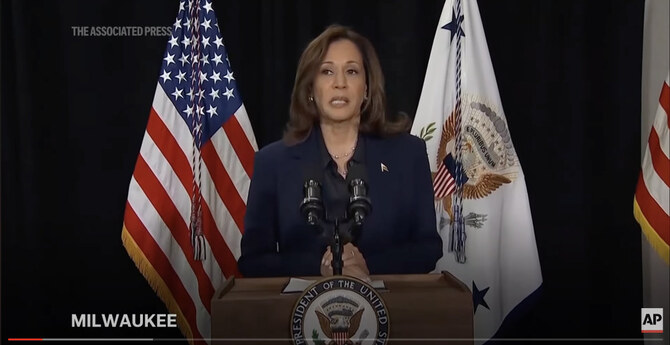
US Vice President Kamala Harris talks about the war in Gaza on Thursday as she reacts to the reported killing of Hamas leader Yahya Sinwar by Israeli troops. (Screengrab from AP video)
Short Url
Updated 18 October 2024
Follow

Harris says elimination of Hamas’ Yahya Sinwar gives opportunity to ‘end the war in Gaza’

  • Israeli officials said Sinwar was killed in a battle with Israeli forces in Gaza
  • The Biden administration’s support for Israel has complicated Harris' campaign push among Arab Americans

MILWAUKEE: Kamala Harris said Thursday that Israel’s killing of Hamas’ top leader offers “an opportunity to finally end the war in Gaza,” talking plainly about next steps even as the pro-Palestinian demonstrators who gathered outside her campaign event underscored the complicated politics at play.
The Democratic presidential nominee said the war “must end such that Israel is secure, the hostages are released, the suffering in Gaza ends and the Palestinian people can realize their right to dignity, security, freedom and self-determination.”
“It is time for the day after to begin,” she said, speaking from the University of Wisconsin-Milwaukee just moments after the White House released President Joe Biden’s statement on the death of Yahya Sinwar. Israeli officials said Sinwar was killed in a battle with Israeli forces in Gaza.

The administration’s response to the killing of a chief architect of the Oct. 7, 2023, attack on Israel was carefully choreographed, leaving room for Harris to emphasize the push to end the war as she balances her loyalty to Biden.
With the presidential race at razor-thin margins and the election just a few weeks away, the vice president is seeking to solidify support in battleground states and shore up left flank voters who want to see an immediate end to the bloody conflict, some of whom threaten not to vote for her.
The Biden administration’s support for Israel has complicated her campaign push in metro Detroit, especially in Dearborn, an area home to the nation’s largest Arab American community. The death earlier this month of a Dearborn resident killed in south Lebanon ignited more anger in the traditionally Democratic area.
Speaking Thursday in Flint, Michigan, Democratic Gov. Gretchen Whitmer said she was hopeful for an end to the violence.
“Have the hostages returned and have a solution for long-term peace in the region. That’s everything that I think is so important. And, you know, any chance that we can do that, I think would be welcomed by so many people,” she said.

Trump ’unstable’

At Harris’ next stop in Wisconsin, at the University of Wisconsin-La Crosse, her remarks focused on Trump and his falsehoods around the Jan. 6, 2021, riot at the US Capitol.
Trump is “increasingly unstable and unhinged, and will stop at nothing to claim unchecked power for himself,” she said.

William Schauberger, a 24-year-old political science major, said ahead of her rally there that he wasn’t optimistic that either side would put a stop to the conflict raging in the Middle East.
“I mean, especially when there were, you know, massive protests. And instead of doing anything about it, and trying to secure stuff, they just tended to, you know, ignore it and ... just denounce the protests,” he said.
Harris has not proposed any policy shifts on Israel, and her remarks largely echoed Biden’s statement. But she has, of late, faced increasing pressure to articulate how she would govern differently from Biden.
While Biden’s favorability ratings remain underwater, some of the biggest pieces of his legislative agenda, from infrastructure to lowering the costs of some prescription drugs, are popular, and signaling any daylight with the president on foreign policy at a time of global crises could be seen as reckless.
Biden’s written statement on Sinwar’s death — released as he was traveling to Germany for a visit with Chancellor Olaf Scholz — focused on how US intelligence helped the Israelis pursue Hamas leadership and noted that Israel had every right to “eliminate the leadership and military structure of Hamas.”
“Today proves once again that no terrorists anywhere in the world can escape justice, no matter how long it takes,” Biden said.
He said he would speak with Prime Minister Benjamin Netanyahu to “congratulate them, to discuss the pathway for bringing the hostages home to their families and for ending this war once and for all, which has caused so much devastation to innocent people.”


Leaders of Indonesia and Australia sign a new security treaty to affirm deeper ties

Updated 3 sec ago
Follow

Leaders of Indonesia and Australia sign a new security treaty to affirm deeper ties

JAKARTA: Indonesian and Australian leaders signed a new bilateral security treaty Friday that both governments say will deepen ties between the often-testy neighbors.
The treaty was signed in Indonesia’s capital, Jakarta, three months after Australian Prime Minister Anthony Albanese and Indonesian President Prabowo Subianto announced in Sydney that negotiations on the pact had been substantively concluded, highlighting their ambition to better utilize the two country’s past security agreements inked in 1995 and 2006.
Albanese has cast the agreement as a “watershed moment” in relations with its major closest neighbor, saying in a statement ahead of his arrival in Jakarta late Thursday, that it marks a major extension of existing security and defense cooperation and reflects a relationship “as strong as it has ever been.” He is traveling with Foreign Minister Penny Wong, who called it the most important step in the partnership in three decades.
Analysts said the treaty is becoming increasingly important to Australia in face of growing tensions with China in the region. However, it is expected to echo elements of a 1995 security agreement inked between then-Prime Minister Paul Keating and Indonesia’s former authoritarian President Suharto — Prabowo ‘s former father-in-law.
That agreement committed both nations to consult on security issues and respond to adverse challenges, but was terminated by Indonesia four years later following Australia’s decision to lead a peacekeeping mission into East Timor. The two countries improved their security relationship over the next decade by signing a new treaty in 2006, known as the Lombok Treaty, which they expanded on in 2014.
Susannah Patton from the Lowy Institute, a Sydney-based international policy think tank, said the agreement, whose text has not been published, is largely about the political commitment to consult. She described it as a “symbolic agreement,” noting the 2024 defense cooperation accord was more focused on practical military collaboration.
Patton said the new treaty sits below Australia’s alliance with the United States and the security agreement signed with Papua New Guinea in terms of obligations. She did not expect to find clarity in the agreement on whether Indonesia would come to Australia’s defense in the event of a security threat in the region.
“So it’s very much not a mutual defense treaty because I think that would not be politically acceptable to Indonesia as a non-aligned country,” Patton said.
Despite that, she praised the agreement as a huge success for Albanese, because not many people would have predicted this kind of agreement would be possible with Indonesia as a non-aligned country with “a very big difference between the way that Australia and Indonesia see the world.”
She said that Australia has very much taken advantage of the fact that the Southeast Asia country is now under Prabowo, a president who is really much more willing to break with Indonesian foreign policy tradition and to strike leader-led agreements.
Albanese’s office framed the visit as his fifth official trip to Indonesia and part of a broader push to expand cooperation beyond security into trade, investment, education and development.
Albanese is scheduled to meet Prabowo and Indonesian officials through Sunday before returning to Australia.
Although Indonesia, a vast archipelago nation of more than 280 million people, is often presented as one of Australia’s most important neighbors and strategic allies, the relationship has undergone various ups and downs. Recent disagreements include allegations of wiretapping by the Australian Signals Directorate to monitor the private phone calls of Indonesia’s former President Susilo Bambang Yudhoyono, his wife and other senior officials, as well as Indonesia’s execution of Australian drug smugglers, and cases of people smuggling.