Biden says Sinwar’s death is ‘good day’ for world, ‘opportunity’ for hostage deal, end to Gaza war

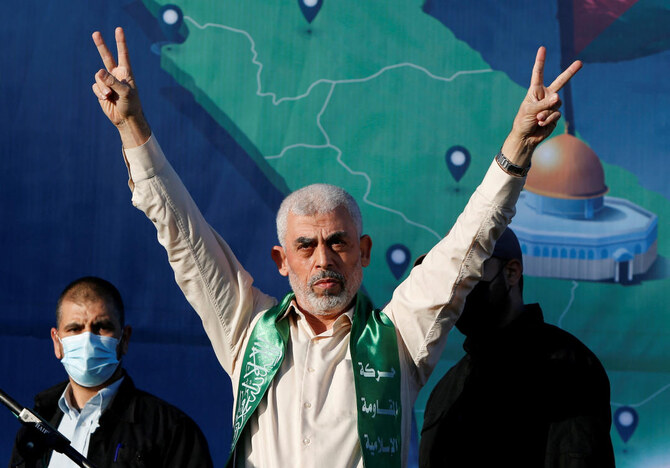
Hamas Gaza chief Yahya Sinwar gestures during an anti-Israel rally in Gaza City, in May, 2021. (Reuters/File)
Short Url
Updated 17 October 2024
Follow

Biden says Sinwar’s death is ‘good day’ for world, ‘opportunity’ for hostage deal, end to Gaza war

  • Biden, in a statement, compared it to the feeling in the US after the killing of Al-Qaeda leader Osama bin Laden
  • Biden said with Sinwar’s death “there is now the opportunity for a ‘day after’ in Gaza without Hamas in power”

ABOARD AIR FORCE ONE: President Joe Biden said Thursday that the killing of Hamas leader Yahya Sinwar by Israeli troops is a “good day for Israel, for the United States, and for the world,” and called it an “opportunity” to free Israeli hostages held by Hamas and end the yearlong war in Gaza.
Biden, in a statement, compared it to the feeling in the US after the killing of Al-Qaeda leader Osama bin Laden, who was responsible for the Sept. 11, 2001, attacks, saying the killing of the mastermind of the Oct. 7, 2023, attack on Israel “proves once again that no terrorists anywhere in the world can escape justice, no matter how long it takes.”
Biden said he would speak with Israeli Prime Minister Benjamin Netanyahu and other Israeli leaders to congratulate them “and to discuss the pathway for bringing the hostages home to their families, and for ending this war once and for all.”
Biden said with Sinwar’s death “there is now the opportunity for a ‘day after’ in Gaza without Hamas in power, and for a political settlement that provides a better future for Israelis and Palestinians alike.”
He praised US special operations forces and intelligence operatives who helped advise Israeli allies on tracking and locating Sinwar and other Hamas leaders over the last year — though the US said the operation that killed Sinwar was an Israeli one.
National security adviser Jake Sullivan called Sinwar a “massive obstacle” to peace. He added, “his removal from the battlefield does present an opportunity to find a way forward that gets the hostages home.”


Lebanon says two dead in Israeli strikes

Updated 3 sec ago
Follow

Lebanon says two dead in Israeli strikes

  • Lebanon’s health ministry: An ‘Israeli enemy strike on a vehicle on the Jadra-Siblin road in the Shouf district killed one person and wounded five others’
  • one person was killed in an Israeli strike on a vehicle in Odaisseh near the border with Israel
BEIRUT: Israeli strikes on Lebanon on Tuesday killed two people, one of them near Beirut, the Lebanese health ministry reported, with Israel saying it had targeted Hezbollah operatives.
Despite a November 2024 ceasefire that was supposed to end more than a year of hostilities between Israel and Iran-backed militant group Hezbollah, Israel has kept up strikes on Lebanon and has also maintained troops in five southern areas it deems strategic.
Lebanon’s health ministry said an “Israeli enemy strike on a vehicle on the Jadra-Siblin road in the Shouf district killed one person and wounded five others.”
The area is around 30 kilometers (20 miles) south of the capital.
An AFP photographer saw a damaged goods truck with emergency workers and army personnel deployed at the scene.
Earlier, the ministry said one person was killed in an Israeli strike on a vehicle in Odaisseh near the border with Israel.
In separate statements, the Israeli army said it targeted two Hezbollah members, without providing further details.
On Sunday, Israeli strikes killed three people in separate parts of Lebanon according to the health ministry, with Israel saying it killed Hezbollah members.
Around 340 people have been killed by Israeli attacks on Lebanon since the ceasefire agreement went into force, according to an AFP tally of health ministry reports.
Israel usually says the strikes target Hezbollah members and infrastructure, and aim to stop the group from rearming.
Tuesday’s attacks come as the ceasefire monitoring committee, which includes France and the United States, is set to meet later this week.
According to the ceasefire, Hezbollah was required to pull its forces north of the Litani River, about 30 kilometers (20 miles) from the border with Israel, and have its military infrastructure in the vacated area dismantled.
Under a government-approved plan, Lebanon’s army is to disarm Hezbollah south of the Litani by the end of the year, before tackling the rest of the country.