

Razan is a geotourism gem carved by time’s patient hands

1 / 2
The place is defined by its striking rock formations: dense clusters of stone, stepped ridges that resemble ancient staircases, and natural ceilings sculpted by the relentless flow of seasonal torrents. (SPA)
2 / 2
Razan is more than just a scenic marvel; for centuries, it served as a lifeline
Short Url
Updated 06 February 2026
Follow

Razan is a geotourism gem carved by time’s patient hands

  • In antiquity Razan sustained life in arid environment
  • Strategic landmark, vital in ancient Yemeni Hajj Road

AL-LITH: Sixty kilometers north of Al-Lith governorate in the Kingdom’s west, rising above the shifting sands and valleys of the Makkah region, lies a place where the earth itself tells a story.

This is Razan, a geological wonder where history is not written in ink but etched into the stone by the patient hands of wind, water and time, the Saudi Press Agency reported recently.

Perched atop a high rocky mass and flanked by valleys to the northwest and southeast, Razan stands in natural isolation. This geographic solitude has acted as a guardian, preserving a landscape that feels almost otherworldly — a pristine stage set by nature over millennia.

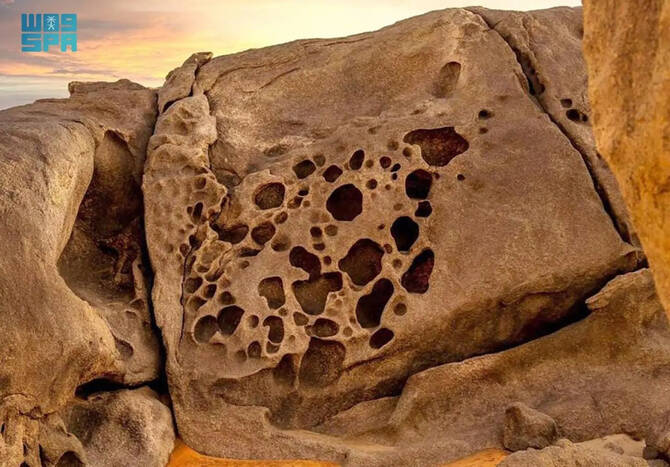
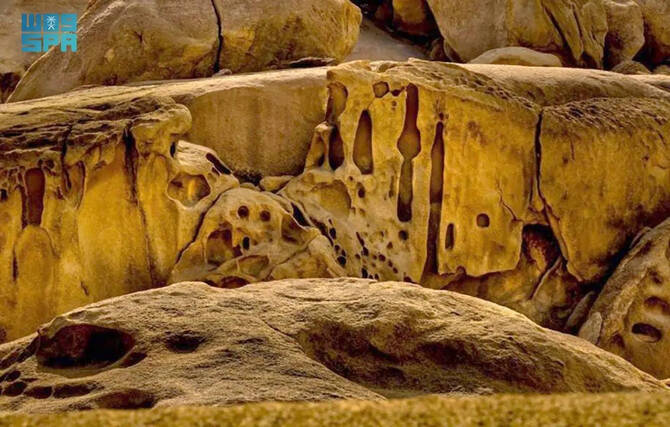
The place is defined by its striking rock formations: dense clusters of stone, stepped ridges that resemble ancient staircases, and natural ceilings sculpted by the relentless flow of seasonal torrents.

The visual impact is one of dramatic contrast — the heaviness of solid rock balanced against open, airy spaces carved by erosion.

Fine channels and intricate flow patterns mark the stone, serving as fossilized evidence of the water that once rushed through these corridors, shaping the land into a rugged work of art.


In the quiet majesty of Razan, the past is preserved. (SPA)

Nature’s infrastructure 

But Razan is more than just a scenic marvel; for centuries, it served as a lifeline. The same forces that sculpted the cliffs also hollowed out natural rock basins.

These geological depressions acted as seasonal reservoirs, catching rainwater and supplementing nearby wells. Long before modern engineering, the geology of Razan functioned as effective natural infrastructure, sustaining life in an arid environment.

This utility made Razan a strategic landmark, playing a vital role in the ancient Yemeni Hajj Road. The sturdy, elevated terrain provided a natural pathway for pilgrims, offering stability and protection on their spiritual journey toward Makkah.

Today, Razan stands at the intersection of heritage and opportunity. No longer just a passage for pilgrims, it is emerging as a valuable asset for geotourism. Its unique topography offers a visual feast for travelers and a treasure trove for scientists studying geological history.

As Saudi Arabia moves toward the goals of Vision 2030, sites such as Razan are finding new purpose. By transforming this geological narrative into a tourism destination, the region aims to preserve its natural heritage while breathing new life into the local economy.


Rolls-Royce highlights importance of Saudization for defense readiness

Updated 19 sec ago
Follow

Rolls-Royce highlights importance of Saudization for defense readiness

  • Firm’s Saudization over 80%, vice president tells Arab News
  • Cate Wilkenson spotlights plans to support defense industry

RIYADH: Rolls-Royce, which has most of its in-country workforce consisting of citizens, has highlighted the importance of Saudization in supporting the Kingdom’s defense readiness.

Cate Wilkinson, senior vice president at Rolls-Royce PLC Middle East, told Arab News on the sidelines of the World Defense Show recently that the company’s Saudization level is “over 80 percent” in the Kingdom, with figures varying by site.

“Depending on whether or not we’re talking about our MRO (Maintenance, Repair and Overhaul) facility in Taif or more generally, we are well over 82 percent, nearly 90 percent,” she said.

Wilkinson said the company focuses on developing local talent as a part of that push. “We take talented Saudis from fresh out of school, and we give them skills and help them grow.”

She said localization strengthens the company’s day-to-day processes inside the Kingdom. “We are integrated within the nation. We are there to support it regardless of what happens.”

“Having a Saudi team doing work on Saudi engines is really key for us.”

Wilkinson said predictive maintenance — anticipating problems before they happen — has become essential for fleet availability and mission readiness.

“Predictive maintenance and digital twinning is mission critical for our fleet these days.”

She explained that digital twin technology helps Rolls-Royce monitor performance and anticipate deterioration, improving planning and sustainment.

“Digital-twinning technology helps us understand how the engine is working and how the engine is deteriorating, which means we can provide a better, more cost-effective service to the customer.”

Wilkinson said she is seeing increased demand from Saudi Arabia customers for more integrated approaches, linked to the Kingdom’s Vision 2030 trajectory.

“There’s a lot of opportunity to do things better, to become more integrated and support the defense of Saudi Arabia,” she said.

As an example of Rolls-Royce’s footprint beyond aviation, Wilkinson pointed to the company’s maritime engine base.

“We have about 450 reciprocating engines in the Saudi Navy, Coast Guard and fleets,” she said.

Wilkinson added that it is an area the company has not historically highlighted as much, but sees as increasingly important.

On sustainability, Wilkinson said: “Sustainable fuels is something that we’ve been looking at across the whole of the group for quite a number of years.”

From a defense perspective, she said the company has been working with air forces on reciprocating engines — particularly in the UK and US.

“Within the reciprocating engine side of things, we’re looking at alternative fuels … so it wouldn’t necessarily be diesel going forward,” she said.

Wilkinson argued that sustainability in defense must be broader than fuel efficiency alone. “It’s not just about sustainable aviation fuels.”

She added that defense organizations want to move toward a more sustainable future.

“It’s not just about the fuel they burn. It’s about what you do with them afterwards,” Wilkinson said. “It’s all the way through the life cycle, it’s disposal as well.”