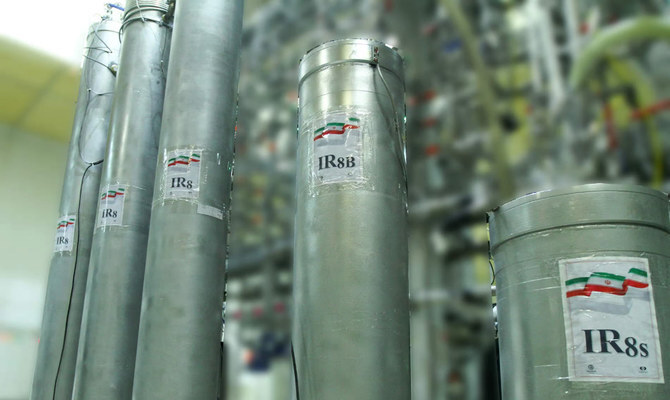
Iran atomic agency says Israeli attack on nuclear sites ‘unlikely’

Iran's atomic energy agency said Wednesday an Israeli attack on key nuclear sites was "very unlikely" and the country would be able to "quickly compensate" for any potential damage. (AFP/File)
Short Url
Updated 16 October 2024
Follow

Iran atomic agency says Israeli attack on nuclear sites ‘unlikely’

  • The agency spokesman Behrouz Kamalvandi said: “In the event of an attack on a key site: be sure it will not succeed”
  • His remarks came ahead of an expected Israeli response to Iran’s firing of around 200 missiles at Israel on Oct. 1

TEHRAN: Iran’s atomic energy agency said Wednesday an Israeli attack on key nuclear sites was “very unlikely” and the country would be able to “quickly compensate” for any potential damage.
“It is very unlikely to happen,” said the agency spokesman Behrouz Kamalvandi in a video interview with the Nournews agency.
“In the event of an attack on a key site: be sure it will not succeed,” he said.
“And if they (Israel) do such a stupid thing, it is very unlikely that they will cause serious damage to us and even if we assume that they can cause some damage, the country can quickly compensate for it,” he added.
His remarks came ahead of an expected Israeli response to Iran’s firing of around 200 missiles at Israel on October 1.
Tehran said it was a retaliation for the killing of Iran-aligned militant leaders in the region and a general in its Revolutionary Guards.
The missile barrage came after an Israeli air raid killed Hezbollah chief Hassan Nasrallah and IRGC top general Abbas Nilforoushan in Beirut on September 27.
It also followed the killing of Palestinian group Hamas leader Ismail Haniyeh on July 31 in Tehran in an attack widely blamed on Israel.
Israel has since vowed to retaliate, with Israeli Defense Minister Yoav Gallant vowing that Israel’s response will be “deadly, precise and surprising.”
US President Joe Biden, whose government is Israel’s top arms supplier, has warned Israel against striking Iran’s nuclear or oil facilities.
The office of Israeli Prime Minister Benjamin Netanyahu said that Israel — and not its top ally the United States — would decide how to strike back.
“We listen to the opinions of the United States, but we will make our final decisions based on our national interest,” it said Tuesday.
Iran has warned that any attack on its “infrastructure” would provoke an “even stronger response,” while Revolutionary Guards General Rassul Sanairad said an attack on nuclear or energy sites would cross a red line.


US plans meeting for Gaza ‘Board of Peace’ in Washington on Feb 19, Axios reports

Updated 3 sec ago
Follow

US plans meeting for Gaza ‘Board of Peace’ in Washington on Feb 19, Axios reports

  • The Axios report cited a US official and diplomats from four countries that are on the board
  • The plans for the meeting, which would also be a fundraising conference for Gaza reconstruction, are in early stages and could still change, Axios reported

WASHINGTON: The White House is planning the first leaders meeting for President Donald Trump’s so-called “Board of Peace” in relation to Gaza on February ​19, Axios reported on Friday, citing a US official and diplomats from four countries that are on the board.
The plans for the meeting, which would also be a fundraising conference for Gaza reconstruction, are in early stages and could still change, Axios reported.
The meeting is planned to be held at the US Institute of Peace in Washington, the report added, noting that Israeli Prime ‌Minister Benjamin Netanyahu ‌is scheduled to meet Trump at the ‌White ⁠House ​on ‌February 18, a day before the planned meeting.
The White House and the US State Department did not respond to requests for comment.
In late January, Trump launched the board that he will chair and which he says will aim to resolve global conflicts, leading to many experts being concerned that such a board could undermine the United Nations.
Governments around ⁠the world have reacted cautiously to Trump’s invitation to join that initiative. While some ‌of Washington’s Middle Eastern allies have joined, many ‍of its traditional Western allies have ‍thus far stayed away.
A UN Security Council resolution, adopted in ‍mid-November, authorized the board and countries working with it to establish an international stabilization force in Gaza, where a fragile ceasefire began in October under a Trump plan on which Israel and Palestinian militant group Hamas signed off.
Under ​Trump’s Gaza plan revealed late last year, the board was meant to supervise Gaza’s temporary governance. Trump thereafter said ⁠it would be expanded to tackle global conflicts.
Many rights experts say that Trump overseeing a board to supervise a foreign territory’s affairs resembled a colonial structure and have criticized the board for not including a Palestinian.The fragile ceasefire in Gaza has been repeatedly violated, with over 550 Palestinians and four Israeli soldiers reported killed since the truce began in October. Israel’s assault on Gaza since late 2023 has killed over 71,000 Palestinians, caused a hunger crisis and internally displaced
Gaza’s entire population.
Multiple rights experts, scholars and a UN inquiry say it amounts to genocide. Israel calls its actions self-defense after Hamas-led ‌militants killed 1,200 people and took over 250 hostages in a late 2023 attack.