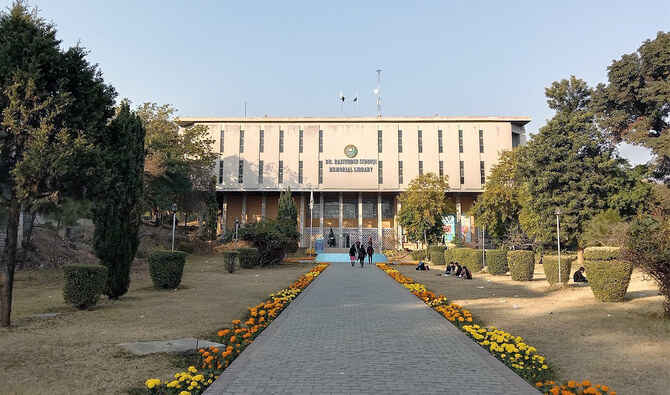
ISLAMABAD: Pakistan’s Quaid-e-Azam University has secured a spot among the top 500 universities in the world, according to the Times Higher Education World University Rankings 2025, with the institution placed in the 401-500 band.
The Times Higher Education World University Rankings are released annually and consider several benchmarks that include teaching, research, employability, and sustainability. Securing a position in these rankings not only enhances a university’s reputation but also reflects its academic excellence and global impact.
Quaid-e-Azam University is the only educational institution in Pakistan to fall in the 401-500 ranking band followed by seven other local universities falling within the 601-800 band.
“This year’s ranking analyzed more than 134 million citations across 16.5 million research publications and included survey responses from 68,402 scholars globally,” the Times Higher Education website said. “Overall, we collected 411,789 data points from more than 2,673 institutions that submitted data.”
“Trusted worldwide by students, teachers, governments and industry experts, the 2024 league table reveals how the global higher education landscape is shifting,” it added.
The Pakistani universities in the 601-800 band include Abdul Wali Khan University Mardan, Air University, Capital University of Science and Technology, COMSATS University Islamabad, University of Engineering and Technology Taxila, Government College University Faisalabad and National University of Sciences and Technology.
Eleven Pakistani universities attained a spot in the 801-1000 ranking band including Bahria University, Hazara University Mansehra, International Islamic University Islamabad, Islamia College Peshawar, University of Lahore, Lahore University of Management Sciences, University of Malakand, University of Management and Technology, University of the Punjab, Institute of Space Technology and University of Veterinary and Animal Sciences, Lahore.
The 1001-1200 ranking band included 13 Pakistani universities while the 1201-1500 ranking band included four local universities and the rest fall in the 1500+ category.
Quaid-e-Azam University is located in Pakistan’s capital city of Islamabad. Its inclusion in top 500 global institutions underscores its emerging prominence on the world stage, highlighting its commitment to delivering quality education and research.

Pakistan’s Quaid-e-Azam University breaks into top 500 global institutions
https://arab.news/bpuhb
Pakistan’s Quaid-e-Azam University breaks into top 500 global institutions
- Located in Islamabad, the university is placed in the 401-500 band by Times Higher Education Rankings
- Other Pakistani educational institutions on the list include LUMS, NUST, COMSATS and Air University
Pakistani economists flag debt sustainability risks as foreign loans surge in FY26
- Pakistan received $2.98 billion from bilateral, global lenders from July to November this year, official data shows
- Economists urge government to take structural reforms to boost exports, cut energy costs, ensure rupee stability
KARACHI: Pakistani economists on Wednesday warned the government against debt sustainability risks as the country’s foreign loan receipts surged to nearly $3 billion in the first five months of the current fiscal year, data from the economic affairs ministry showed.
Pakistan received 16 percent more financing, which is $2.98 billion, from bilateral and multilateral lenders during the July to November period of the current fiscal year compared to last year, the economic affairs’ ministry data showed.
Pakistan, as per the data, seeks to raise $19.8 billion in loans this year through June, which include $16.7 billion non-project and $3.11 billion project loans from multilateral lenders such as the Asian Development Bank (ADB), Asian Infrastructure Investment Bank (AIIB), Islamic Development Bank (IsDB), European Union (EU), European Investment Bank (EIB), UNICEF and others.
Pakistan’s bilateral lenders include the countries of China, Saudi Arabia, Kuwait, Oman, the US, Denmark, France, Germany, Italy, Japan and South Korea
“As long as you are utilizing the loan for economic recovery and growth, it is understood,” Sana Tawfik, head of research at the Karachi-based brokerage firm Arif Habib Limited, told Arab News.
“But in the long term, it is not sustainable to rely only on loans. Foreign reserves should be built on FDI [foreign direct investment] and not on loans,” she added.
Pakistan’s finance adviser Khurram Schehzad and finance ministry spokesperson Qamar Sarwar Abbasi did not respond to requests for comment.
Cash-strapped Pakistan came close to a sovereign default in 2023 before a last-gasp financial bailout by the International Monetary Fund (IMF) averted the risk.
While Pakistan has lowered inflation and registered other economic gains, the country’s $15.9 billion foreign reserves mostly come from the IMF in budgetary support and bank deposits from countries such as Saudi Arabia and China.
The cash-strapped country will seek $13.5 billion in budgetary support, $700 million in short-term loans from the IsDB, $1.44 billion as program loans, $1 billion worth of oil on deferred payments and $3.11 billion as project loans by June, the data said.
Prime Minister Shehbaz Sharif’s government also plans to raise $400 million through issuing international bonds, $3.1 billion in loans from foreign commercial banks, $410 million from the IMF, $609 million through Naya Pakistan Certificates (NPCs) and $5 billion as time deposits from Saudi Arabia, and $4 billion as safe deposit from China.
“Long-term solution is not to take loans and this only adds up to the existing external account,” Tawfik said.
She, however, appreciated the government’s ability to reduce its current account deficit in recent months. The economist noted that Pakistan, in the short run, could manage its current account deficit if it remains in the $1.5 billion range throughout the year.
She urged the government to focus on increasing exports, noting its debt servicing requirement was $25.8 billion this year.
Tawfik called for long-term reforms such as reducing the cost of doing business, cutting energy costs, clearing Pakistan’s longstanding power sector debt and keeping the rupee stable to attract increased remittances from Pakistanis working abroad.
“In the long run, we must focus on increasing Pakistan’s exports, remittances, and FDI,” the economist said. “FDI is the most important.”
‘OBVIOUSLY A RISK FACTOR’
However, neither are Pakistan’s exports on the rise nor is FDI. Pakistan’s current account deficit widened by 37 percent to $16 billion from July to November this year. This was due to a 6.4 percent decline in exports to $12.8 billion and a 13 percent hike in imports to $28 billion, data from the Pakistan Bureau of Statistics (PBS) showed.
FDI dropped by more than 25 percent to $927 million during the same period and has never surged beyond $3 billion in nearly 20 years, data from Pakistan’s central bank shows.
“Our debt sustainability will be questioned at any point if we, going forward, are not able to match these debt flows or counter these debt flows with growth and remittances and exports,” Muhammad Saad Ali, head of research at Lucky Investments Ltd, told Arab News.
He noted that debt sustainability is “obviously a risk factor” as Pakistan has not increased its FDI nor exports during the period when its foreign debt has increased.
However, he said that there was a positive side to the 16 percent rise in foreign debt receipts as well, adding that recent macroeconomic improvements have enabled Islamabad to borrow more from global lenders.
But the risks remain.
“You (government) are increasing your debt and your debt sustainability will come into question again if global factors or global environment turn south,” he warned.