


RIYADH: Saudi Arabia’s container transhipment volume between 2017 and 2023 witnessed a 55 percent surge, according to the president of the Saudi Ports Authority, or Mawani.
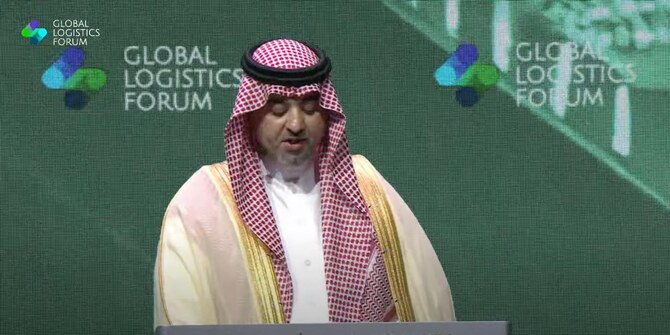
During his presentation titled “Shaping Saudi Arabia’s Maritime Future” on the first day of the Global Logistics Forum taking place at the King Abdullah Financial District in Riyadh from Oct.13 — 14, Omar Hariri highlighted that the Kingdom saw a 31 percent increase in container import and export volumes over the same period.
This falls in line with Mawani’s goal to double the capacity of its ports, from the current 20 million containers to more than 40 million.
It also aligns well with its aim to grow the market share of regional transhipment from around 32 percent to 45 percent and to lift the port occupancy rate to 70 percent.
“Between 2017 and 2023, we witnessed a 31 percent increase in container import and export volumes and a 55 percent surge in container transhipment,” Hariri said.
“These gains reflect both our economic growth story, as well as our success in improving port infrastructure and streamlining related operations in collaboration with you, our partners,” he added.
During his speech, Hariri also shed light on the advantages of Saudi Arabia’s geographical position.
“Our geographic location, bordered by the Red Sea and the Arabian Gulf, offers direct access to key maritime channels, which facilitate nearly 30 percent of the world’s container trade volume. This prime position strengthens Saudi Arabia’s ability to act as a bridge between the East and West, driving regional and global commerce,” the president said.
“As the economic engine of the region, it generates 15 percent of the GCC’s (Gulf Cooperation Council) GDP (gross domestic product). In every way, our strategic location and economic strength make Saudi Arabia a country that can play an important role in shaping the future of global trade,” he added.
As part of the event, President of the Saudi General Authority of Civil Aviation Abdulaziz Al-Duailej participated in a fireside chat titled “The Role of Air Cargo in Saudi Arabia’s Vision for Global Logistics Leadership,” in which he highlighted the importance of the sector in global supply chain and how it cannot be overstated.
“In an era where speed, reliability, and safety are paramount, air cargo has a distinct advantage over other modes of transport,” Al-Duailej said.
“First, air cargo is essential for time-sensitive goods, from health care goods to electronics. We’ve seen its importance in a crisis like COVID-19, where GACA’s commitment to overcoming logistical challenges allowed the transportation and distribution of more than 53,000 kgs of vaccines,” he added.
The GACA president underlined that globally, air cargo handles approximately $5.6 trillion, or 35 percent, of world trade by value despite accounting for less than 1 percent by volume.
“In 2023, the global air cargo volume was 58 million tonnes with $138 billion in revenue for airlines. In 2024, the global air cargo volume is expected to increase to 61 million tonnes with $120 billion revenue for airlines. This indicates a 5.2 percent increase in air cargo volume,” Al-Duailej said.
“Saudi Arabia has also witnessed significant growth in air cargo in 2024, with a 53 percent increase compared to 2023. For the first time, the country’s airports are expected to surpass the 1 million tonnes mark with a total volume of 1.2 million tonnes of air cargo anticipated,” he concluded in that regard.
Speaking in a separate panel titled “The New Map of Global Logistics Corridors, Putting the Pieces Together,” Chief Commercial Officer at Riyadh Air, Vincent Coste, revealed that the airline received its last certification flight with GACA.
“Riyadh Air had quite an amazing achievement today because we completed our last certification flight with GACA. It has been a fantastic adventure with GACA since we started this. So, in the coming weeks, we will have hopefully this stamp from GACA saying we are an official airline, so that’s a great step,” Coste said.
“The next step is summer 2025 when we are planning to start operating. We will operate in the summer to a few destinations, but starting from summer 2025 until the end of 2030, we’ll have the fastest growth that any commercial airline has experienced, with an average of two destinations opened every month and will be at over 100 destinations by 2030,” he added.
Speaking during the same panel discussion, the CEO of Vietnam SuperPort at YCH Group, Yap Kwong Weng, explained the company’s offers.
“And I’m also the CEO of the Vietnam SuperPort, a multi-modal logistics port that focuses on bonded warehouses cargo and also, you know, a spectrum of other activities that facilitate and push toward a sustainable outcome,” Weng said.
“And here we are talking about cost competitiveness. We are talking about, you know, building new advantages. And that’s what logistics is all about, reducing cost, increasing efficiency,” he added.
GLF24 brings together global logistics leaders to discuss the latest trends, challenges, and opportunities in the sector.
Participants will explore future cooperation between stakeholders, focusing on reshaping the future of global logistics services.
The two-day event aims to boost international collaboration and drive growth in the logistics sector by highlighting the latest technologies and innovative solutions. The event will also launch several initiatives to strengthen global communication and contribute to developing more efficient, sustainable, and flexible supply chain services.
The first edition of the Global Logistics Forum is a pivotal event for the Ministry of Transport and Logistics Services, as it aims to revolutionize global trade by enhancing efficiency and profitability.


