

40 nations contributing to UN Lebanon peacekeeping force condemn ‘attacks’

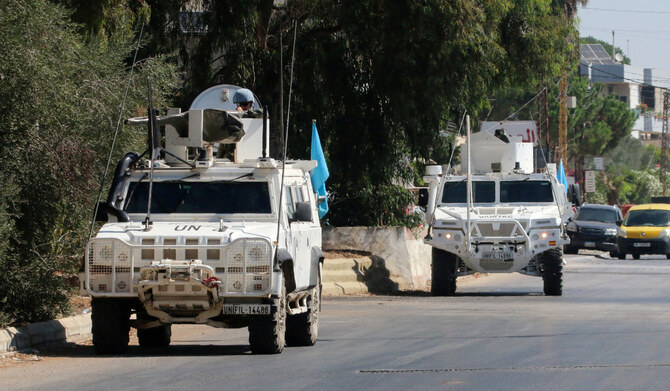
UN peacekeepers (UNIFIL) vehicles are seen parked in Marjayoun, near the border with Israel, in southern Lebanon August 9, 2024. (REUTERS)
Short Url
Updated 13 October 2024
Follow

40 nations contributing to UN Lebanon peacekeeping force condemn ‘attacks’

  • At least five peacekeepers were wounded by Israeli fire in the past 48 hours as Israel takes its fight against Hezbollah into southern Lebanon
  • UNIFIL, which involves about 9,500 troops of some 50 nationalities, is tasked with monitoring a ceasefire that ended a 33-day war in 2006 between Israel and Hezbollah

UNITED NATIONS, United States: Forty nations that contribute to the UN peacekeeping force in Lebanon said Saturday that they “strongly condemn recent attacks” on the peacekeepers.
“Such actions must stop immediately and should be adequately investigated,” said the joint statement, posted on X by the Polish UN mission and signed by nations including leading contributors Indonesia, Italy and India.
Other signatories include Ghana, Nepal, Malaysia, Spain, France and China — all countries that have contributed several hundred troops to the force.
At least five peacekeepers have been wounded in recent days as Israel takes its fight against Hezbollah into southern Lebanon.
The peacekeeping mission, UNIFIL, has accused the Israeli military of “deliberately” firing on its positions.
The 40 contributing countries “reaffirm our full support for UNIFIL’s mission and activities, whose principal aim is to bring stabilization and lasting peace in South Lebanon as well as in the Middle East,” the statement read.
“We urge the parties of the conflict to respect UNIFIL’s presence, which entails the obligation to guarantee the safety and security of its personnel at all times,” it added.
UNIFIL, which involves about 9,500 troops of some 50 nationalities, is tasked with monitoring a ceasefire that ended a 33-day war in 2006 between Israel and Hezbollah.
Its role was bolstered by UN Security Council Resolution 1701 of that year, which stipulated that only the Lebanese army and UN peacekeepers should be deployed in south Lebanon.
At a summit on Friday, French, Italian and Spanish leaders said the “attacks” on UNIFIL peacekeepers violated Resolution 1701 and must end.
UNIFIL said that, in recent days, its forces have “repeatedly” come under fire in the Lebanese town of Naqura where it is headquartered, as well as in other positions.
The mission said that Israeli tank fire on Thursday caused two Indonesian peacekeepers to fall off a watch tower in Naqura.
The following day it said explosions close to an observation tower in Naqura wounded two Sri Lankan Blue Helmets, while Israel said it had responded to an “immediate threat” near a UN peacekeeping position.
On Saturday UNIFIL said a peacekeeper in Naqura “was hit by gunfire” on Friday night.
UNIFIL spokesman Andrea Tenenti told AFP the peacekeeping mission’s work had become “very difficult because there is a lot of damage, even inside the bases.”


Lebanon foreign minister declines Tehran visit, proposes talks in neutral country

Updated 31 sec ago
Follow

Lebanon foreign minister declines Tehran visit, proposes talks in neutral country

  • Lebanon’s foreign minister Youssef Raji cited ‘current conditions’ for the decision not to go to Iran

Lebanon’s foreign minister Youssef Raji said on Wednesday he had declined an invitation to visit Tehran for now, proposing instead talks with Iran in a mutually agreed neutral third country, Lebanese state news agency NNA reported.

Raji cited “current conditions” for the decision not to go to Iran, without elaborating, and stressed that the move did not mean rejection of dialogue with Iran. He did not immediately respond to a request from Reuters for additional comment.

Iran’s Foreign Minister Abbas Araqchi had extended the invitation last week, seeking talks on bilateral ties.

Raji said Lebanon stood ready to open a new phase of constructive relations with Iran, on the condition that ties be based strictly on mutual respect, full recognition of each country’s independence and sovereignty, and non-interference in internal affairs under any pretext.

In an apparent reference to calls to disarm Hezbollah, the Lebanese armed movement allied for decades to Iran, Raji added that no strong state could be built unless the government held the exclusive right to hold weapons.

Hezbollah, once a dominant political force with wide influence over the Lebanese state, was severely weakened by Israeli strikes last year that ended with a US-brokered ceasefire. It has been under mounting domestic and international pressure to surrender its weapons and place all arms under state control.

In August, Iran’s top security official Ali Larijani visited Beirut, warning Lebanon not to “confuse its enemies with its friends.” In June, Foreign Minister Araqchi said Tehran sought a

“new page” in ties.